
Presentation
The caracal (Caracal caracal) is a medium-sized feline, recognizable by its long black ears topped with a brush of hair. Widespread in Africa and certain regions of the Middle East and Asia, it frequents dry and open environments. An agile and discreet hunter, it is capable of leaping high to capture birds in flight. Although present in Tunisia, it has become very rare there and is subject to protection measures. Its uniform tawny coat and slender silhouette make it a feline often confused with the lynx, although it does not belong to the same genus.
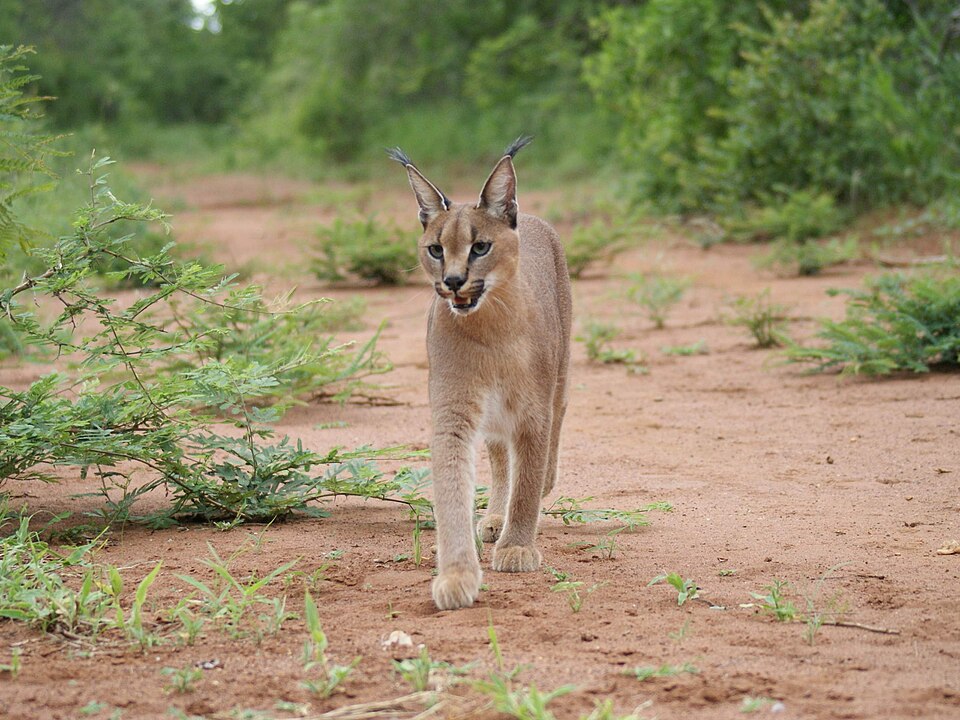
The caracal has a muscular and slender body, adapted for running and jumping. Its long, pointed ears, decorated with tufts of black hair, constitute its most striking distinctive feature. Its coat varies from light fawn to red, with a paler underbelly and sometimes light markings on the muzzle.
Characteristics
Indicative values: they vary by subspecies, sex and region.
Habitat and distribution
The caracal frequents arid and semi-arid areas, savannahs, steppes and sometimes sparsely forested mountainous areas. It avoids dense forests and prefers open environments with low vegetation. In Tunisia, it is found in desert and steppe habitats in the south.
CURRENT RANGE
The caracal's range covers much of Africa, as well as the Middle East and parts of central and southern Asia as far as India. In North Africa, it persists in scattered and few populations. In Tunisia, its presence is confirmed but rare, mainly in the Saharan zones.
Behaviour
Solitary and mainly nocturnal or twilight, the caracal marks its territory by scratching and depositing urine. He is an excellent climber and jumper, capable of leaping more than three meters high to grab a bird. Discreet and shy, he generally avoids contact with humans.
Reproduction
The female gives birth to a litter of one to four young after a gestation of approximately two and a half months. The young are born in a burrow or rock shelter and remain dependent on their mother for several months. Sexual maturity is reached around one year of age in females and a little later in males.
Peculiarities
The name "caracal" derives from a Turkish word meaning "black ear", referring to the color of the back of its ears. Its ability to capture several birds in the same flight by leaping is an often cited characteristic. It is sometimes called "desert lynx", although it is not genetically close to true lynxes.
Threats and conservation
The caracal is threatened by the destruction of its natural habitat, the reduction of available prey and conflicts with breeders who consider it a predator of livestock. Illegal hunting and trapping also contribute to the decline of some local populations. In Tunisia, the species is protected by national legislation due to its rarity.
Numbers and trends vary across sources and regions. See the IUCN assessment for the latest reference data.
Gallery
1 documented photographs.
References
Profile updated 18 August 2026 · Reviewed by the TunisieVet editorial team.
Comments (0)
No comments yet.
CONSERVATION STATUS
Least concern (LC)
IUCN source, latest published assessment.
Species health
Documented diseases for this species.
See the 8 diseases of this species Find a veterinarianThis information is provided for educational purposes only and is not a substitute for a veterinary consultation. If you have any concerns about your animal's health, consult a veterinarian.
Related species
To discover around: Caracal
Videos, facts, stories and records linked to this species.
Similar animals
Other species documented in Animalpedia.

TunisieVet in your pocket 📱🐾 Access your veterinary services wherever you are. [ Download the app ]
Learn more