
Presentation
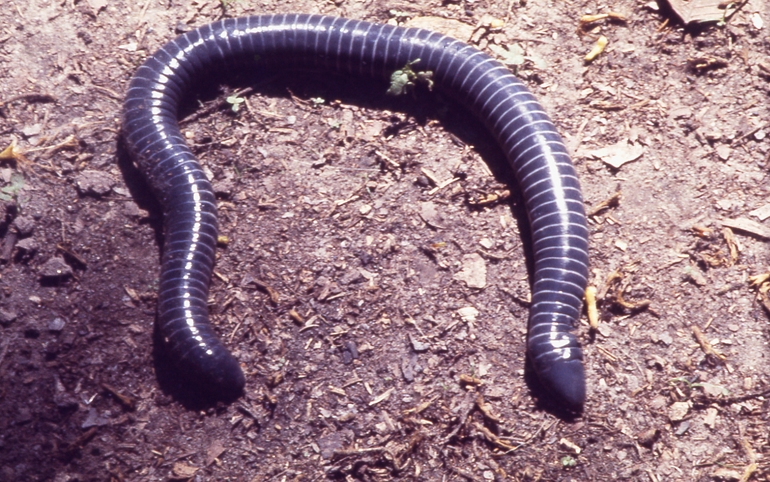
The Cecilie is a legless amphibian (without legs) with an elongated body reminiscent of a worm or a small snake. This group, called Gymnophiones, brings together several dozen species living mainly in humid soils in tropical regions. Its smooth, often ringed skin and lack of limbs make it easily identifiable among amphibians. It leads a discreet life, mainly underground or aquatic depending on the species, which makes it rarely observed in the wild. Its eyes are reduced and covered with skin or bone, an adaptation to a burrowing life. It also has sensory tentacles unique among vertebrates, located between the eye and the nostril.
Cylindrical and elongated body, without legs, measuring from a few centimeters to more than a meter depending on the species. Ringed skin often covered in mucus, making it easier to move through the soil. Small retractile chemosensory tentacles located near the nostrils, unique among vertebrates. Vestigial eyes, little or not functional, adapted to a burrowing or aquatic lifestyle.
Characteristics
Indicative values: they vary by subspecies, sex and region.
Habitat and distribution
Lives mainly in soft, moist soils of tropical forests, as well as in decaying leaf litter. Some species are strictly aquatic and occupy rivers and wetlands. Constant humidity is essential to its survival, its skin being permeable and sensitive to desiccation.
CURRENT RANGE
Found in tropical regions of Central and South America, sub-Saharan Africa and Southeast Asia. Absent from Europe, North America and Australia. Its distribution closely follows tropical rainforest areas and warm year-round climates.
Behaviour
Primarily burrowing animal, spending most of its life buried in damp soil or forest litter. Some species are aquatic and live in tropical waterways and wetlands. Solitary and nocturnal behavior, avoiding direct light. Communication and environmental sensing rely primarily on smell and touch rather than sight.
Reproduction
Reproduction takes place by internal fertilization, a rare feature among amphibians. Depending on the species, the female lays eggs which she monitors until hatching, or gives birth to live larvae after internal development. Some species practice dermatophagy, where the young feed on the nutrient-rich maternal skin. Development may include an aquatic larval stage before metamorphosis.
Peculiarities
Cecilies are the only amphibians completely lacking legs and a visible pelvic or pectoral girdle. They have sensory tentacles unique in the animal kingdom, used to chemically detect the environment. Some species practice a mode of reproduction where the larvae consume the maternal skin, a rare behavior called maternal dermatophagy.
Threats and conservation
The destruction of tropical forests and degradation of wet soils threatens several species of Cecilies. Pollution of waterways particularly affects aquatic species. The lack of data on many species makes accurate assessment of their conservation status difficult.
Numbers and trends vary across sources and regions. See the IUCN assessment for the latest reference data.
Gallery
1 documented photographs.
References
Profile updated 31 August 2026 · Reviewed by the TunisieVet editorial team.
Comments (0)
No comments yet.
CONSERVATION STATUS
Data deficient (DD)
IUCN source, latest published assessment.
Species health
Documented diseases for this species.
This information is provided for educational purposes only and is not a substitute for a veterinary consultation. If you have any concerns about your animal's health, consult a veterinarian.
Similar animals
Other species documented in Animalpedia.

TunisieVet in your pocket 📱🐾 Access your veterinary services wherever you are. [ Download the app ]
Learn more