
Presentation
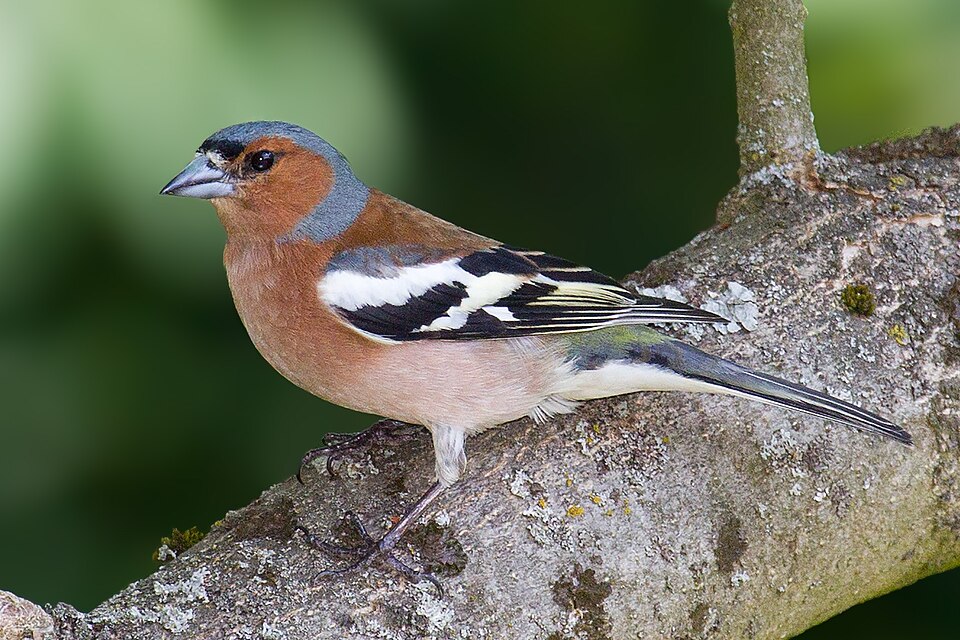
The common chaffinch is a small songbird found throughout Europe, North Africa, and Western Asia. Males display colorful plumage with a rosy breast, blue-grey nape, and chestnut-brown back, while females show duller, brownish-green tones. The species is recognized for its vigorous and varied song, which ornithologists often use to identify individual birds. It thrives in both woodlands and gardens, parks, and urban areas, adapting readily to human presence. Outside the breeding season, chaffinches are highly social, sometimes forming large flocks during winter migration. It ranks among the most common songbird species across the European continent.
The chaffinch measures approximately 14 to 16 cm in length with a wingspan of 24 to 29 cm. Its conical, sturdy bill is well-adapted for seed-eating. Sexual dimorphism is marked, with males displaying significantly brighter plumage than females, particularly during the breeding season.
Characteristics
Indicative values: they vary by subspecies, sex and region.
Habitat and distribution
The finch inhabits deciduous and coniferous forests, hedgerows, orchards, and urban parks and gardens. It favors habitats providing both nesting trees and open foraging areas. In North Africa, it also occupies wooded mountain zones.
CURRENT RANGE
The species is widely distributed throughout Europe, North Africa, and parts of western Asia. Northern populations migrate south in winter, while those from temperate and Mediterranean regions are often resident. In Tunisia, it is found notably in the forested areas of the northern part of the country.
Behaviour
The chaffinch is active during daylight hours and moves about in short, undulating flights. Outside the breeding season, birds gather in flocks that may include other finch species. Males sing vigorously in spring to defend territory and attract a mate.
Reproduction
The female builds a cup-shaped nest carefully hidden in tree branches, using moss, lichen, and spider silk. She typically lays 4 to 5 eggs, which she incubates alone for about two weeks. Both parents feed the young until they fledge, roughly two weeks after hatching.
Peculiarities
The male's song varies slightly by region, forming distinct local dialects studied by ornithologists. The finch is able to learn certain song variations by listening to other birds during its youth.
Threats and conservation
The species is not globally threatened and its populations remain stable or abundant. Locally, loss of wooded habitats and pesticide use can affect available food resources. Traditional trapping of small birds poses occasional pressure in certain Mediterranean regions.
Numbers and trends vary across sources and regions. See the IUCN assessment for the latest reference data.
Gallery
1 documented photographs.
References
Profile updated 19 August 2026 · Reviewed by the TunisieVet editorial team.
Comments (0)
No comments yet.
CONSERVATION STATUS
Least concern (LC)
IUCN source, latest published assessment.
Species health
Documented diseases for this species.
Find a veterinarianThis information is provided for educational purposes only and is not a substitute for a veterinary consultation. If you have any concerns about your animal's health, consult a veterinarian.
Similar animals
Other species documented in Animalpedia.
