
Presentation
The Chinchilla (Chinchilla lanigera) is a small rodent native to the Andes of South America, kept today as a pet and for its fur. It is known for its extremely dense and soft coat, the result of adaptation to the cold and arid climates of its native habitat. With a rather nocturnal habit, it is appreciated for its curious character and its relative sociability in captivity. The wild species is now threatened, while the domestic form has spread widely throughout the world. It requires specific care, including a cool, dry environment as well as regular dust bathing. Its longevity in captivity is notable for a rodent of this size.
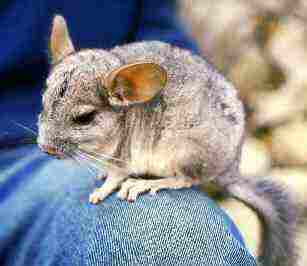
The Chinchilla has an extremely dense coat, considered one of the finest in the animal world, with up to 60 hairs emerging from a single follicle. Its body is stocky, its ears are large and rounded, and its tail is bushy. Its large black eyes give it good night vision. It measures a modest size and is distinguished by its long hind legs adapted to jumping.
Characteristics
Indicative values: they vary by subspecies, sex and region.
Habitat and distribution
In the wild, the chinchilla lives in the rocky, arid areas of the Andean highlands, at high altitudes where the climate is cool and dry. In captivity, it is kept in spacious cages protected from heat and humidity, reproducing as best as possible a cool environment. He appreciates spaces to explore with platforms for climbing and jumping.
CURRENT RANGE
The wild species is native to the arid mountainous regions of Chile, in the Andes mountain range. The domestic form, resulting from breeding since the beginning of the 20th century, is today widespread throughout the world as a pet. It is commonly found in Europe, North America, Asia and North Africa, including Tunisia, in private homes.
Behaviour
The Chinchilla is a crepuscular and nocturnal animal, active mainly at dawn and dusk. He is sociable and lives well in groups or couples, but can be fearful of noise and rough handling. Very agile, it jumps and climbs with ease thanks to its powerful hind legs. It communicates through a variety of vocalizations and adopts dust baths to maintain its coat.
Reproduction
The female chinchilla has a long gestation for a rodent, approximately 105 to 115 days, and gives birth to one or two litters per year. Each litter generally has one to three young, which are born already covered in hair and relatively developed. Weaning occurs around 6 to 8 weeks, and sexual maturity is reached around 8 months.
Peculiarities
The chinchilla should never be wet with water because its very dense coat dries poorly and promotes the development of skin mold; it is cleaned exclusively by bathing in fine dust. It is also sensitive to heat stroke above 25°C, its body being adapted to the cool climates of the Andes. Its fur, once highly sought after in the industry, led to intensive hunting of the wild species.
Threats and conservation
The wild species was greatly decimated by hunting for its fur during the 19th and 20th centuries, making it rare in its original natural habitat. Degradation of its Andean habitat and historical overexploitation remain threats to remaining wild populations. The domestic form, on the other hand, poses no conservation threat, being largely bred in captivity.
Numbers and trends vary across sources and regions. See the IUCN assessment for the latest reference data.
Gallery
1 documented photographs.
References
Profile updated 17 August 2026 · Reviewed by the TunisieVet editorial team.
Comments (0)
No comments yet.
CONSERVATION STATUS
Least concern (LC)
IUCN source, latest published assessment.
Species health
Documented diseases for this species.
See the 9 diseases of this species Find a veterinarianThis information is provided for educational purposes only and is not a substitute for a veterinary consultation. If you have any concerns about your animal's health, consult a veterinarian.
To discover around: Chinchilla
Videos, facts, stories and records linked to this species.
Similar animals
Other species documented in Animalpedia.

TunisieVet in your pocket 📱🐾 Access your veterinary services wherever you are. [ Download the app ]
Learn more