
Presentation
The Domestic rabbit is a herbivorous mammal belonging to the Leporidae family, native to the Mediterranean basin. Domesticated since Antiquity, it has become one of the most common pets and livestock in the world. Characterized by its long ears, varied coat and small white tail, the Domestic rabbit comes in many breeds and color varieties.
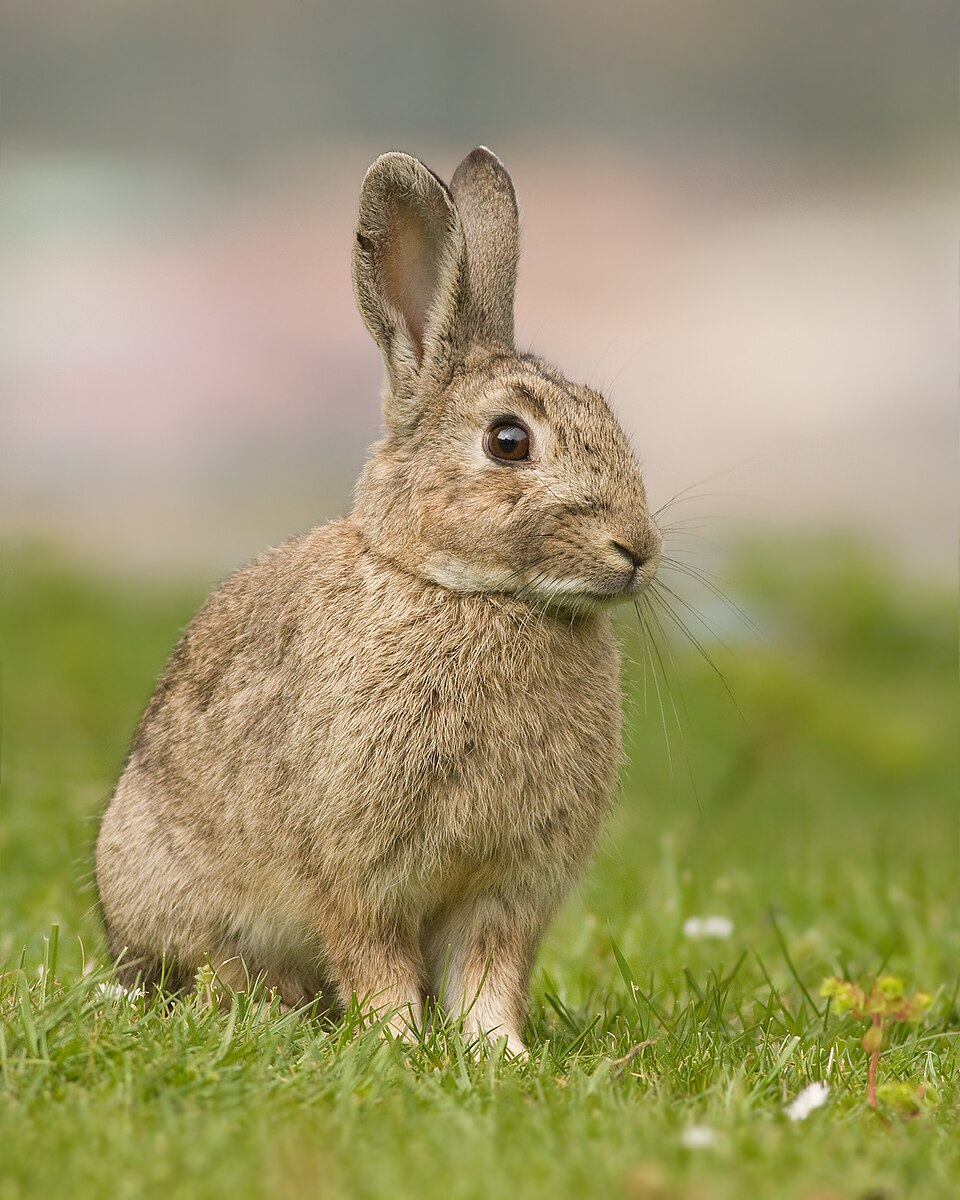
Domestic rabbit has long, erect ears containing numerous blood vessels that regulate its body temperature. Its body is compact and muscular, with powerful hind legs suitable for running and jumping. Its side eyes provide panoramic vision and its incisors grow continuously throughout its life.
Did you know?
Why do rabbits have constantly growing teeth?
Characteristics
BREEDS
Indicative values: they vary by subspecies, sex and region.
Habitat and distribution
The Domestic rabbit adapts well to varied environments: farms, meadows, gardens and human habitations. In the wild or semi-wild state, it prefers open environments with access to dense vegetation in which to dig burrows. In breeding, it can be kept in cages, open-air enclosures or in semi-freedom depending on regional practices.
CURRENT RANGE
Originally from the Mediterranean basin (Spain and North Africa), Domestic rabbit spread worldwide thanks to domestication and human transport. It is present on all continents, from temperate regions to the tropics. In the wild, the wild rabbit persists in Western and Mediterranean Europe.
Behaviour
The Domestic rabbit is generally crepuscular and nocturnal, most active at sunrise and sunset. It is naturally sociable and can live in small groups, although domestic breeding has made it adaptable to solitude. Domestic rabbits are burrow diggers and like to snuggle; in captivity, they express natural behaviors like jumping and rapid turns.
Reproduction
The female (rabbit) reaches sexual maturity around 4 to 6 months. Gestation lasts about 31 days and she can give birth to 4 to 12 young per litter. Rabbits are polyestric and can have several litters per year. Young rabbits are born naked and blind, weaning occurring around 4 to 5 weeks.
Peculiarities
Domestic rabbit shines with its exceptional reproductive capacity and genetic malleability, having spawned a great diversity of breeds and phenotypes. He is a model for study in genetics and experimental medicine. Endowed with caecotrophy, this mammal recovers nutrients by ingesting its own soft feces, a process unique among domestic lagomorphs.
Threats and conservation
The Domestic rabbit is not threatened with extinction; it remains abundant and well established. However, as an invasive species in certain ecosystems (notably Australia), wild populations can cause significant damage to local vegetation. In breeding, it is vulnerable to various infectious and parasitic diseases.
Numbers and trends vary across sources and regions. See the IUCN assessment for the latest reference data.
Gallery
1 documented photographs.
References
Profile updated 28 August 2026 · Reviewed by the TunisieVet editorial team.
Comments (0)
No comments yet.
CONSERVATION STATUS
Not evaluated (NE)
IUCN source, latest published assessment.
Species health
Documented diseases for this species.
See the 5 diseases of this species Find a veterinarianThis information is provided for educational purposes only and is not a substitute for a veterinary consultation. If you have any concerns about your animal's health, consult a veterinarian.
Related species
To discover around: Domestic rabbit
Videos, facts, stories and records linked to this species.
Similar animals
Other species documented in Animalpedia.

TunisieVet in your pocket 📱🐾 Access your veterinary services wherever you are. [ Download the app ]
Learn more