
Presentation
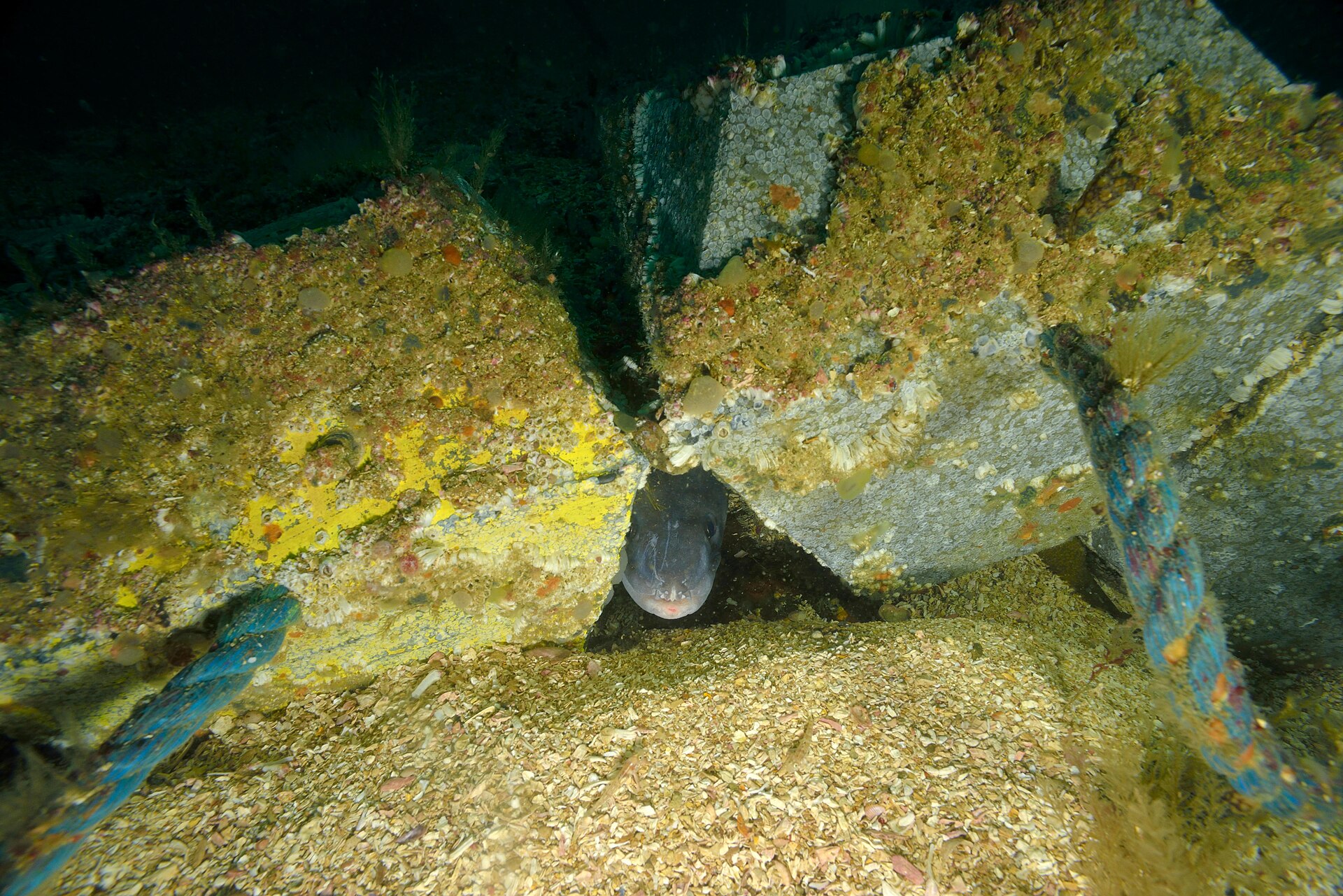
The Conger (Conger conger) is a large marine anguilliform fish, present in the Mediterranean and the North-East Atlantic. It is distinguished by its elongated, serpentine body, devoid of visible scales, and its smooth, slimy skin. It frequents rocky coastal bottoms where it hides in faults and caves during the day. A nocturnal predator, it hunts fish and crustaceans. Conger is appreciated in Tunisia for its flesh, particularly in certain fish soup preparations.
The body of the Conger is cylindrical at the front and laterally compressed towards the tail, lacking visible scales. Its coloring varies from gray-brown to gray-black on the back, with a lighter, white to cream belly. A long, continuous dorsal fin runs along the back to the tail, fused with the anal fin. Its powerful jaw is armed with sharp teeth adapted to capturing lively prey.
Characteristics
Indicative values: they vary by subspecies, sex and region.
Habitat and distribution
The Conger prefers rocky bottoms, underwater caves and wrecks, generally between the surface and 100 meters deep. Juveniles can frequent more littoral and shallow areas, while adults breed in deeper waters. It tolerates a wide range of temperatures but remains dependent on substrates offering hiding places.
CURRENT RANGE
Conger is present in the Northeast Atlantic, from Norway to Senegal, as well as throughout the Mediterranean basin, including the Tunisian coast. It is also reported in the Black Sea in a more marginal manner. This wide distribution makes it a common species on the rocky coasts of Europe and North Africa.
Behaviour
The Conger is a solitary and mainly nocturnal animal, remaining hidden in rocky crevices or wrecks during the day. It displays great defensive aggressiveness when disturbed or captured, particularly through fishing. This territorial behavior pushes it to reoccupy the same shelters repeatedly.
Reproduction
The Conger reproduces only once in its life, after a migration towards deep waters, sometimes beyond 1000 meters, in the Atlantic. After laying, which can number several million eggs, the adults die, a phenomenon called semelparity. The larvae, called leptocephali, then drift for several months before reaching the coast and metamorphosing into juveniles.
Peculiarities
Conger can reach impressive sizes, with some individuals exceeding two meters in length. Its thick, scaleless skin protects it from injury when passing through rock faults. Unlike the eel, it never leaves the marine environment for fresh water.
Threats and conservation
The Conger is the subject of moderate commercial and recreational fishing in the Mediterranean and the Atlantic, without exceptional pressure on populations. It is not listed among the globally threatened species. The degradation of certain rocky coastal habitats can locally affect its availability of shelter.
Numbers and trends vary across sources and regions. See the IUCN assessment for the latest reference data.
Gallery
1 documented photographs.
References
Profile updated 28 August 2026 · Reviewed by the TunisieVet editorial team.
Comments (0)
No comments yet.
CONSERVATION STATUS
Least concern (LC)
IUCN source, latest published assessment.
Species health
Documented diseases for this species.
This information is provided for educational purposes only and is not a substitute for a veterinary consultation. If you have any concerns about your animal's health, consult a veterinarian.
Similar animals
Other species documented in Animalpedia.

TunisieVet in your pocket 📱🐾 Access your veterinary services wherever you are. [ Download the app ]
Learn more