
Presentation
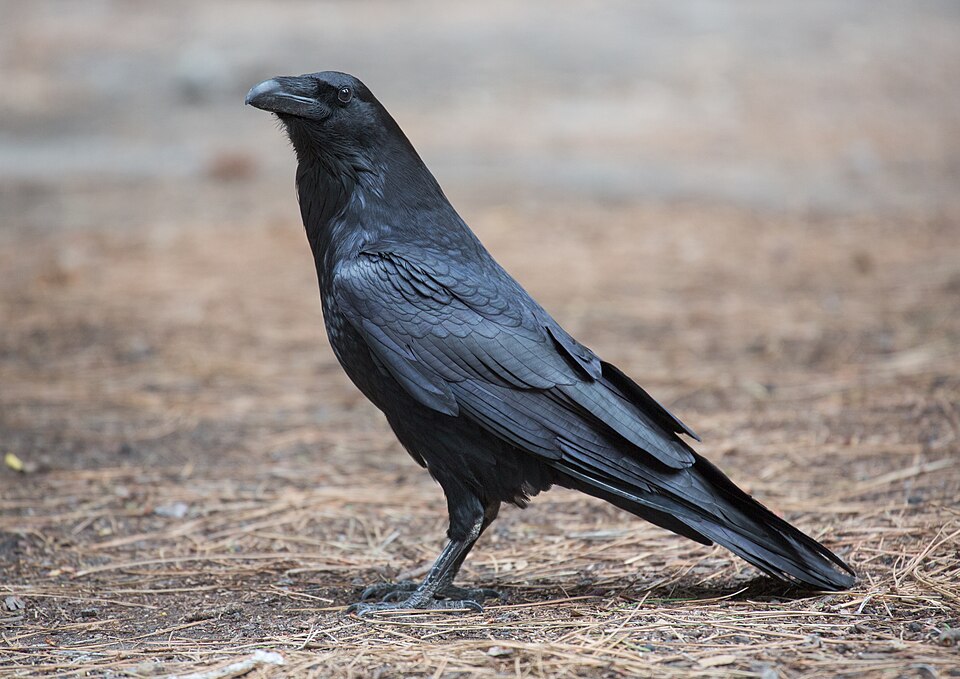
The Crow designates several species of the Corvus genus, of which the Greater Crow (Corvus corax) is the most emblematic. This bird with entirely black plumage and bluish reflections stands out for its remarkable intelligence among birds. Opportunistic and adaptable, it occupies a wide variety of environments, from deserts to mountains to urban areas. Long associated with fatal symbols in certain cultures, it actually plays an important ecological role as a scavenger and population regulator. In Tunisia, it is present particularly in the steppe and desert regions of the south.
The Greater Crow has uniform black plumage with metallic green or purplish reflections depending on the light. Its beak is robust, thick and slightly curved, suitable for a varied diet. Its tail is wedge-shaped, which distinguishes it from other corvids in flight. It emits hoarse and deep cries, which vary depending on the social context.
Characteristics
Indicative values: they vary by subspecies, sex and region.
Habitat and distribution
The Crow frequents a wide variety of environments: rocky cliffs, mountains, steppes, deserts and agricultural areas. It also adapts to urban environments where it easily finds food. Its ecological plasticity makes it one of the most widespread birds in the world.
CURRENT RANGE
The Greater Crow has one of the largest ranges among birds, spanning North America, Europe, Asia and North Africa. In Tunisia, it is observed mainly in the steppe and Saharan zones of the center and the south. Other species of the Corvus genus occupy more localized regions depending on the continent.
Behaviour
The Crow is renowned for his intelligence, capable of solving complex problems and using rudimentary tools. It generally lives in pairs or small family groups, although large gatherings may form around abundant food sources. This species is territorial and faithful to its partner over several years. Its complex social interactions include games and cooperative behaviors.
Reproduction
The pair builds a large nest made of branches, often placed on a cliff, a tall tree or an artificial structure. The female generally lays 3 to 6 eggs which she incubates alone for about three weeks. Both parents then help feed the young until they fledge, around six weeks later.
Peculiarities
The Crow is among the rare non-primate animals capable of recognizing itself in a mirror according to certain behavioral studies. It can imitate sounds, including the human voice in some cases. Its longevity and exceptional spatial memory allow it to find food caches months after having created them.
Threats and conservation
The Crow is not subject to major threats on a global scale due to its high adaptability. Locally, it can be persecuted by farmers who consider it harmful to crops. Deliberate or accidental poisoning via bait intended for other species constitutes a one-off risk.
Numbers and trends vary across sources and regions. See the IUCN assessment for the latest reference data.
Gallery
1 documented photographs.
References
Profile updated 03 September 2026 · Reviewed by the TunisieVet editorial team.
Comments (0)
No comments yet.
CONSERVATION STATUS
Least concern (LC)
IUCN source, latest published assessment.
Species health
Documented diseases for this species.
Find a veterinarianThis information is provided for educational purposes only and is not a substitute for a veterinary consultation. If you have any concerns about your animal's health, consult a veterinarian.
To discover around: Crow
Videos, facts, stories and records linked to this species.
Similar animals
Other species documented in Animalpedia.

TunisieVet in your pocket 📱🐾 Access your veterinary services wherever you are. [ Download the app ]
Learn more