
Presentation
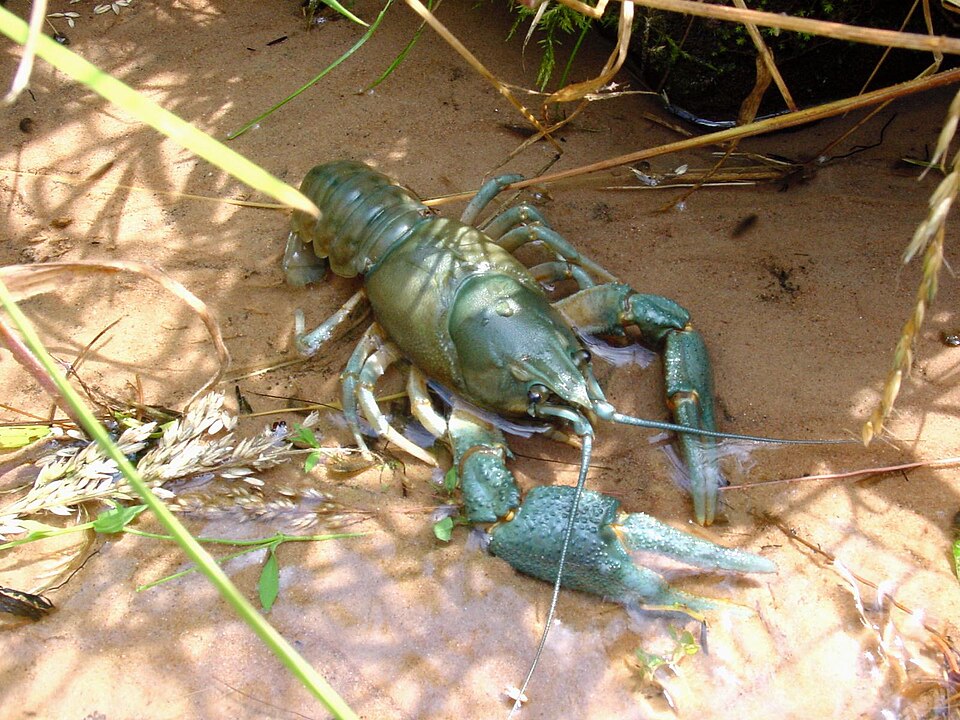
The crayfish is a freshwater decapod crustacean related to lobsters but considerably smaller. Its body is protected by a rigid, segmented carapace extending into a muscular abdomen that ends in a fan-shaped tail fin. It has two large claws (chelipeds) used for defense, capturing prey, and handling food. Many species exist worldwide; some native European species are now threatened by invasive species introduced such as the Louisiana crayfish. A secretive and primarily nocturnal animal, it lives hidden under stones or in burrows dug into riverbanks. It plays an important role in freshwater ecosystems as a detritivore and prey for numerous vertebrates.
Segmented body covered with a chitinous exoskeleton, often brown, green, or reddish depending on the species. Five pairs of thoracic legs, the first pair transformed into powerful claws. Long, sensitive antennae combined with stalked compound eyes provide good environmental detection despite limited vision.
Characteristics
Indicative values: they vary by subspecies, sex and region.
Habitat and distribution
It lives in calm freshwater or slow-moving water: rivers, streams, lakes, ponds, and canals. It favors soft substrates where it can dig burrows, as well as areas rich in natural shelters such as rocks and aquatic vegetation. Water quality, particularly oxygen content and calcium levels, strongly influences its presence.
CURRENT RANGE
Crayfish are found on several continents, with great species diversity in North America, Europe, and Asia. Some species have been introduced outside their native range, notably in North Africa, where they have sometimes established themselves in watercourses and reservoirs.
Behaviour
Essentially nocturnal, it spends the day hidden under stones, roots, or in burrows dug into the mud of riverbanks. It is territorial and can be aggressive toward its own kind, particularly when competing for shelter or a mate. When threatened, it rapidly retreats by propelling its tail—a very effective escape reflex.
Reproduction
Breeding typically occurs in autumn, following mating in which the male deposits sperm on the female's abdomen. The female then carries the fertilized eggs under her abdomen for several months until they hatch in spring. Young crayfish remain attached to the mother for a time before becoming independent and growing through successive molts.
Peculiarities
The crayfish is capable of regenerating a claw or leg lost during successive molts. Some introduced species, such as the Louisiana crayfish, are healthy carriers of a pathogenic fungus that is deadly to native European crayfish.
Threats and conservation
Native European species are threatened by water pollution, habitat degradation, and especially by competition and diseases brought by invasive introduced species. The loss of wetland areas and fragmentation of watercourses further aggravate their decline in several regions.
Numbers and trends vary across sources and regions. See the IUCN assessment for the latest reference data.
Gallery
1 documented photographs.
References
Profile updated 13 September 2026 · Reviewed by the TunisieVet editorial team.
Comments (0)
No comments yet.
CONSERVATION STATUS
Data deficient (DD)
IUCN source, latest published assessment.
Species health
Documented diseases for this species.
This information is provided for educational purposes only and is not a substitute for a veterinary consultation. If you have any concerns about your animal's health, consult a veterinarian.
Similar animals
Other species documented in Animalpedia.
