Presentation
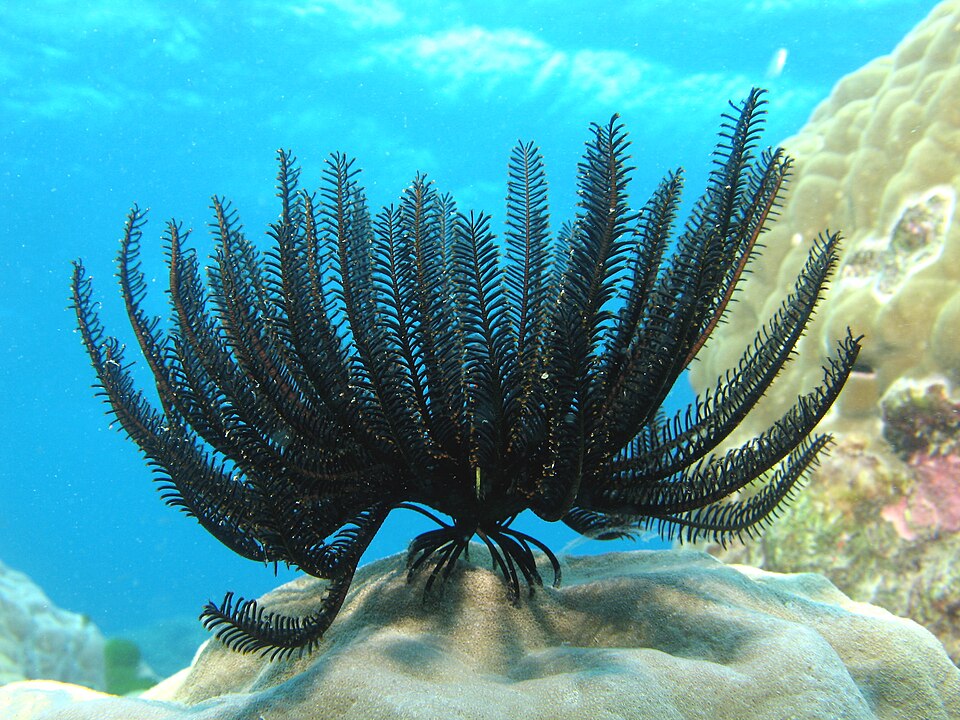
Crinoids make up a class of marine echinoderms characterized by a cup-shaped body (calyx) extended by feathery arms arranged in a crown. Some species, called sea lilies, remain attached to the seabed by a jointed stalk, while others, known as feather stars, are free-living and able to swim or crawl. This ancient group first appeared during the Paleozoic Era, over 480 million years ago, and today includes roughly 600 living species. Their five-fold radial symmetry and branched arms covered in tiny pinnules give them a plant-like appearance, which explains their common name. They live mainly in marine waters, from shallow coastal areas to the deep ocean floor. Their colour, often bright (red, yellow, orange, or brown), likely serves both as camouflage and as a chemical defence signal.
The body consists of a central calyx bearing five primary arms, which often branch into many secondary arms lined with ciliated pinnules. Fixed forms possess a stalk that anchors them to the seabed, while free-living feather stars have hooked cirri that allow temporary attachment. The skeleton is made of articulated calcareous plates, typical of echinoderms. Size generally ranges from a few centimetres to roughly 40 centimetres across when the arms are fully extended.
Characteristics
Indicative values: they vary by subspecies, sex and region.
Habitat and distribution
Crinoids occupy a wide range of marine environments, from shallow tropical coral reef waters to abyssal depths exceeding 5000 meters. They attach to rocky, coral, or sedimentary substrates depending on the species. Stalked forms, which are rarer today, are mainly found in deep waters, while feather stars dominate coastal and reef habitats.
CURRENT RANGE
Crinoids are found in all the world's oceans, with particularly high diversity in the tropical Indo-Pacific region. They are also present in the Mediterranean Sea, where certain feather star species are observed along rocky coasts. Their distribution extends from temperate to tropical zones, and includes polar waters for some species adapted to cold conditions.
Behaviour
Most crinoids adopt a sessile or relatively immobile lifestyle, orienting their arms into the current to maximize feeding. Free-living feather stars can move slowly by crawling using their cirri, and some are capable of swimming with coordinated arm movements over short distances. Many species are nocturnal, withdrawing or hiding in crevices during the day to avoid predators. They can regenerate lost arms, an ability useful when attacked by fish or crustaceans.
Reproduction
Reproduction is typically sexual, occurring through external fertilization with gametes released directly into the water. The planktonic larvae, known as vitellaria, develop in open water before settling on a substrate and metamorphosing into young stalked crinoids. In feather stars, the attached stage is temporary, and the juvenile later detaches to become free-living. Sexual maturity is reached after several months to a few years depending on the species.
Peculiarities
Crinoids are considered 'living fossils' because their body structure has changed little over hundreds of millions of years, offering a valuable link to prehistoric echinoderms. Their ability to regenerate arms is remarkable and rapid compared to other invertebrates. Some species produce chemical compounds that deter predators, making them unpalatable, which explains their bright non-camouflaged colors.
Threats and conservation
Crinoids are not globally threatened overall, with most species classified as of least concern or not evaluated. Coral reef degradation and marine pollution can locally affect coastal populations. Climate change and ocean acidification represent potential long-term threats to this group, which depends on healthy calcareous substrates.
Numbers and trends vary across sources and regions. See the IUCN assessment for the latest reference data.
Gallery
1 documented photographs.
References
Profile updated 01 September 2026 · Reviewed by the TunisieVet editorial team.
Comments (0)
No comments yet.
CONSERVATION STATUS
Data deficient (DD)
IUCN source, latest published assessment.
Species health
Documented diseases for this species.
Find a veterinarianThis information is provided for educational purposes only and is not a substitute for a veterinary consultation. If you have any concerns about your animal's health, consult a veterinarian.
Similar animals
Other species documented in Animalpedia.

Be among the first to use our app. Sign up and get early Google Play access.
Discover