
Presentation
Desert locust is an orthopteran of the Acrididae family, famous for its ability to form massive, devastating swarms. This species is one of the most feared agricultural pests in the world, capable of crossing thousands of kilometers and causing famines.
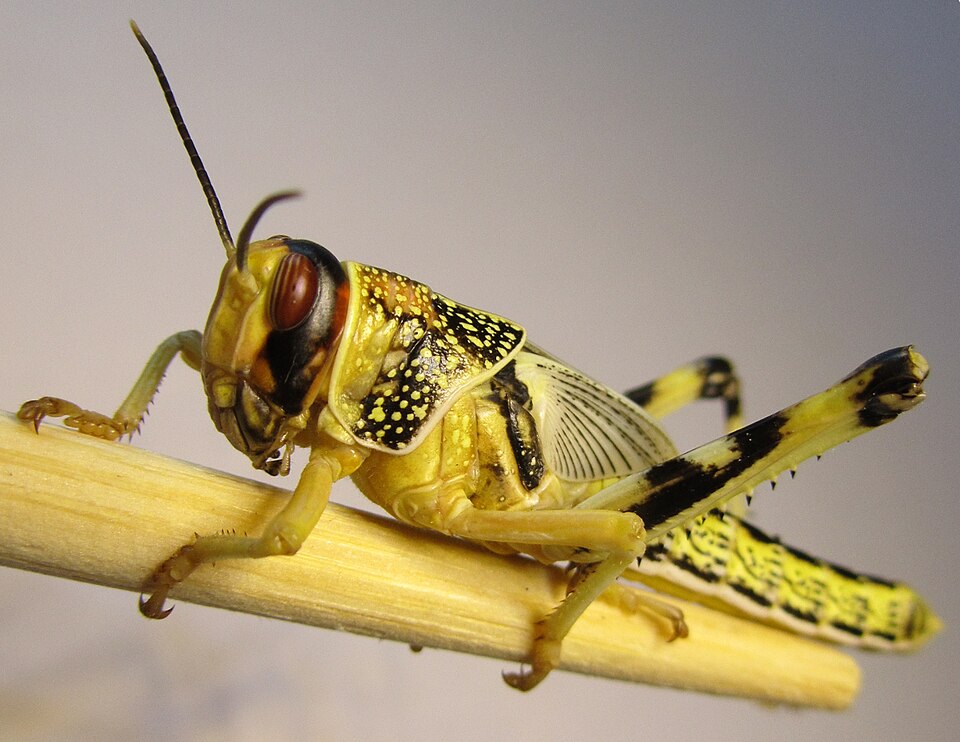
Desert locust presents a remarkable polymorphism: its solitary form is greenish and not very gregarious, while the gregarious form is yellow and brown with dark colorations, and has a distinct morphotype. Gregarious individuals are more robust and show reduced wing size.
Characteristics
Indicative values: they vary by subspecies, sex and region.
Habitat and distribution
Desert locust colonizes semi-arid and arid environments: steppes, deserts and transition zones. It is found particularly in the Sahelian and Saharan regions, where climatic conditions allow the development of large populations. It particularly likes areas with sporadic plant cover.
CURRENT RANGE
Desert locust occurs in a wide area stretching from West Africa to South Asia. Its distribution area includes more than 60 countries covering approximately 29 million square kilometers. Periodic invasions go far beyond this usual area, reaching the Atlantic coasts and Mediterranean regions.
Behaviour
In the solitary phase, locusts are shy and sedentary. Under the effect of population density and favorable climatic factors, they transform into the gregarious phase, forming bands which become spectacular migratory swarms. Their behavior changes radically: they become aggressive and extremely mobile.
Reproduction
Reproduction of the Desert locust is fast and efficient. Females lay their eggs in moist soil in clusters that may contain 50 to 100 eggs. Embryonic development generally lasts 2 to 3 weeks, followed by 5 pupal stages before imago. Several generations can follow one another in a single year.
Peculiarities
The major particularity of Desert locust is its extreme behavioral and morphological polymorphism: the same genetically individuals can pass from the solitary phase to the gregarious phase depending on the conditions. A swarm can travel up to 150 km in a day. This species is mentioned in biblical texts as one of the ten plagues of Egypt.
Threats and conservation
Although the species is not threatened with extinction, Desert locust poses a major risk to global food security. Locust invasions can affect crops and pastures over millions of hectares, causing substantial economic losses in affected countries.
Numbers and trends vary across sources and regions. See the IUCN assessment for the latest reference data.
Gallery
1 documented photographs.
References
Profile updated 31 August 2026 · Reviewed by the TunisieVet editorial team.
Comments (0)
No comments yet.
CONSERVATION STATUS
Not evaluated (NE)
IUCN source, latest published assessment.
Species health
Documented diseases for this species.
This information is provided for educational purposes only and is not a substitute for a veterinary consultation. If you have any concerns about your animal's health, consult a veterinarian.
Related species
To discover around: Desert locust
Videos, facts, stories and records linked to this species.
Similar animals
Other species documented in Animalpedia.

TunisieVet in your pocket 📱🐾 Access your veterinary services wherever you are. [ Download the app ]
Learn more