
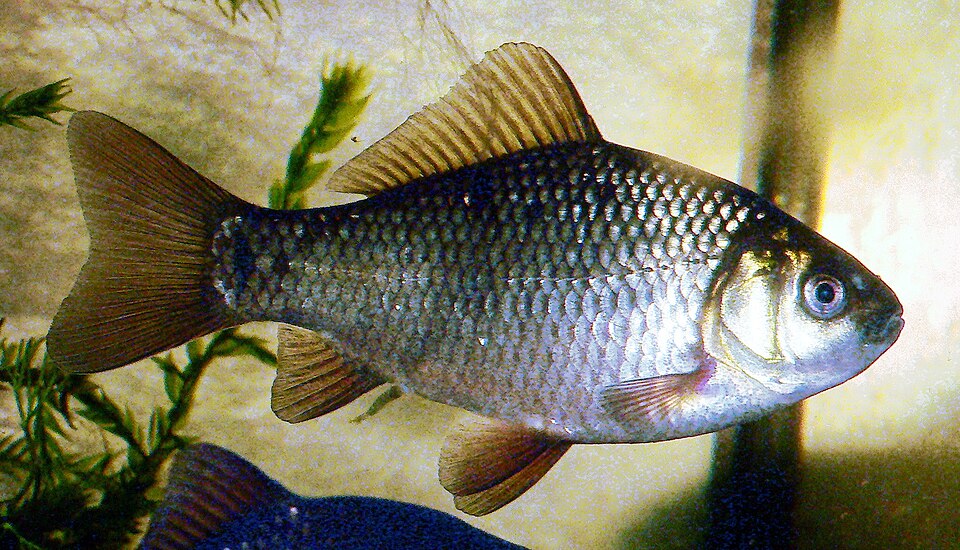
Presentation
The Crucian carp is a freshwater fish from the Cyprinidae family, close to goldfish and carp. Its body is stocky, tall and slightly laterally compressed, covered with large golden to brownish scales. It is native to central and eastern Europe and Asia, where it occupies calm, stagnant waters. Very hardy, it supports extreme conditions of temperature and low oxygenation, which explains its wide distribution. It is sometimes confused with young carp or with the silver Crucian carp, a related species introduced into many countries. In Tunisia, it is present in certain bodies of water and reservoirs, often following introductions.
The body is oval, thick and tall, with a long and slightly convex dorsal fin. The color varies from golden to brown-green depending on the environment and the age of the individual. The scales are large and clearly visible, giving a characteristic shiny appearance. It does not have barbels unlike the common carp, which makes it easy to distinguish.
Characteristics
Indicative values: they vary by subspecies, sex and region.
Habitat and distribution
The Crucian carp frequents stagnant or slow-moving water: ponds, ponds, canals and silted reservoirs. It tolerates waters low in oxygen and high turbidity, unlike many other fish species. It particularly likes areas rich in aquatic vegetation which offer it shelter and food.
CURRENT RANGE
The species is native to central and eastern Europe as well as much of temperate Asia. It has been widely introduced elsewhere because of its hardiness and its use in aquaculture or ornamental fish farming. In Tunisia, its presence results from occasional introductions into certain dams and bodies of fresh water.
Behaviour
It is a gregarious species that often lives in small groups, especially in calm, vegetated waters. Crucian carp is capable of significantly slowing down its metabolism to survive long periods of freezing or anoxia. It remains active mainly at dawn and dusk, during which it actively feeds. Its exceptional tolerance to difficult conditions makes it a pioneer species in degraded environments.
Reproduction
Reproduction takes place in spring and summer, when water temperatures reach a favorable threshold. The female lays her eggs on aquatic vegetation, where they are fertilized by the males. No parental care is given to the eggs or fry after hatching. Sexual maturity is generally reached between two and three years of age.
Peculiarities
Crucian carp is able to survive prolonged freezing of its habitat by dramatically reducing its metabolic activity. It can also tolerate extremely low dissolved oxygen levels, a rare ability among freshwater fish. It is one of the wild ancestors from which the domestic goldfish originated.
Threats and conservation
The species is not globally threatened, but it is under pressure linked to the degradation of wetlands and competition with introduced species such as the silvery Crucian carp. The pollution of stagnant water and the drying out of certain natural habitats can affect local populations. No particular protection measures are applied to it internationally.
Numbers and trends vary across sources and regions. See the IUCN assessment for the latest reference data.
Gallery
1 documented photographs.
References
Profile updated 30 August 2026 · Reviewed by the TunisieVet editorial team.
Comments (0)
No comments yet.
CONSERVATION STATUS
Least concern (LC)
IUCN source, latest published assessment.
Species health
Documented diseases for this species.
See the 4 diseases of this species Find a veterinarianThis information is provided for educational purposes only and is not a substitute for a veterinary consultation. If you have any concerns about your animal's health, consult a veterinarian.
Similar animals
Other species documented in Animalpedia.

TunisieVet in your pocket 📱🐾 Access your veterinary services wherever you are. [ Download the app ]
Learn more