
Presentation
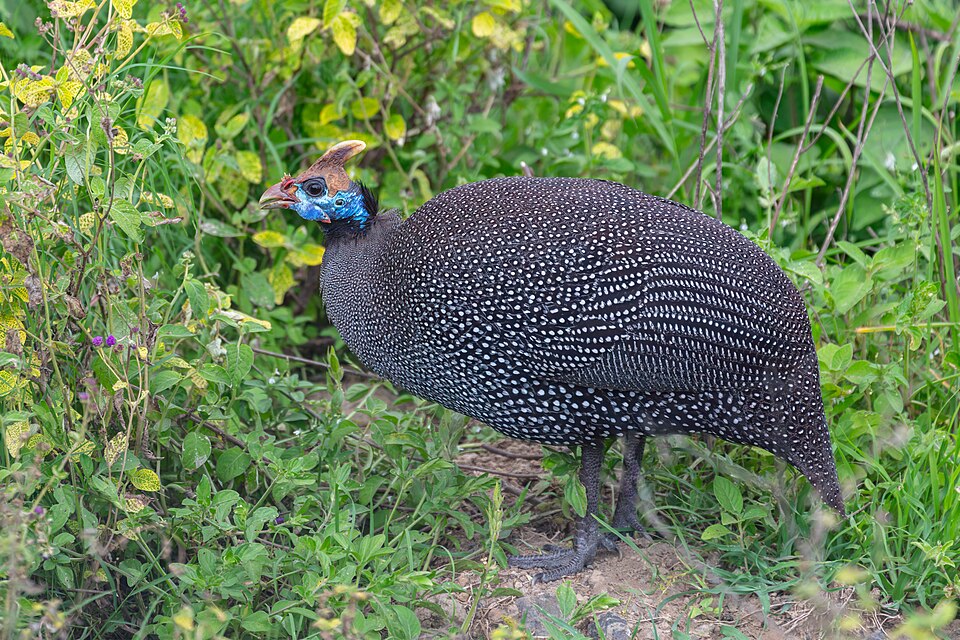
The Helmeted guineafowl is a domestic galliform bird native to West Africa, recognizable by its gray-blue plumage dotted with regular white dots. With its small bare head and its stocky silhouette, it occupies an intermediate place between the hen and the peacock in the collective imagination. This rustic bird has adapted to many environments and remains a traditional breeding appreciated in rural and agricultural environments.
The plumage of the Helmeted guineafowl is characterized by a uniform gray-blue color covered with regular, sharp white dots. Its head is small, elongated and partially bare, presenting bluish or reddish skin depending on the variety, with wattles hanging from the neck. The wings are rounded and relatively short, while the tail is curved downward, giving the bird a compact and dynamic appearance.
Characteristics
Indicative values: they vary by subspecies, sex and region.
Habitat and distribution
Helmeted guineafowl mainly frequents grassy savannahs and semi-arid areas of West Africa, seeking open lands with low vegetation. In breeding, it easily adapts to farms, meadows, gardens and cultivated land. It appreciates areas with accessible water points and natural shelters for the night. Its excellent adaptability allows it to thrive in very diverse environments, from dry to subtropical climates.
CURRENT RANGE
Wild Helmeted guineafowl is native to West Africa, with its natural distribution extending mainly between Senegal and Ivory Coast. However, the species has been domesticated since Antiquity and introduced to Europe in the 16th century, then gradually throughout the world. It is now raised on farms on all continents, with both wild and domestic populations present in many African countries.
Behaviour
The Helmeted guineafowl is a very social and gregarious bird, naturally living in flocks which can number ten to one hundred individuals. It is diurnal and spends the majority of its time on the ground scratching and searching for food. Although capable of flying short distances, she prefers running. It communicates by characteristic piercing and repetitive cries. Rustic and undemanding, it adapts well to life in semi-liberty.
Reproduction
Helmeted guineafowl reaches sexual maturity around three to four months. The female lays between 8 and 15 eggs in a nest hidden on the ground, generally in the dry season or beginning of the rainy season. Incubation lasts approximately 26 to 28 days. The chicks are precocial and follow the mother upon hatching, reaching food independence within a few weeks.
Peculiarities
The Helmeted guineafowl is known for its very high-pitched and persistent calls, which have earned it the nickname "farm guard" due to its role in alerting intruders. It has a remarkable ability to control pests and pests, making it valuable in organic gardens. Its eggs, with a very hard shell and rich flavor, are highly appreciated in gastronomy. It is also characterized by a great longevity compared to the domestic hen.
Threats and conservation
The wild species enjoys a favorable conservation status and faces no major threats. The domestic Helmeted guineafowl, which has become very common in breeding, presents no risk of disappearance and adapts remarkably well to various agricultural and climatic contexts.
Numbers and trends vary across sources and regions. See the IUCN assessment for the latest reference data.
Gallery
1 documented photographs.
References
UICN — Liste rouge des espèces menacées
Profile updated 27 August 2026 · Reviewed by the TunisieVet editorial team.
Comments (0)
No comments yet.
CONSERVATION STATUS
Least concern (LC)
IUCN source, latest published assessment.
Species health
Documented diseases for this species.
See the 4 diseases of this species Find a veterinarianThis information is provided for educational purposes only and is not a substitute for a veterinary consultation. If you have any concerns about your animal's health, consult a veterinarian.
To discover around: Helmeted guineafowl
Videos, facts, stories and records linked to this species.
Similar animals
Other species documented in Animalpedia.

TunisieVet in your pocket 📱🐾 Access your veterinary services wherever you are. [ Download the app ]
Learn more