
Presentation
The Turkey is a large domestic bird belonging to the Phasianidae family. Native to North America, it was domesticated over a thousand years ago and has spread throughout the world. It is one of the largest farmed poultry, recognizable by its imposing appearance and characteristic behaviors.
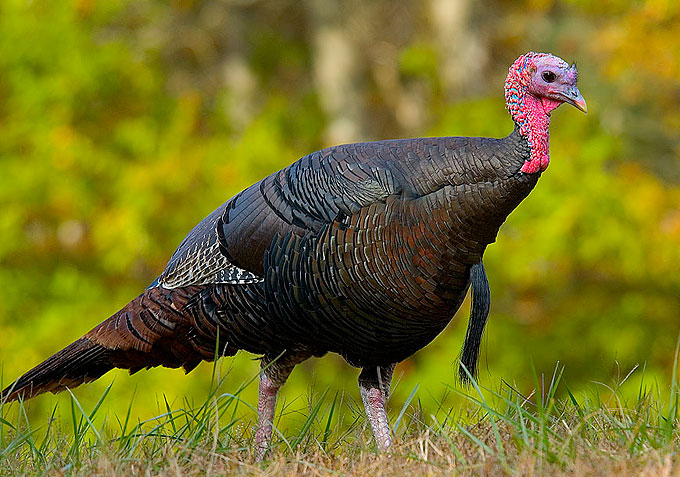
The Turkey is distinguished by its varied plumage depending on the breed, ranging from black to white, including red and bronze. The male (turkey) has distinctive red and blue wattles on the head and neck, as well as a fleshy beard under the chin. Females are generally smaller and inconspicuous.
Characteristics
Indicative values: they vary by subspecies, sex and region.
Habitat and distribution
The Turkey is suitable for farms and open meadows. In the wild, it frequents sparse forests, mixed woodlands and herbaceous areas. In breeding, it appreciates spaces with shelter, whether henhouses or farm buildings. It tolerates various climates well.
CURRENT RANGE
Native to Mexico and the southwestern United States, wild Turkey has a natural distribution limited to North America. However, its domesticated form has spread worldwide and is now found on all continents in agricultural breeding contexts.
Behaviour
The Turkey is a very social bird that generally lives in groups. The male displays territorial behavior with a characteristic rubbing called “strut”, during which he fluffs up his feathers, lowers his wings and raises his wattles. It communicates through distinctive vocalizations, including the turkey’s characteristic “goblet.”
Reproduction
Turkey reaches sexual maturity around 5 to 6 months. The female usually lays 8 to 15 eggs in a nest on the ground, which she incubates alone for about 28 days. Chicks are born semi-nidifuge and quickly follow their mother to learn how to feed and protect themselves.
Peculiarities
The Turkey has excellent vision and remarkable hearing, allowing it to detect potential threats. She can reach impressive speeds on the ground despite her size. Modern livestock breeds have been selected for meat production, which has significantly changed its morphology compared to wild forms.
Threats and conservation
The domesticated Turkey does not face major threats as a well-established livestock species. However, genetic concentration in modern livestock farming reduces diversity and can create vulnerability to disease. The wild form, although not threatened on a global scale, is experiencing decline locally due to habitat loss.
Numbers and trends vary across sources and regions. See the IUCN assessment for the latest reference data.
Gallery
1 documented photographs.
References
UICN — Liste rouge des espèces menacées
Profile updated 03 September 2026 · Reviewed by the TunisieVet editorial team.
Comments (0)
No comments yet.
CONSERVATION STATUS
Least concern (LC)
IUCN source, latest published assessment.
Species health
Documented diseases for this species.
See the 5 diseases of this species Find a veterinarianThis information is provided for educational purposes only and is not a substitute for a veterinary consultation. If you have any concerns about your animal's health, consult a veterinarian.
Similar animals
Other species documented in Animalpedia.

TunisieVet in your pocket 📱🐾 Access your veterinary services wherever you are. [ Download the app ]
Learn more