
Presentation
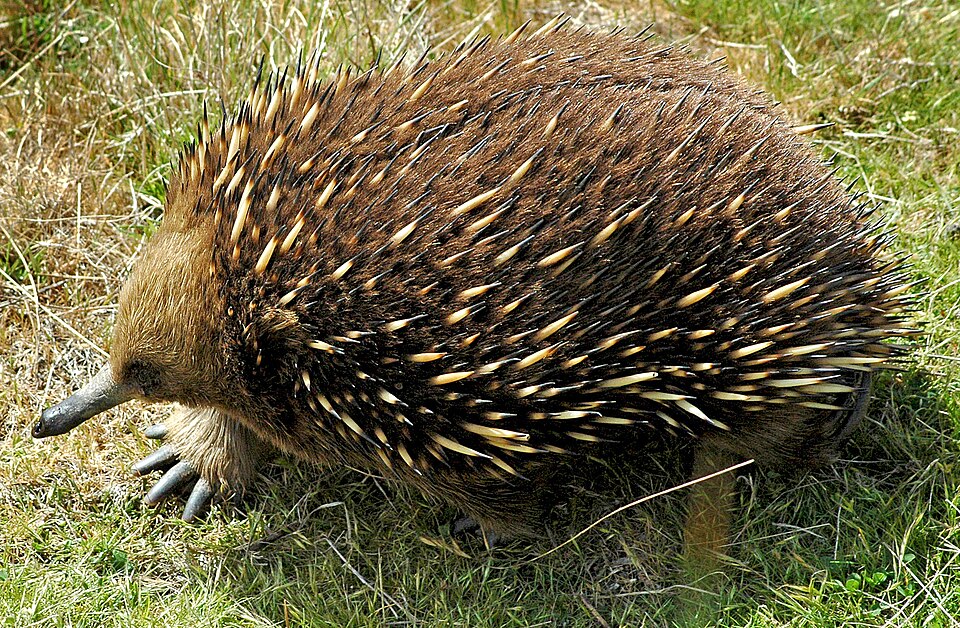
The Echidna is a monotreme mammal covered with quills, found in Australia and New Guinea. It is one of the rare mammals that lay eggs, along with the platypus. Its stocky body, short legs and elongated, beak-shaped snout allow it to search the ground in search of ants and termites. Discreet and mainly solitary, it moves slowly but can dig quickly to bury itself in case of danger. It plays an important cultural role among Aboriginal people and attracts scientific interest due to its unique physiology.
The body of the Echidna is covered in keratinized quills mixed with hair. It has a sensitive tubular snout, used to detect prey through electroreception. Its sturdy legs are equipped with powerful claws adapted to burrowing. Unlike other mammals, it lays eggs and breastfeeds its young through pores in the skin, without nipples.
Characteristics
Indicative values: they vary by subspecies, sex and region.
Habitat and distribution
Echidna occupies a variety of environments, from tropical rainforests to arid and mountainous areas. It appreciates loose soils rich in insects, conducive to burrowing. Its adaptability allows it to survive in very different climatic environments, from the savannah to cooler high altitude regions.
CURRENT RANGE
The species is distributed throughout Australia, including Tasmania, as well as New Guinea. It is absent in its natural state from other continents. Its wide distribution reflects its ability to adapt to varied habitats.
Behaviour
A solitary animal and mainly nocturnal or twilight depending on the climate, the Echidna spends a large part of its time searching the ground and dead wood. When faced with a threat, it rolls up into a ball or digs quickly to leave only its quills protruding. It goes into hibernation or torpor in colder regions. Its social interactions are essentially limited to the breeding period.
Reproduction
The female lays a single soft egg which she places in a temporary ventral pouch. After about ten days of incubation, the little one hatches and continues to develop in the pouch by feeding on the mother's milk secreted through skin pores. The young, called a “puggle”, remains protected until its quills begin to grow. It is then left in a burrow while the mother goes to feed.
Peculiarities
The Echidna is one of only five extant monotreme mammals, alongside the platypus. It has an electroreception system in its snout, rare among terrestrial mammals. Its low body temperature and slow metabolism make it an atypical animal among mammals.
Threats and conservation
The Echidna faces habitat loss due to urbanization and agriculture. Road collisions and predation by introduced species such as foxes also pose localized threats. Overall, its populations remain stable thanks to its wide distribution and its adaptive capacities.
Numbers and trends vary across sources and regions. See the IUCN assessment for the latest reference data.
Gallery
1 documented photographs.
References
Profile updated 24 August 2026 · Reviewed by the TunisieVet editorial team.
Comments (0)
No comments yet.
CONSERVATION STATUS
Least concern (LC)
IUCN source, latest published assessment.
To discover around: Echidna
Videos, facts, stories and records linked to this species.
Similar animals
Other species documented in Animalpedia.
