
Presentation
The blue-footed booby is a seabird recognizable by its bright blue feet, which are displayed during spectacular courtship displays. It belongs to the Sulidae family, alongside other boobies, and lives in colonies on rocky coasts and tropical Pacific islands. An excellent diver, it catches prey by plunging headfirst into the water from the air. The species is famous for its presence in the Galápagos archipelago, where it has been extensively studied. Its global population remains generally stable despite local fluctuations linked to food availability. This species is not present in Tunisia.
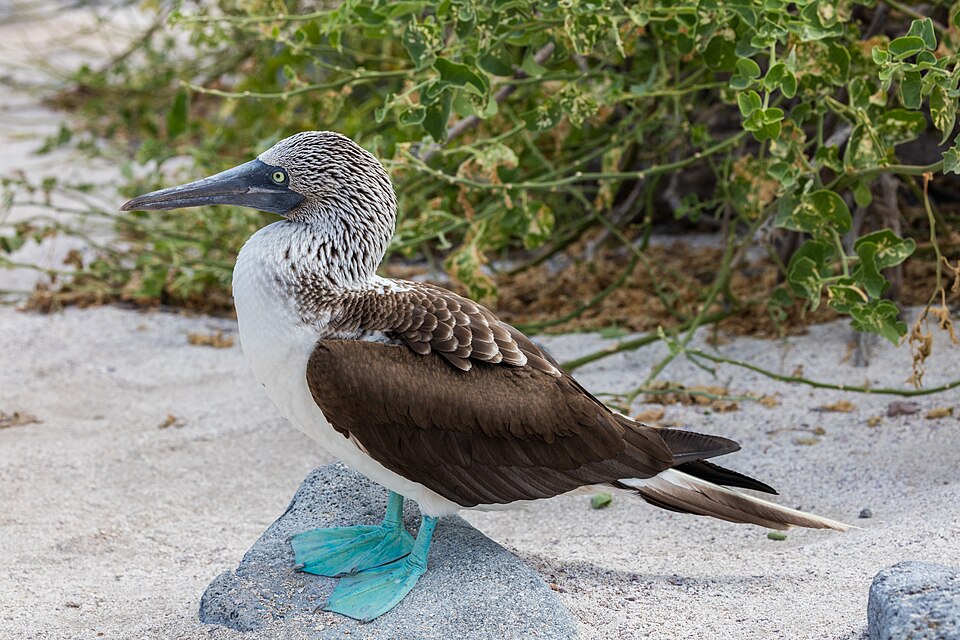
Adults measure approximately 80 to 90 cm in length with a wingspan close to 1.5 m. The plumage is brown on the upperparts and white below, with a streaked head. The webbed feet display a turquoise blue color, whose intensity varies according to the individual's health and diet. The beak is long, conical, and grayish in color.
Characteristics
Indicative values: they vary by subspecies, sex and region.
Habitat and distribution
The species inhabits rocky coasts, cliffs, and tropical and subtropical islands along the Pacific coast. It nests directly on the ground in open areas near the ocean. The adjacent marine environment makes up its primary hunting territory.
CURRENT RANGE
The blue-footed booby is found along the Pacific coasts of Central and South America, notably in Peru and Ecuador. The most iconic population occurs in the Galápagos archipelago. Colonies also exist on other islands in the eastern Pacific.
Behaviour
The blue-footed booby is a gregarious bird that nests in sometimes large colonies. Courtship displays feature a ritualized exhibition of the blue feet, with the male raising each foot alternately in front of the female. The species is diurnal and spends much of its time fishing at sea before returning to rest on land. Couples may remain paired across several breeding seasons.
Reproduction
The female typically lays two to three eggs directly on the ground without building an elaborate nest. Incubation lasts approximately 41 to 45 days and is shared by both parents in turns. Chicks hatch asynchronously, which can lead to competition among them for food. Fledging occurs at around three months of age.
Peculiarities
The colour of the feet serves as an indicator of the bird's physical condition, appearing more vivid in well-nourished individuals. This characteristic plays a central role in mate selection during breeding. The species has become an emblematic symbol of the fauna of the Galápagos.
Threats and conservation
The main threats include local decline in prey availability related to climatic phenomena such as El Niño. Marine pollution and human disturbance at nesting sites may also affect colonies. The species is not currently considered globally threatened.
Numbers and trends vary across sources and regions. See the IUCN assessment for the latest reference data.
Gallery
1 documented photographs.
References
Profile updated 08 September 2026 · Reviewed by the TunisieVet editorial team.
Comments (0)
No comments yet.
CONSERVATION STATUS
Least concern (LC)
IUCN source, latest published assessment.
Species health
Documented diseases for this species.
This information is provided for educational purposes only and is not a substitute for a veterinary consultation. If you have any concerns about your animal's health, consult a veterinarian.
Similar animals
Other species documented in Animalpedia.

TunisieVet in your pocket 📱🐾 Access your veterinary services wherever you are. [ Download the app ]
Learn more