
Presentation
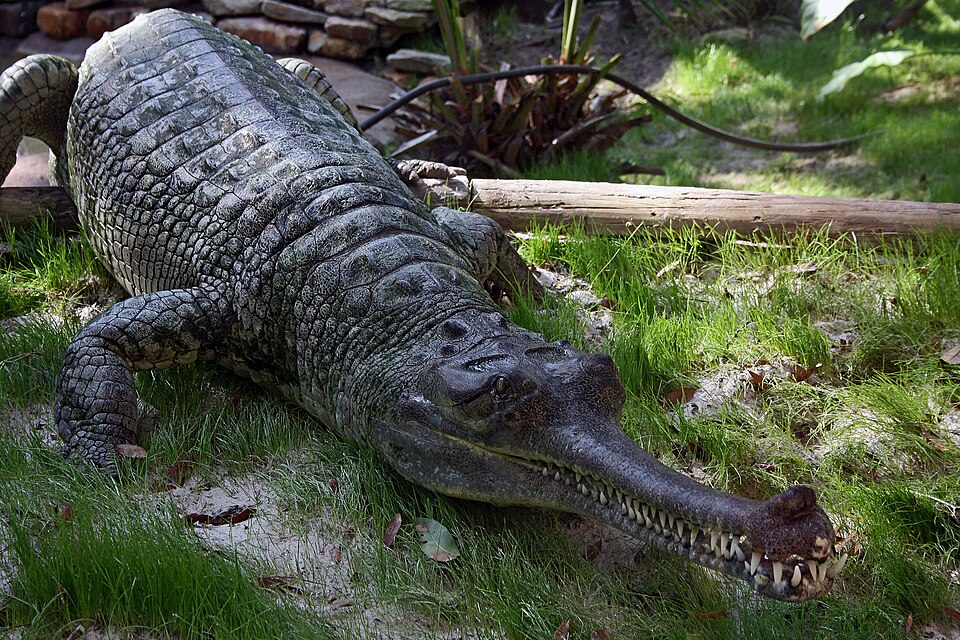
The Ganges Gharial (Gharialis gangeticus) is a large crocodilian recognizable by its long and narrow snout. It lives exclusively in the rivers of the Indian subcontinent and is distinguished by an almost exclusively piscivorous diet. Adult males have a fleshy growth at the end of their snout called a “ghara”. This reptile is one of the most endangered species of crocodilians in the world. It plays an important ecological role by regulating fish populations in its riverine habitat.
The Gharial has a very thin and elongated snout, lined with a hundred fine and sharp teeth adapted to catching fish. Its body is robust and its scaly skin has an olive to light brown hue. The legs are relatively weak, making terrestrial locomotion difficult, in contrast to its great aquatic agility.
Characteristics
Indicative values: they vary by subspecies, sex and region.
Habitat and distribution
Gharial frequents deep, fast-flowing rivers and adjacent wetlands with sandbars for resting and laying eggs. It avoids stagnant water and marine environments, unlike other crocodilians.
CURRENT RANGE
The species is native to the Indian subcontinent, mainly occurring in the Ganges, Chambal and Brahmaputra river basins in India and Nepal. Its populations are today fragmented and confined to a few protected waterways.
Behaviour
This animal is essentially aquatic and spends most of its time submerged or basking on sandy banks to thermoregulate. It is rather fearful of humans and quickly flees if disturbed. Males emit sound and visual signals, particularly via their ghara, to attract females during the breeding season.
Reproduction
Breeding takes place in the dry season, when females dig sand nests near the banks to lay between 20 and 60 eggs. Incubation lasts approximately two to three months. The young Gharials, once hatched, remain under the supervision of adults for several weeks before gaining their independence.
Peculiarities
The Gharial is the only living crocodilian to have such a thin, elongated snout, specialized in catching fish. The males' ghara, unique among crocodilians, serves as both a visual and audible signal. It is also one of the largest existing crocodilians, although it is not very dangerous to humans due to its fish-eating diet.
Threats and conservation
The degradation of its riverine habitat, the construction of dams and sand extraction seriously threaten the species. Net fishing also leads to accidental drownings. Pollution of waterways and historical poaching for eggs and skins have greatly reduced its populations.
Numbers and trends vary across sources and regions. See the IUCN assessment for the latest reference data.
Gallery
1 documented photographs.
References
Profile updated 01 September 2026 · Reviewed by the TunisieVet editorial team.
Comments (0)
No comments yet.
CONSERVATION STATUS
Critically endangered (CR)
IUCN source, latest published assessment.
Species health
Documented diseases for this species.
This information is provided for educational purposes only and is not a substitute for a veterinary consultation. If you have any concerns about your animal's health, consult a veterinarian.
To discover around: Gharial
Videos, facts, stories and records linked to this species.
RECORD
Highest muzzle length/width ratio
The thinnest snout of crocodilians
Measured among all living species of crocodilians, suitable for the exclusive capture of f...
Similar animals
Other species documented in Animalpedia.

TunisieVet in your pocket 📱🐾 Access your veterinary services wherever you are. [ Download the app ]
Learn more