
Presentation
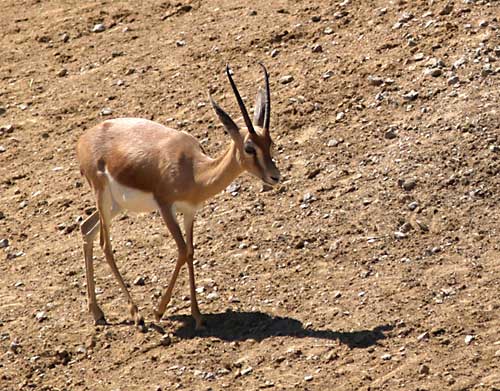
The Dorcas gazelle is a small, elegant antelope, perfectly adapted to the arid environments of the Sahara and the Middle East. It is distinguished by its graceful silhouette, its long slender legs and its large, expressive eyes. It is one of the most delicate and iconic gazelles of the North African deserts.
Dorcas gazelle has a light brown to gray-brown coat, paler on the sides and belly. Its horns, present in males and generally absent in females, are long, thin and slightly curved. It is also characterized by black bands on its sides and a distinctive white rear.
Did you know?
How does the Dorcas gazelle survive without drinking in the Sahara?
Characteristics
Indicative values: they vary by subspecies, sex and region.
Habitat and distribution
The Dorcas gazelle specializes in desert and semi-desert habitats, particularly sandy and stony deserts, as well as arid steppes. It prefers areas with sparse but sufficient vegetation for feeding. It can live in regions where annual rainfall is extremely low.
CURRENT RANGE
Dorcas gazelle is distributed in arid and semi-arid regions of the Sahara and the Middle East, from Morocco and Algeria east to the Arabian Peninsula. Its range also extends to West Africa and Egypt. Isolated populations exist in different regions of the Sahel.
Behaviour
Dorcas gazelle is a diurnal and crepuscular animal, particularly active during the coolest hours of the day. It lives in small groups of 1 to 6 individuals, often females with their young. It is very fast and can reach 60 km/h to escape predators. She is also known for her remarkable endurance in the desert.
Reproduction
Dorcas gazelle reaches sexual maturity at 1.5-2 years. The rutting period generally lasts from November to December. After a gestation of approximately 165 days, the female gives birth to one or two young. Breastfeeding lasts 3 to 4 months.
Peculiarities
Dorcas gazelle has a unique physiology allowing it to live for a long time without drinking water, obtaining its hydration primarily from vegetation. Its eyes are particularly developed to detect threats at great distances. It is capable of withstanding extreme temperature variations.
Threats and conservation
The Dorcas gazelle faces several threats: habitat loss due to the degradation and fragmentation of desert areas, overgrazing, unregulated hunting, and climate change affecting the availability of water and food resources. Poaching remains a concern in some areas.
Numbers and trends vary across sources and regions. See the IUCN assessment for the latest reference data.
Gallery
1 documented photographs.
References
UICN — Liste rouge des espèces menacées
Profile updated 02 September 2026 · Reviewed by the TunisieVet editorial team.
Comments (0)
No comments yet.
CONSERVATION STATUS
Vulnerable (VU)
IUCN source, latest published assessment.
Species health
Documented diseases for this species.
This information is provided for educational purposes only and is not a substitute for a veterinary consultation. If you have any concerns about your animal's health, consult a veterinarian.
Related species
To discover around: Dorcas gazelle
Videos, facts, stories and records linked to this species.
Similar animals
Other species documented in Animalpedia.

TunisieVet in your pocket 📱🐾 Access your veterinary services wherever you are. [ Download the app ]
Learn more