Presentation
The wolverine (Gulo gulo) is the largest terrestrial mustelid, adapted to cold regions of the Northern Hemisphere. Despite its bear-like appearance, it belongs to the same family as weasels and otters. An opportunistic scavenger and occasional hunter, it is known for its disproportionate strength relative to its size and its ability to drive larger predators, such as wolves or bears, away from their prey. Solitary and discreet, it occupies vast territories in boreal forests and Arctic tundra. Its reputation for voraciousness, which inspired its name, stems mainly from its habit of storing food for winter.
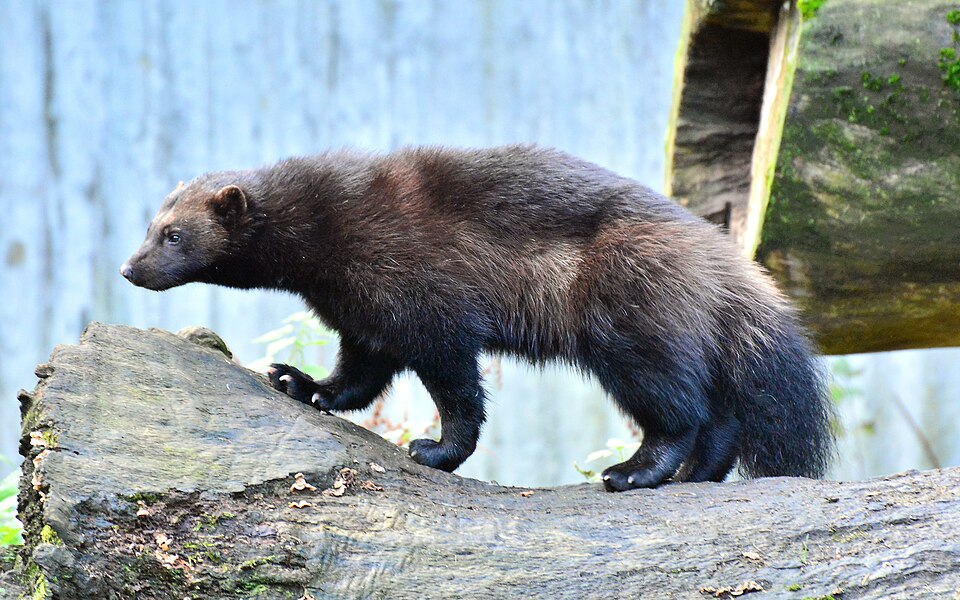
The wolverine resembles a small, stocky bear but actually belongs to the mustelid family, like the otter or badger. Its massive body is covered in thick, water-resistant fur, dark brown with lighter bands on the flanks. Its broad paws, equipped with powerful claws, allow it to dig through snow and climb trees. Its powerful jaws enable it to crush frozen bones from carcasses.
Characteristics
Indicative values: they vary by subspecies, sex and region.
Habitat and distribution
The wolverine inhabits boreal forests, taiga, and arctic tundra, often at high altitude or in remote regions. It favors cold areas with minimal human activity and prolonged snow cover. Its territories are extensive, covering several hundred square kilometers depending on food availability.
CURRENT RANGE
The wolverine is found in the arctic and subarctic regions of North America, Scandinavia, and Russia. It inhabits Canada, Alaska, and Siberia. Its populations are fragmented and declining in certain parts of its range, particularly in Europe. It is absent from temperate and southern zones.
Behaviour
The wolverine is a solitary, territorial animal, active mainly at dusk and night. It has a highly developed sense of smell that allows it to detect carcasses buried under several meters of snow. Renowned for its strength and boldness, it can hunt prey much larger than itself, particularly during times of scarcity. It roams vast territories, marked by odorous glandular secretions.
Reproduction
The female wolverine typically gives birth every two to three years after delayed gestation that can last several months. She produces a litter of two to four young in a den dug beneath the snow. The young remain dependent on their mother for several months before becoming independent around one year of age.
Peculiarities
The wolverine possesses fur so resistant to frost that it was traditionally used to line the hoods of polar clothing. Its name comes from a legend exaggerating its voraciousness, though it actually consumes reasonable quantities but stores food abundantly. It is capable of driving bears or wolves away from their kills through its aggressiveness and robust build.
Threats and conservation
The wolverine is threatened by climate change, which reduces the snow cover necessary for its reproduction. Trapping for its fur and habitat fragmentation from human activities also impact its populations. In some regions, it is considered vulnerable or locally threatened despite its worldwide status of minor concern.
Numbers and trends vary across sources and regions. See the IUCN assessment for the latest reference data.
Gallery
1 documented photographs.
References
Profile updated 18 September 2026 · Reviewed by the TunisieVet editorial team.
Comments (0)
No comments yet.
CONSERVATION STATUS
Least concern (LC)
IUCN source, latest published assessment.
Species health
Documented diseases for this species.
Find a veterinarianThis information is provided for educational purposes only and is not a substitute for a veterinary consultation. If you have any concerns about your animal's health, consult a veterinarian.
To discover around: Wolverine
Videos, facts, stories and records linked to this species.
Similar animals
Other species documented in Animalpedia.