
Presentation
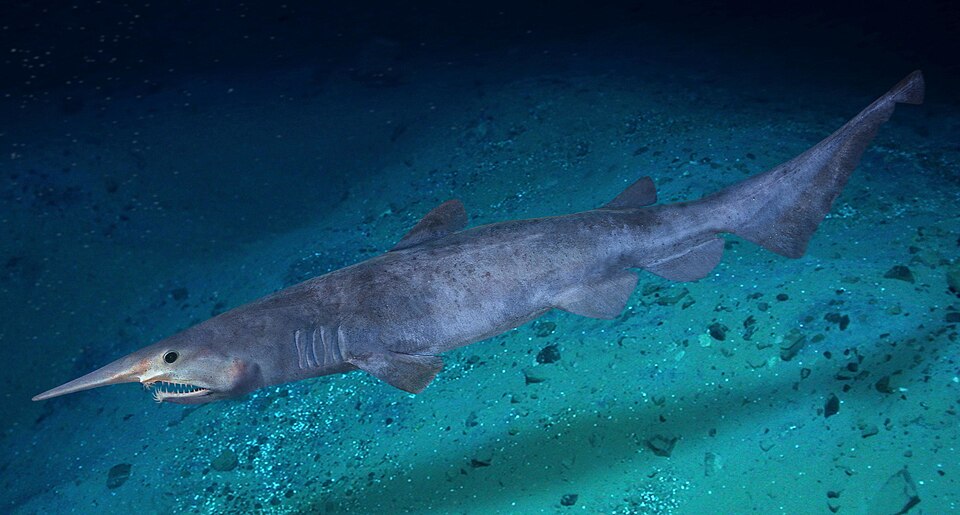
The goblin shark (Mitsukurina owstoni) is a deep-sea shark considered a living fossil due to its very ancient lineage, the Mitsukurinidae family dating back approximately 125 million years. It is immediately recognizable by its elongated, blade-shaped snout and its protruding jaws, capable of suddenly extending to snatch prey. Its pinkish coloration, resulting from the transparency of its skin allowing blood vessels to show through, sometimes earns it the nickname "ghost shark." This species typically lives between 250 and 1,300 meters in depth, rarely observed by humans. It is accidentally caught by trawlers in several oceans around the world, which represents the primary source of scientific information about it. Its lifestyle and reproductive biology remain largely unknown due to the difficulty of studying it in the abyssal environment.
This shark is distinguished by its long, flat, blade-shaped snout and protractile jaws capable of projecting far forward from the head when capturing prey. Its skin is pale pink to greyish, translucent, allowing blood vessels to show through. The body is soft and flabby, poorly adapted for fast swimming, unlike most other shark species.
Characteristics
Indicative values: they vary by subspecies, sex and region.
Habitat and distribution
This species inhabits exclusively deep marine environments along continental slopes and abyssal plains, generally at depths between 250 and 1300 metres. It favours cold, dark waters devoid of sunlight. This benthopagic lifestyle severely restricts opportunities for direct scientific observation.
CURRENT RANGE
The species occurs sporadically throughout the Atlantic, Pacific, and Indian Oceans, generally along continental slopes and deep oceanic ridges. Specimens have been reported off Japan, the United States, Portugal, South Africa, and several other coastal regions. Its worldwide but fragmented range suggests continuous distribution along continental margins, though data remain incomplete. No established populations have been formally identified in the Mediterranean Sea near Tunisia.
Behaviour
The Goblin shark is a solitary, inactive predator adapted to life in deep waters where light is absent. It moves slowly thanks to poorly developed musculature and flabby flesh, conserving energy in a nutrient-poor environment. Its prey capture relies on rapid forward projection of its jaws, a mechanism unique among present-day sharks. Direct observations in the wild remaining rare, most knowledge derives from specimens caught accidentally.
Reproduction
The goblin shark's breeding mode is poorly understood, but it is presumed to be ovoviviparous like most related sharks in the same order. No gravid female has been formally examined to date to confirm litter size or gestation duration. Knowledge of sexual maturity and reproductive cycles therefore remains largely speculative.
Peculiarities
Its ability to project its jaws forward with remarkable speed is a unique feature among living sharks. Its long, flattened snout, rich in ampullae of Lorenzini, serves to detect the faint electrical signals emitted by prey in total darkness. Its pink and translucent skin, along with its unusual appearance, have earned it a reputation as a strange creature in popular culture.
Threats and conservation
The goblin shark is not targeted by direct commercial fishing but is occasionally caught as bycatch by deep-sea trawlers. Its abyssal habitat affords it some protection from surface human activities. No significant population decline has been documented to date.
Numbers and trends vary across sources and regions. See the IUCN assessment for the latest reference data.
Gallery
1 documented photographs.
References
Profile updated 07 September 2026 · Reviewed by the TunisieVet editorial team.
Comments (0)
No comments yet.
CONSERVATION STATUS
Least concern (LC)
IUCN source, latest published assessment.
Species health
Documented diseases for this species.
This information is provided for educational purposes only and is not a substitute for a veterinary consultation. If you have any concerns about your animal's health, consult a veterinarian.
To discover around: Goblin shark
Videos, facts, stories and records linked to this species.
RECORD
approx. 3.1 meters per second
The fastest jaw projection speed in a shark
Speed of jaw projection measured during prey attack in filmed specimens.
Similar animals
Other species documented in Animalpedia.

TunisieVet in your pocket 📱🐾 Access your veterinary services wherever you are. [ Download the app ]
Learn more