
Presentation
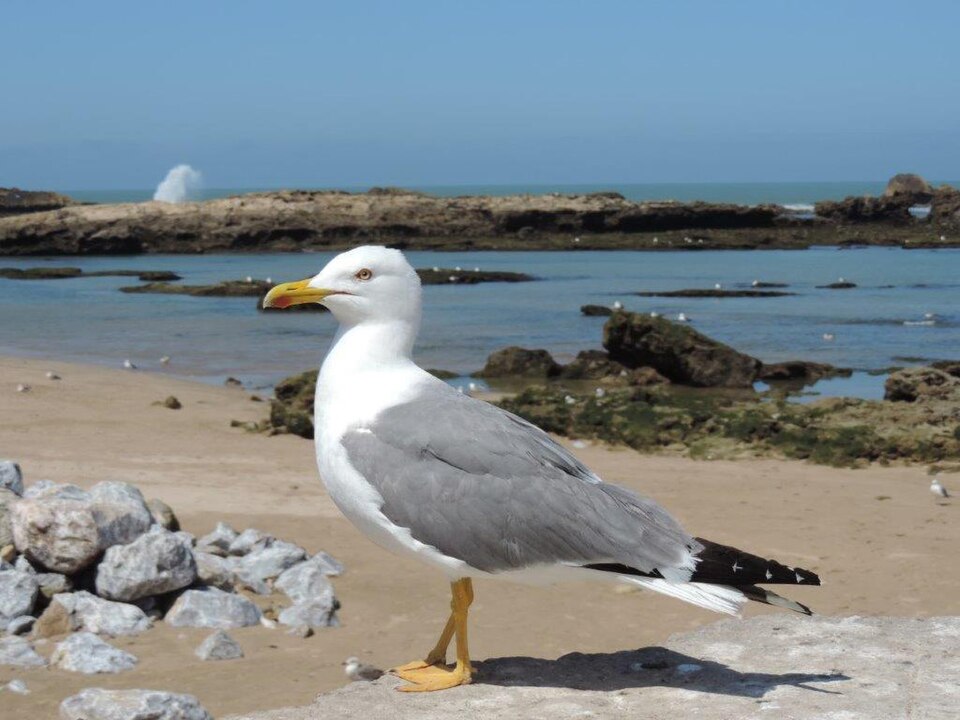
The gull is a large seabird belonging to the Laridae family, often confused with other gull species although it is typically larger and more robust. Its plumage is predominantly white and light grey on the back and wings, with a yellow beak marked by a characteristic red spot. An opportunistic species, the gull has adapted well to living alongside humans, frequenting rocky coasts, harbours, and urban refuse sites alike. It is renowned for its intelligence, dietary flexibility, and gregarious behaviour, forming large, noisy colonies. Throughout the Mediterranean, including Tunisia, it is one of the most visible and common seabird species.
The gull has a sturdy body, webbed feet, and a powerful beak that is slightly hooked at the tip, suited to a varied diet. Its long, pointed wings enable efficient soaring flight over water and coastal areas. Juvenile plumage is brown and speckled, taking several years to develop into the adult grey and white pattern.
Characteristics
Indicative values: they vary by subspecies, sex and region.
Habitat and distribution
Gulls mainly inhabit rocky coastlines, cliff faces, islands, and coastal zones where they establish breeding colonies. They also venture into inland rivers, lakes, and wetlands, as well as urban areas near the coast. Their ecological adaptability allows them to colonize very diverse environments, from harbors to public landfills.
CURRENT RANGE
The yellow-legged gull is widely distributed around the Mediterranean basin, along European Atlantic coasts, and in parts of North Africa. In Tunisia, it is present year-round along the coasts and in coastal wetlands. Other gull species also inhabit Europe and Western Asia depending on the season.
Behaviour
The gull is a gregarious bird that lives and nests in colonies that can be quite noisy, particularly on coastal cliffs and small islands. It displays marked territorial behaviour during the breeding season and can be aggressive towards intruders, including humans. Highly adaptable, it exploits food opportunities in urban and coastal environments with notable behavioural intelligence.
Reproduction
The female typically lays two to three eggs in a simple nest built directly on the ground, often on cliff faces, small islands, or rooftops in urban areas. Incubation lasts about 4 weeks, and both parents take part in incubating the eggs and feeding the chicks. Young birds reach sexual maturity and their full adult plumage between 3 and 4 years of age.
Peculiarities
The gull can drink salt water thanks to specialized nasal glands that filter out excess salt. Its extreme dietary flexibility allows it to survive in wild settings as well as in urban centers. Its relatively long lifespan for a bird of its size makes it a resilient species in the face of environmental change.
Threats and conservation
The yellow-legged gull does not face major threats and its populations are globally stable or expanding in some urban regions. Locally, however, it may be considered a pest due to its proliferation in urban areas and may be subject to population control measures. Marine pollution and degradation of certain coastal habitats remain concerns for the quality of its natural environment.
Numbers and trends vary across sources and regions. See the IUCN assessment for the latest reference data.
Gallery
1 documented photographs.
References
Profile updated 07 September 2026 · Reviewed by the TunisieVet editorial team.
Comments (0)
No comments yet.
CONSERVATION STATUS
Least concern (LC)
IUCN source, latest published assessment.
Species health
Documented diseases for this species.
See the 4 diseases of this species Find a veterinarianThis information is provided for educational purposes only and is not a substitute for a veterinary consultation. If you have any concerns about your animal's health, consult a veterinarian.
Similar animals
Other species documented in Animalpedia.

TunisieVet in your pocket 📱🐾 Access your veterinary services wherever you are. [ Download the app ]
Learn more