
Presentation
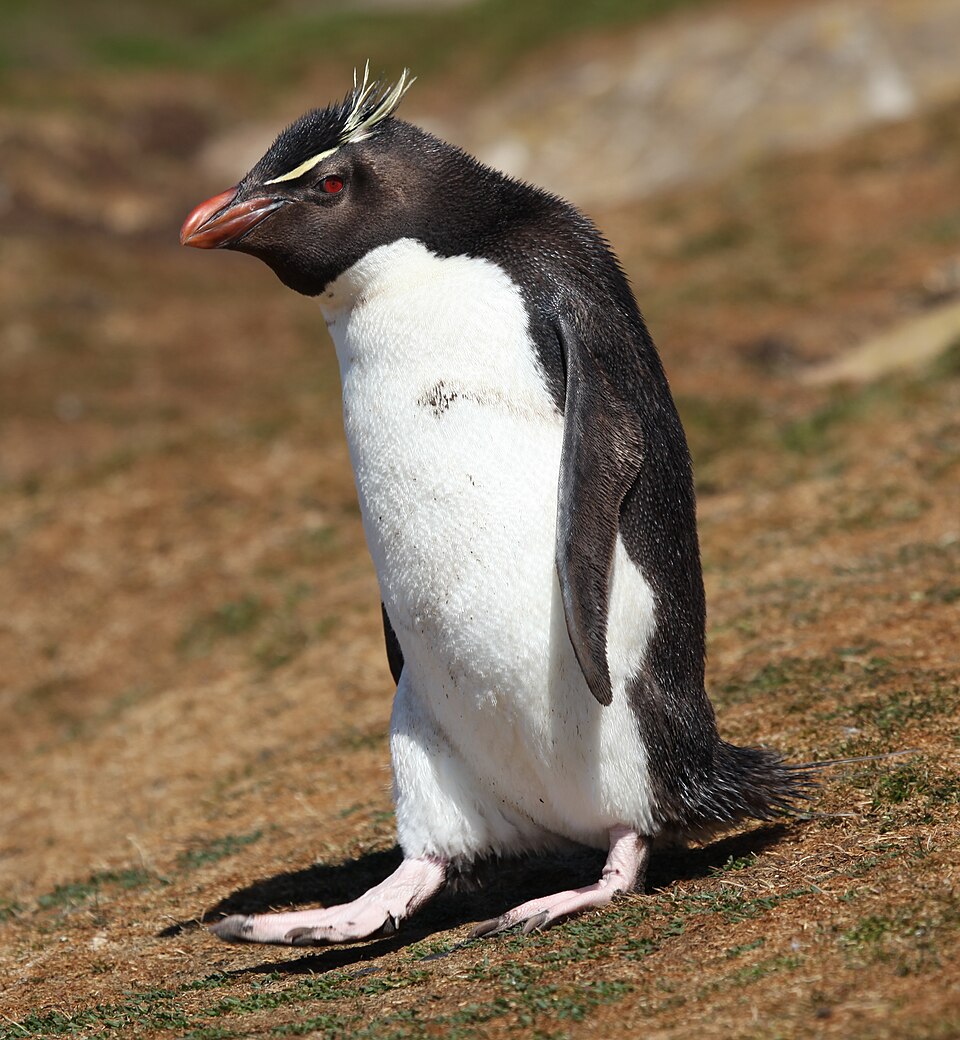
The Rockhopper Penguin (Eudyptes chrysocome) is a small penguin identified by its yellow crests and red eyes. It gets its name from the way it moves across rocks, leaping in bounds rather than walking. This species nests in dense colonies on the rocky coasts of subantarctic islands. An excellent swimmer, it spends most of the year at sea foraging for food. Its populations have declined sharply over the past few decades, making it one of the most threatened penguin species.
The plumage is black on the back and white on the belly, with bright yellow eyebrows extended by long tapered black feathers. The eyes are red and the bill is short, thick, and orange. Its small size and stocky build distinguish it from other rockhopper species.
Characteristics
Indicative values: they vary by subspecies, sex and region.
Habitat and distribution
The species nests on rocky coasts and cliffs of subantarctic islands, often in mixed colonies with other seabirds. It spends the rest of the year far out at sea, away from the coasts.
CURRENT RANGE
Rockhopper penguins breed on various islands in the Southern Hemisphere, particularly around South America and in the Southern Ocean. Outside the breeding season, they disperse widely at sea.
Behaviour
This bird is gregarious and forms large noisy colonies on cliffs and rocky slopes. It moves on land by hopping on both feet, from which its common name derives. At sea, it swims and dives with agility to catch its prey.
Reproduction
The clutch typically consists of two eggs, but usually only the second, which is larger, produces a viable chick. Both parents take turns incubating and feeding the young bird. Incubation lasts approximately one month, followed by a period of care in the nest before fledging.
Peculiarities
Its distinctive yellow crests and hopping mode of locomotion make it an easily recognisable species among penguins. It ranks among the smallest members of its family.
Threats and conservation
Climate change, industrial fishing reducing prey stocks, and marine pollution represent the main threats. Populations have experienced marked decline at several historical breeding sites.
Numbers and trends vary across sources and regions. See the IUCN assessment for the latest reference data.
Gallery
1 documented photographs.
References
Profile updated 08 September 2026 · Reviewed by the TunisieVet editorial team.
Comments (0)
No comments yet.
CONSERVATION STATUS
Vulnerable (VU)
IUCN source, latest published assessment.
Species health
Documented diseases for this species.
This information is provided for educational purposes only and is not a substitute for a veterinary consultation. If you have any concerns about your animal's health, consult a veterinarian.
Similar animals
Other species documented in Animalpedia.

TunisieVet in your pocket 📱🐾 Access your veterinary services wherever you are. [ Download the app ]
Learn more