
Presentation
The Fancy rat is a selected variant of the brown rat (Rattus norvegicus) that has been domesticated since the 19th century. Originally bred for rat fights and shows, it has become a popular pet and a major scientific research subject. Docile and sociable, it differs from the wild rat by its smaller size and its varied colors.
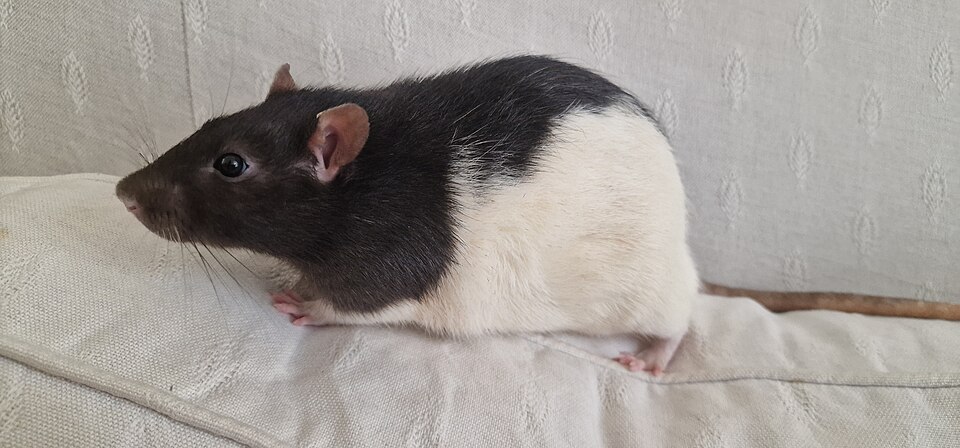
The Fancy rat has a slender body, a long, scaly tail, and small round ears. Its coat, which varies greatly, can be gray, white, black, beige or multi-colored depending on the breed. Its eyes are black, red or pink depending on the genetic mutation. Its pointed snout and sensitive vibrissae allow it excellent exploration.
Characteristics
Indicative values: they vary by subspecies, sex and region.
Habitat and distribution
Fancy rat is entirely dependent on humans and is only found in urban and domestic environments. In captivity, it usually lives in cages or specially designed enclosures with bedding, hiding places and enrichment. In the wild, its ancestors inhabit urban and agricultural areas.
CURRENT RANGE
Fancy rat only occurs freely in urban and peri-urban areas near human habitation. It does not occur naturally in Tunisia in the wild. Most populations of domestic rats are kept by humans in captivity around the world as pets or for scientific research.
Behaviour
The Fancy rat is intelligent, curious and very social. He lives better in groups and likes to interact with his peers and humans. He is active especially at night (nocturnal) and loves to explore and play. These rodents recognize their owner and can learn simple tricks.
Reproduction
Fancy rat reaches sexual maturity at around 8 to 12 weeks. Females have a short reproductive cycle of approximately 4 to 5 days. Gestation lasts about 21 to 23 days, and a female can produce 5 to 10 litters per year, each containing 6 to 12 young.
Peculiarities
The Fancy rat has a high learning capacity and adapts quickly to new environments. It has been used for more than a century in biomedical research, particularly in neurology and pharmacology. Its immune system, similar to that of humans, makes it a preferred animal model for scientific studies.
Threats and conservation
The Fancy rat in captivity does not face natural threats. However, populations maintained in the laboratory are entirely dependent on the conditions of care provided by humans. Escaped domestic rats may occasionally form feral colonies, but without human intervention they generally do not survive long.
Numbers and trends vary across sources and regions. See the IUCN assessment for the latest reference data.
Gallery
1 documented photographs.
References
Profile updated 27 August 2026 · Reviewed by the TunisieVet editorial team.
Comments (0)
No comments yet.
CONSERVATION STATUS
Not evaluated (NE)
IUCN source, latest published assessment.
Species health
Documented diseases for this species.
See the 4 diseases of this species Find a veterinarianThis information is provided for educational purposes only and is not a substitute for a veterinary consultation. If you have any concerns about your animal's health, consult a veterinarian.
Similar animals
Other species documented in Animalpedia.

TunisieVet in your pocket 📱🐾 Access your veterinary services wherever you are. [ Download the app ]
Learn more