
Presentation
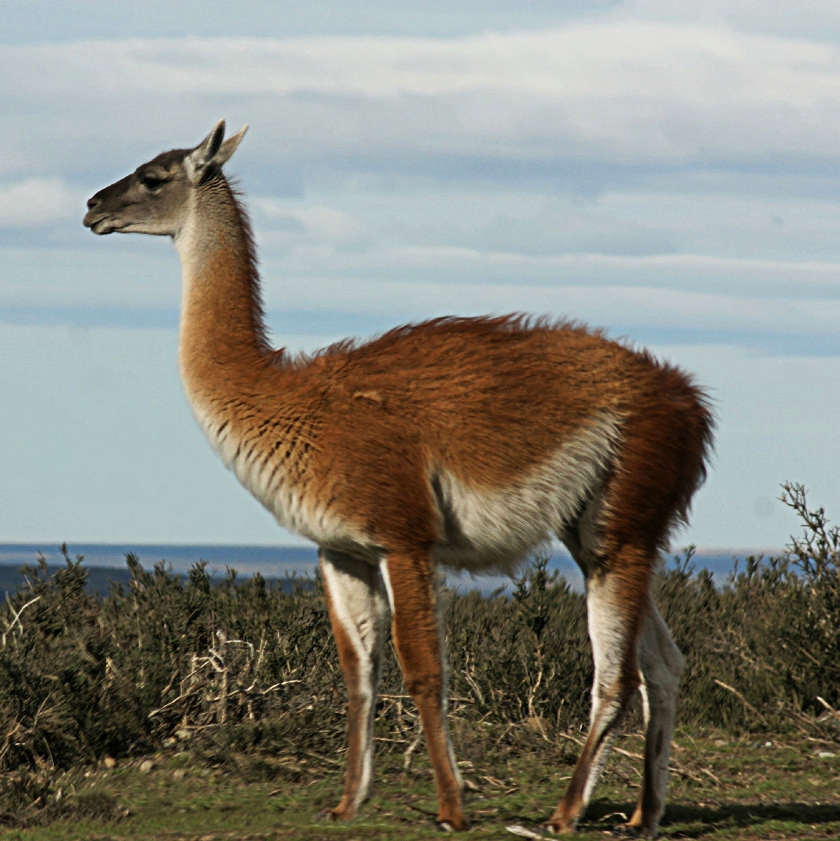
The Guanaco is a large South American camelid, wild ancestor of the domestic llama. It has a short and dense coat, reddish-brown on the back and white on the belly, adapted to strong temperature variations. Its long neck and slender limbs give it an elegant silhouette similar to that of other camelids. It lives in groups structured around a dominant male, females and their young, on the Andean highlands and steppes. An excellent walker, it occupies environments ranging from sea level to more than 4000 meters above sea level. This species remains widespread but locally threatened by hunting and competition with livestock.
The Guanaco has a long, thin neck, a small head with large movable ears and expressive eyes. Its legs are thin but robust, ending in pads adapted to rocky and arid terrain. Its thick coat protects it from both mountain cold and daytime heat.
Characteristics
Indicative values: they vary by subspecies, sex and region.
Habitat and distribution
The Guanaco frequents the steppes, arid plateaus and mountainous areas of the Andes and Patagonia. It tolerates extreme climates, from coastal desert to cold, windy highlands. Its ability to live at very high altitudes makes it one of the large mammals best adapted to harsh Andean conditions.
CURRENT RANGE
The species occurs in several South American countries, including Argentina, Chile, Peru, Bolivia and Paraguay. The largest populations are found in Argentine and Chilean Patagonia. Its range extends from sea level to the Andean highlands.
Behaviour
The species is social and lives in family groups led by a territorial male, accompanied by females and young. Young single males form separate troops until they can challenge a dominant male. The Guanaco is a diurnal, vigilant animal that emits high-pitched alarm calls in case of danger and can reach high speeds to escape predators.
Reproduction
The Guanaco female gives birth to a single calf after a gestation of approximately eleven months. The calf, called chulengo, stands and follows its mother shortly after birth. It is chased out of the family group by the dominant male as it approaches sexual maturity, generally before the age of one year.
Peculiarities
The Guanaco is the wild ancestor of the domestic llama, with which it shares many physiological characteristics. Its blood has large numbers of small red blood cells, an adaptation that facilitates the transport of oxygen at high altitudes. It can spit to repel a rival or an intruder, a behavior shared with other camelids.
Threats and conservation
The main threats are illegal hunting for meat and fiber, as well as competition with domestic livestock for pasture. Habitat fragmentation due to agricultural expansion and enclosures also limits its migratory movements. Some local populations have declined sharply despite a favorable overall conservation status.
Numbers and trends vary across sources and regions. See the IUCN assessment for the latest reference data.
Gallery
1 documented photographs.
References
Profile updated 20 August 2026 · Reviewed by the TunisieVet editorial team.
Comments (0)
No comments yet.
CONSERVATION STATUS
Least concern (LC)
IUCN source, latest published assessment.
Species health
Documented diseases for this species.
See the 8 diseases of this species Find a veterinarianThis information is provided for educational purposes only and is not a substitute for a veterinary consultation. If you have any concerns about your animal's health, consult a veterinarian.
To discover around: Guanaco
Videos, facts, stories and records linked to this species.
Similar animals
Other species documented in Animalpedia.

TunisieVet in your pocket 📱🐾 Access your veterinary services wherever you are. [ Download the app ]
Learn more