
Presentation
The Golden hamster is a small rodent belonging to the Cricetidae family, native to semi-arid regions of Syria. It is one of the most popular hamster species as a pet across the world, valued for its generally docile temperament and endearing appearance.
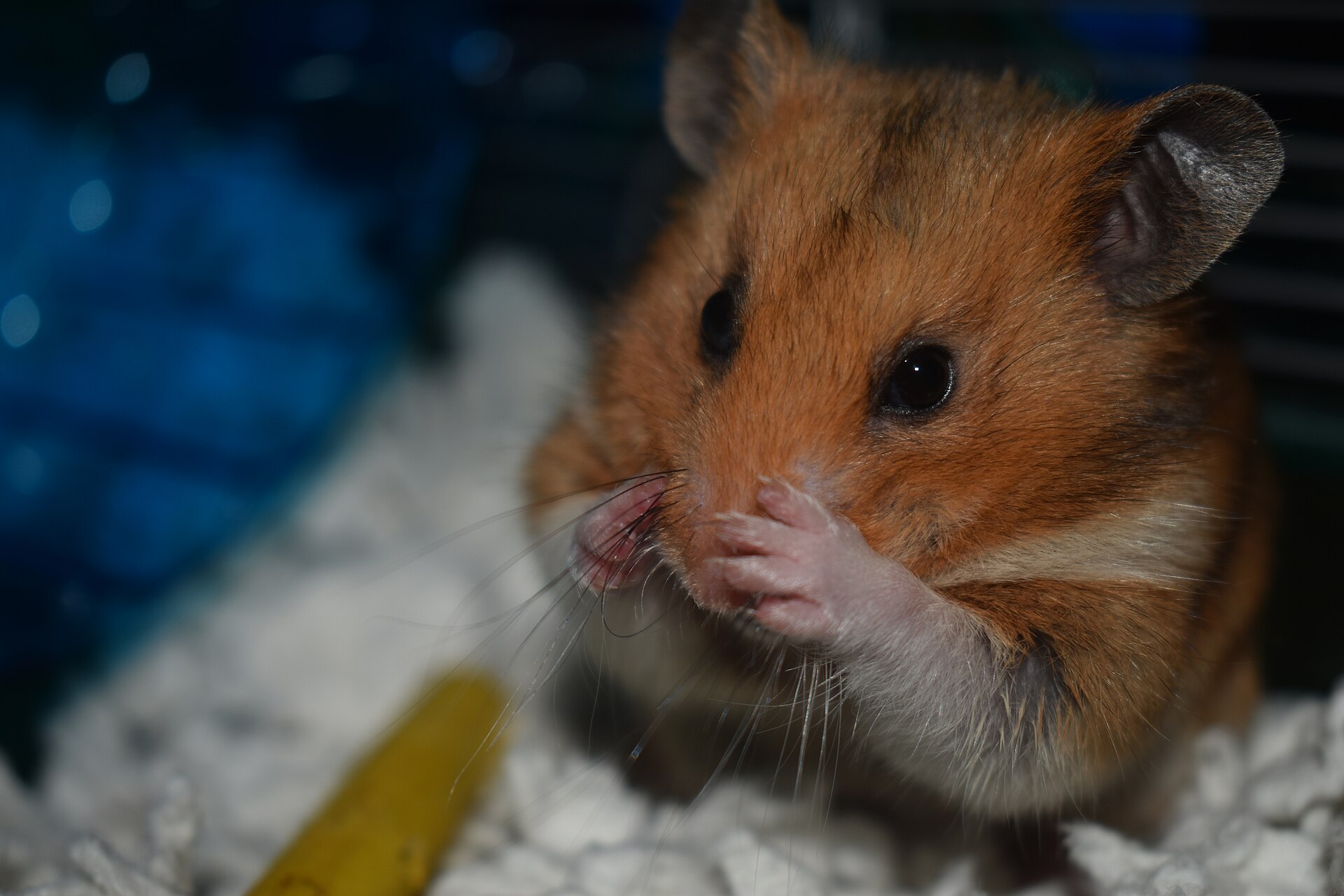
The Golden hamster has dense, short golden to reddish-brown fur, with a generally lighter underbelly. Its body is compact and rounded, with small rounded ears, shiny black eyes, and extendable cheeks that allow it to store food.
Characteristics
Indicative values: they vary by subspecies, sex and region.
Habitat and distribution
The Golden hamster is native to semi-arid regions of Syria where it inhabits urban and peri-urban environments. In its natural state, it digs burrows in the ground where it stores food. In captivity, it adapts easily to cages and designed enclosures.
CURRENT RANGE
Golden hamster is endemic to Syria, where its presence in the wild has been significantly reduced. All golden hamsters in captivity, including those raised as pets or in the laboratory, descend from a few individuals captured in 1930. The species is not present in Tunisia in the natural state.
Behaviour
The Golden hamster is mainly nocturnal and solitary by nature, particularly aggressive towards its conspecifics. It is generally curious and active, spending much of the night exploring, digging, and hoarding food in its cheeks to hide in its burrow.
Reproduction
Golden hamster reaches sexual maturity at approximately 6 to 8 weeks. Gestation lasts about 16 days, and females give birth to litters of 5 to 10 young. The young develop quickly and become independent after about 3 weeks.
Peculiarities
A notable feature of the Golden hamster is its ability to store large quantities of food in its expandable cheeks, being able to increase their volume up to three times the normal size. Current populations in captivity all come from a single founding population, making the species genetically homogeneous.
Threats and conservation
Golden hamster is currently classified as Endangered due to the massive destruction of its natural habitat in Syria and the near-total absence of viable populations in the wild. Armed conflicts and urbanization have seriously damaged the last natural habitats of the species.
Numbers and trends vary across sources and regions. See the IUCN assessment for the latest reference data.
Gallery
1 documented photographs.
References
UICN — Liste rouge des espèces menacées
Profile updated 03 September 2026 · Reviewed by the TunisieVet editorial team.
Comments (0)
No comments yet.
CONSERVATION STATUS
Endangered (EN)
IUCN source, latest published assessment.
Species health
Documented diseases for this species.
See the 4 diseases of this species Find a veterinarianThis information is provided for educational purposes only and is not a substitute for a veterinary consultation. If you have any concerns about your animal's health, consult a veterinarian.
Similar animals
Other species documented in Animalpedia.

TunisieVet in your pocket 📱🐾 Access your veterinary services wherever you are. [ Download the app ]
Learn more