
Presentation
The hellbender is a large aquatic salamander native to the eastern United States, remarkable for its impressive size and fully aquatic lifestyle. Its flattened body, wrinkled skin, and small head with tiny eyes give it a prehistoric appearance. This species breathes mainly through its ridged skin, which increases the surface area for gas exchange in water. It lives hidden under large stones in cold, clear, well-oxygenated streams. The hellbender is an excellent indicator of aquatic habitat quality—its presence signals clean, unpolluted water. Its populations are declining sharply due to habitat degradation.
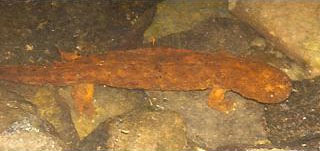
The hellbender has a massive, flattened body that can exceed 24 inches in length, making it one of the largest salamanders in the world. Its loose, wrinkled skin on the flanks serves as an additional respiratory surface. Coloration ranges from grayish-brown to reddish-brown, often blotched, providing effective camouflage among rocks. The legs are short and sturdy, adapted for life under stones in stream environments.
Characteristics
Indicative values: they vary by subspecies, sex and region.
Habitat and distribution
The hellbender lives exclusively in freshwater rivers and streams that are cold, clear, and well-oxygenated. It favors rocky substrates with large flat stones underneath which it can hide. Water quality is essential to its survival; turbid or polluted water is quickly fatal to it. This strict ecological requirement makes it a species highly sensitive to human disturbances.
CURRENT RANGE
The species is endemic to the eastern United States, where it occupies watersheds ranging from New York State in the north to Missouri and Georgia in the south. Its distribution follows mainly the waterways of the Appalachian Mountains and adjacent regions. Populations are fragmented and increasingly isolated from one another. No natural populations are found outside North America.
Behaviour
This animal is primarily nocturnal and solitary, spending most of the day hidden under flat stones. It is territorial, with each individual defending its particular shelter against others. Its movements remain restricted to a relatively limited area of the stream. The hellbender is not very active and conserves energy, which allows it to survive in cool waters that are poor in resources.
Reproduction
Breeding occurs in late summer or autumn, when males prepare nests beneath rocks. The female deposits several hundred eggs in string-like clusters, externally fertilized by the male. The male guards and protects the eggs until they hatch, several weeks later. Larvae possess external gills that they lose as they grow; the adult then becomes dependent on skin respiration.
Peculiarities
The hellbender lacks gills in adulthood and breathes almost exclusively through its skin, a rare trait among vertebrates of this size. Its English name wrongly evokes a reputation as a dangerous creature, yet it is completely harmless to humans. It is among the few giant salamanders still found outside Asia, alongside its Chinese and Japanese cousins.
Threats and conservation
Water pollution, excessive sedimentation, and dam construction severely degrade its natural habitat. Climate change alters the temperature and flow of the waterways on which the species depends. Illegal collection for the exotic pet trade and fungal diseases further worsen the decline of populations.
Numbers and trends vary across sources and regions. See the IUCN assessment for the latest reference data.
Gallery
1 documented photographs.
References
Profile updated 07 September 2026 · Reviewed by the TunisieVet editorial team.
Comments (0)
No comments yet.
CONSERVATION STATUS
Near threatened (NT)
IUCN source, latest published assessment.
Species health
Documented diseases for this species.
This information is provided for educational purposes only and is not a substitute for a veterinary consultation. If you have any concerns about your animal's health, consult a veterinarian.
To discover around: Hellbender
Videos, facts, stories and records linked to this species.
RECORD
up to 74 cm
One of the world's largest salamanders
Total length measured in the largest wild specimens recorded in the United States.
Similar animals
Other species documented in Animalpedia.

TunisieVet in your pocket 📱🐾 Access your veterinary services wherever you are. [ Download the app ]
Learn more