
Presentation
The Hake is an elongated marine fish of the Hakecciidae family, widely fished for its white flesh appreciated in the Mediterranean and the Atlantic. It is distinguished by a prominent jaw furnished with pointed teeth and a spindle-shaped body adapted to rapid swimming. This predator generally lives near the bottom, between the coastal zone and the deeper waters of the continental shelf. It constitutes a major fishing resource in Tunisia and throughout the Mediterranean basin. Its life cycle and vertical migrations make it a species studied for the sustainable management of fisheries.
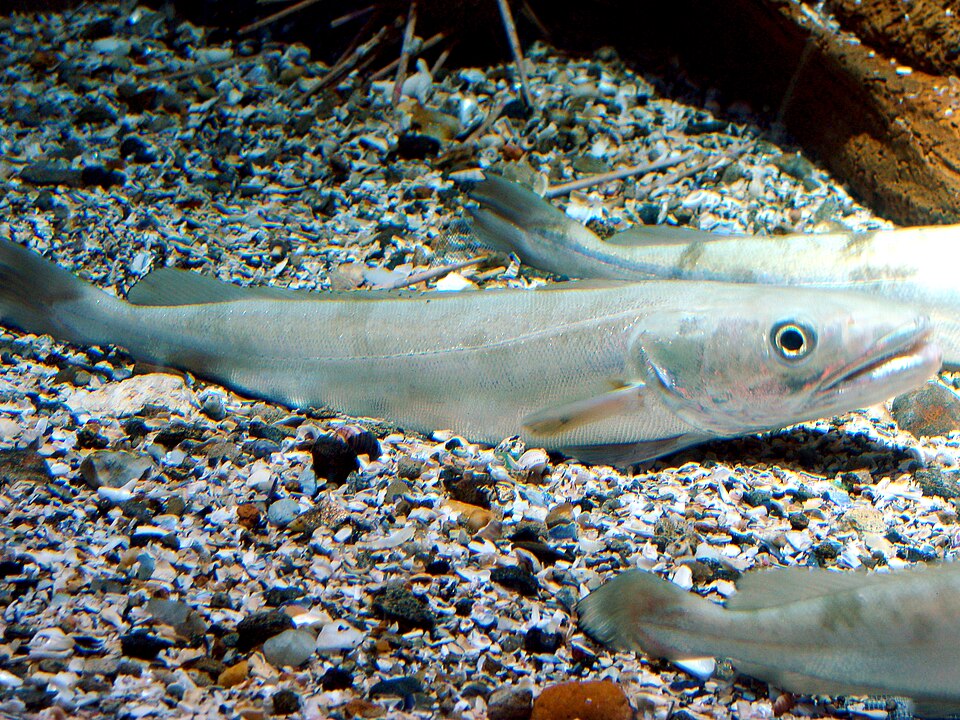
The Hake has an elongated, silvery body, a pointed head, and a large mouth armed with sharp teeth. Its dorsal fin is divided into two distinct parts, the second being long and low. Coloration varies from silvery gray on the sides to a darker, grey-brown to blackish back.
Characteristics
Indicative values: they vary by subspecies, sex and region.
Habitat and distribution
The Hake frequents the waters of the continental shelf and the slope, between around thirty and several hundred meters deep. Juveniles often occupy more coastal and shallower areas than adults. It appreciates soft, muddy or sandy bottoms, where it can hunt effectively. This species tolerates a wide range of temperatures depending on the regions it inhabits.
CURRENT RANGE
The European Hake is found in the Northeast Atlantic, from Norway to the coasts of North Africa, as well as throughout the Mediterranean Sea. It is particularly abundant on the Tunisian coasts, where it is subject to regular fishing. Other related species of Hakes exist in other regions of the world, including the Pacific and South Atlantic.
Behaviour
The Hake is a primarily demersal fish that performs daily vertical migrations, returning to the surface at night to feed. It generally lives in more or less dense groups depending on the areas and seasons. This species is active mainly at dusk and at night. It avoids bright light and takes refuge near the bottom during the day.
Reproduction
Breeding of Hake occurs mainly in spring and summer, with variations depending on regional populations. Females lay large numbers of pelagic eggs which drift with ocean currents. Sexual maturity is reached around two to three years old depending on the individual. The larvae and juveniles develop in open water before reaching the coastal depths.
Peculiarities
The Hake has a very long second dorsal fin and anal fin, almost continuous to the tail. Its widely slit mouth and inwardly curved teeth make it easier to capture fleeing prey. It is capable of significant vertical movements in the water column during the same day.
Threats and conservation
Overfishing constitutes the main threat to Hake populations, particularly in the Mediterranean where stocks are considered overexploited. The capture of juveniles before sexual maturity aggravates population declines. Some non-selective fishing practices also result in significant bycatch. Management measures, such as minimum catch sizes, attempt to limit these pressures.
Numbers and trends vary across sources and regions. See the IUCN assessment for the latest reference data.
Gallery
1 documented photographs.
References
Profile updated 29 August 2026 · Reviewed by the TunisieVet editorial team.
Comments (0)
No comments yet.
CONSERVATION STATUS
Near threatened (NT)
IUCN source, latest published assessment.
Species health
Documented diseases for this species.
See the 4 diseases of this species Find a veterinarianThis information is provided for educational purposes only and is not a substitute for a veterinary consultation. If you have any concerns about your animal's health, consult a veterinarian.
Similar animals
Other species documented in Animalpedia.

TunisieVet in your pocket 📱🐾 Access your veterinary services wherever you are. [ Download the app ]
Learn more