
Presentation
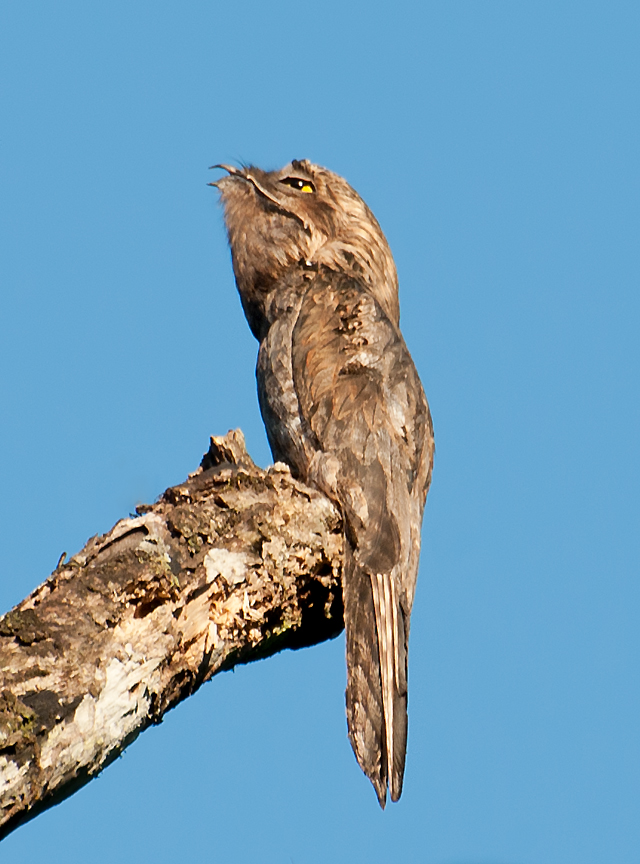
The gray potoo is a nocturnal bird of South and Central America belonging to the family Nyctibiidae. Its finely streaked brown-gray plumage gives it remarkable camouflage against the bark of trees where it perches motionless during the day. With large yellow eyes and a very short bill but a mouth that opens extremely wide, it catches prey in flight at dusk. This discreet solitary bird spends most of the day perched vertically on a stump or broken branch, a posture that enhances its concealment. Its nocturnal call, a series of plaintive descending notes, is heard far more often than the bird is seen. It builds no nest and lays its single egg directly in a cavity or hollow of bark.
The potoo measures between 33 and 38 cm in length with a modest wingspan suited to stealthy flight. Its cryptic plumage of brown, gray and black perfectly mimics bark and lichens. Its eyes, very large and sensitive to dim light, reflect an orange glow at night when illuminated. The mouth, disproportionately large compared to the head, facilitates the capture of flying insects in mid-flight.
Characteristics
Indicative values: they vary by subspecies, sex and region.
Habitat and distribution
The Potoo inhabits tropical forests, wooded edges, and areas of savanna woodland. It prefers environments offering natural perches such as dead trunks or bare branches. It is found in dense forest as well as semi-open areas near clearings.
CURRENT RANGE
The species is widely distributed across Central and South America, from Mexico to northern Argentina. It occupies a wide variety of wooded habitats throughout this vast territory. Its presence is generally discrete due to its camouflage and nocturnal habits.
Behaviour
Strictly nocturnal and crepuscular, the potoo remains completely motionless during the day, a cryptic posture that makes it nearly invisible to predators. It is solitary and territorial, pairing only during the breeding season. Its characteristic call, emitted mainly at dusk, serves to mark its territory and attract a mate. It avoids unnecessary movement during the day, thus conserving its energy for nocturnal activity.
Reproduction
The female lays a single egg directly on a broken branch or in a shallow depression in the bark, without building a nest. Both parents share incubation duties in turn, particularly at night. Once hatched, the chick quickly adopts an immobile posture similar to that of adults to blend in with its surroundings. Fledging occurs after several weeks of parental care.
Peculiarities
The Potoo's camouflage is so effective that it is often mistaken for a simple piece of dead wood. Its eyelids have small slits that allow it to maintain partial vigilance even when its eyes are closed during the day. This unique trait enables it to detect movements of potential predators without giving away its presence.
Threats and conservation
The species is not considered threatened globally, benefiting from a wide distribution range. Localized deforestation can, however, reduce the availability of suitable perches in some regions. No specific conservation measures are currently necessary.
Numbers and trends vary across sources and regions. See the IUCN assessment for the latest reference data.
Gallery
1 documented photographs.
References
Profile updated 04 September 2026 · Reviewed by the TunisieVet editorial team.
Comments (0)
No comments yet.
CONSERVATION STATUS
Least concern (LC)
IUCN source, latest published assessment.
Species health
Documented diseases for this species.
This information is provided for educational purposes only and is not a substitute for a veterinary consultation. If you have any concerns about your animal's health, consult a veterinarian.
Related species
Similar animals
Other species documented in Animalpedia.

TunisieVet in your pocket 📱🐾 Access your veterinary services wherever you are. [ Download the app ]
Learn more