
Presentation
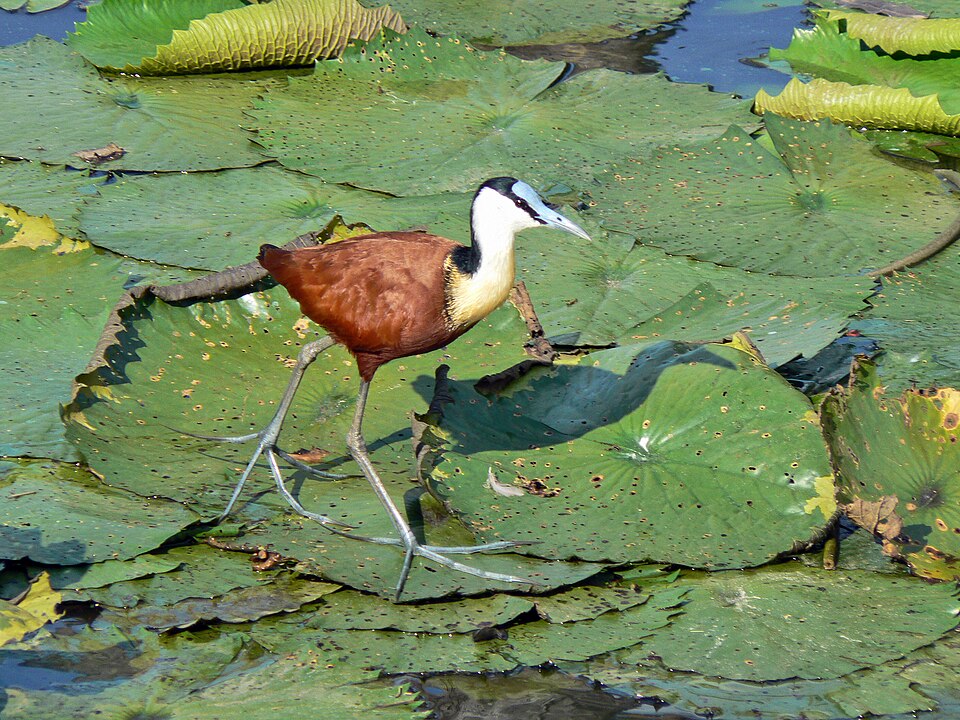
The African jacana is a wading bird characteristic of the wetlands of sub-Saharan Africa. It stands out for its reddish-brown plumage, its golden-yellow breast and neck, and its blue-black crown topped with a bluish frontal plate. Its disproportionately long and slender legs end in extremely elongated toes, adapted for walking on floating vegetation. This body structure has earned it the nickname of 'the bird that walks on water'. The species shows reversed sexual dimorphism, with females being larger and heavier than males. It lives in small groups on freshwater bodies rich in aquatic plants.
The African jacana has a compact body supported by very long slender legs. Its disproportionate toes and claws distribute its weight across floating leaves such as water lilies. The plumage combines brown, black and golden tones, with a bluish beak and frontal shield. The female is noticeably larger than the male, a rare characteristic among birds.
Characteristics
Indicative values: they vary by subspecies, sex and region.
Habitat and distribution
The African jacana inhabits lakes, ponds, marshes, and slow-moving rivers where floating vegetation is abundant. It particularly favours areas covered with water lilies and aquatic plants that provide a surface for movement. These habitats supply both food and nesting sites.
CURRENT RANGE
The species is widely distributed throughout sub-Saharan Africa, from Senegal to Ethiopia and southward to South Africa. It occupies most of the permanent wetlands in the region. It is absent from North Africa and does not occur in Tunisia.
Behaviour
The species is territorial and lives in a polyandrous system, with the female defending a territory that shelters several males. Each male incubates the eggs alone and raises the young without the female's help. Jacanas are active during the day, moving with agility across floating vegetation thanks to their long toes. They emit loud calls to defend their territory against intruders.
Reproduction
The female mates with several males in succession and lays eggs in each of their nests built on floating vegetation. The male alone incubates the eggs, a process lasting approximately three to four weeks. He sometimes carries chicks under his wings to protect them or move them to a new location. Young birds are nidifugous and capable of walking and swimming shortly after hatching.
Peculiarities
The reversal of sexual roles, with polyandrous females and males providing sole parental care, is a notable feature of this species. Its extremely elongated toes allow it to walk on floating leaves without sinking, a striking example of morphological adaptation to a specific habitat.
Threats and conservation
Habitat degradation and drying of wetlands, along with water pollution, represent the main threats to the species. It remains common throughout much of its range. No major global threats have been identified at present.
Numbers and trends vary across sources and regions. See the IUCN assessment for the latest reference data.
Gallery
1 documented photographs.
References
Profile updated 08 September 2026 · Reviewed by the TunisieVet editorial team.
Comments (0)
No comments yet.
CONSERVATION STATUS
Least concern (LC)
IUCN source, latest published assessment.
Species health
Documented diseases for this species.
This information is provided for educational purposes only and is not a substitute for a veterinary consultation. If you have any concerns about your animal's health, consult a veterinarian.
Similar animals
Other species documented in Animalpedia.

TunisieVet in your pocket 📱🐾 Access your veterinary services wherever you are. [ Download the app ]
Learn more