
Presentation
The jay (Garrulus glandarius), also known as the Eurasian jay, is a bird of the corvid family, widely distributed across Europe, North Africa, and temperate Asia. It is recognizable by its colorful plumage, blending russet-brown, white, and bright blue barred markings on the wings. A forest species, it is particularly associated with oak woodlands where it plays an important role in dispersing acorns. In Tunisia, it inhabits the wooded areas of the northern and central regions. It is an intelligent, opportunistic, and discreet bird, capable of adapting its diet according to the seasons.
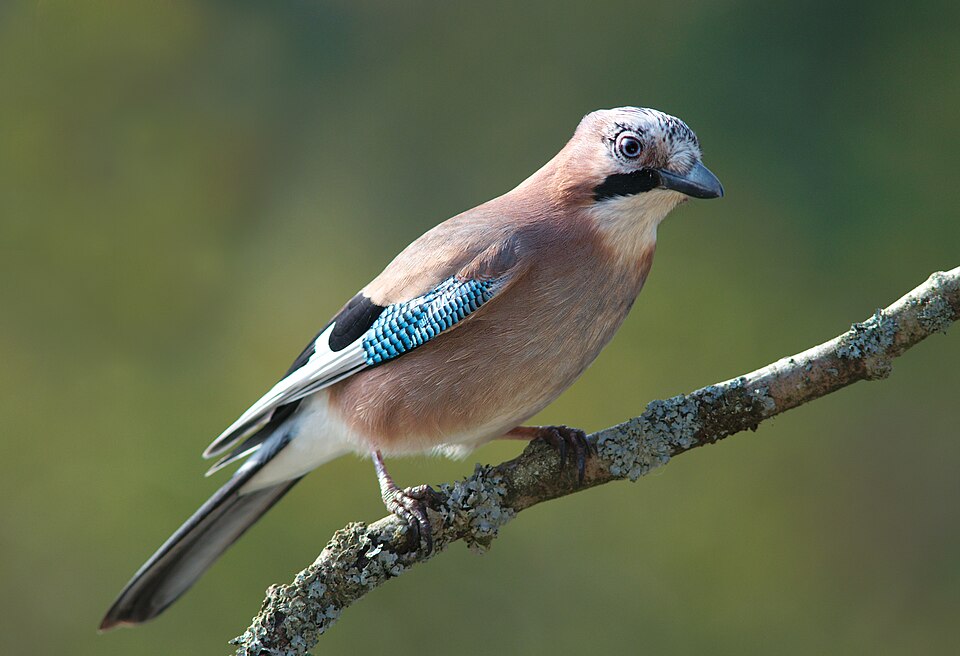
The Eurasian jay displays russet-brown plumage, black and white wings marked with characteristic barred blue, and a crown striped with black and white. Its tail is black and its white rump is clearly visible in flight. It has a medium size among corvids, with a sturdy bill suited to a varied diet.
Characteristics
Indicative values: they vary by subspecies, sex and region.
Habitat and distribution
The jay favors broadleaf forests, particularly oak woods, as well as mixed forests and mountain woodlands. It also frequents wooded parks and certain tree-lined gardens in urban fringes. In Tunisia, it is mainly found in the forested highlands of the north and wooded mountainous areas.
CURRENT RANGE
The species is found across most of Europe, North Africa including Tunisia, and temperate Asia extending to Japan. It occupies a wide variety of forested zones under temperate and Mediterranean climates. In Tunisia, it is localized primarily in the wooded regions of the northwest and Kroumirie.
Behaviour
The Eurasian jay is a lively and wary bird, often difficult to observe directly despite its characteristic harsh calls. It is renowned for its memory, particularly for relocating acorns it has buried in autumn. It can mimic sounds and calls of other birds, including raptors. Outside the breeding season, it typically lives in small family groups.
Reproduction
The breeding season spans from spring through early summer. The female typically lays 3 to 6 eggs in a nest built in a tree, often well concealed within the foliage. Incubation lasts approximately 16 to 19 days, and both parents participate in feeding the young until fledging.
Peculiarities
The jay is capable of burying thousands of acorns in a single season, of which it will recover only a portion, thereby promoting the natural dispersal of oaks. It occasionally mimics the call of the common buzzard, which may deceive other birds or observers.
Threats and conservation
The species is not globally threatened, though it is locally affected by deforestation and fragmentation of forest habitats. It may also be disturbed by human activities such as hunting or disturbance during the nesting period.
Numbers and trends vary across sources and regions. See the IUCN assessment for the latest reference data.
Gallery
1 documented photographs.
References
Profile updated 18 August 2026 · Reviewed by the TunisieVet editorial team.
Comments (0)
No comments yet.
CONSERVATION STATUS
Least concern (LC)
IUCN source, latest published assessment.
Species health
Documented diseases for this species.
See the 4 diseases of this species Find a veterinarianThis information is provided for educational purposes only and is not a substitute for a veterinary consultation. If you have any concerns about your animal's health, consult a veterinarian.
Similar animals
Other species documented in Animalpedia.
