
Presentation
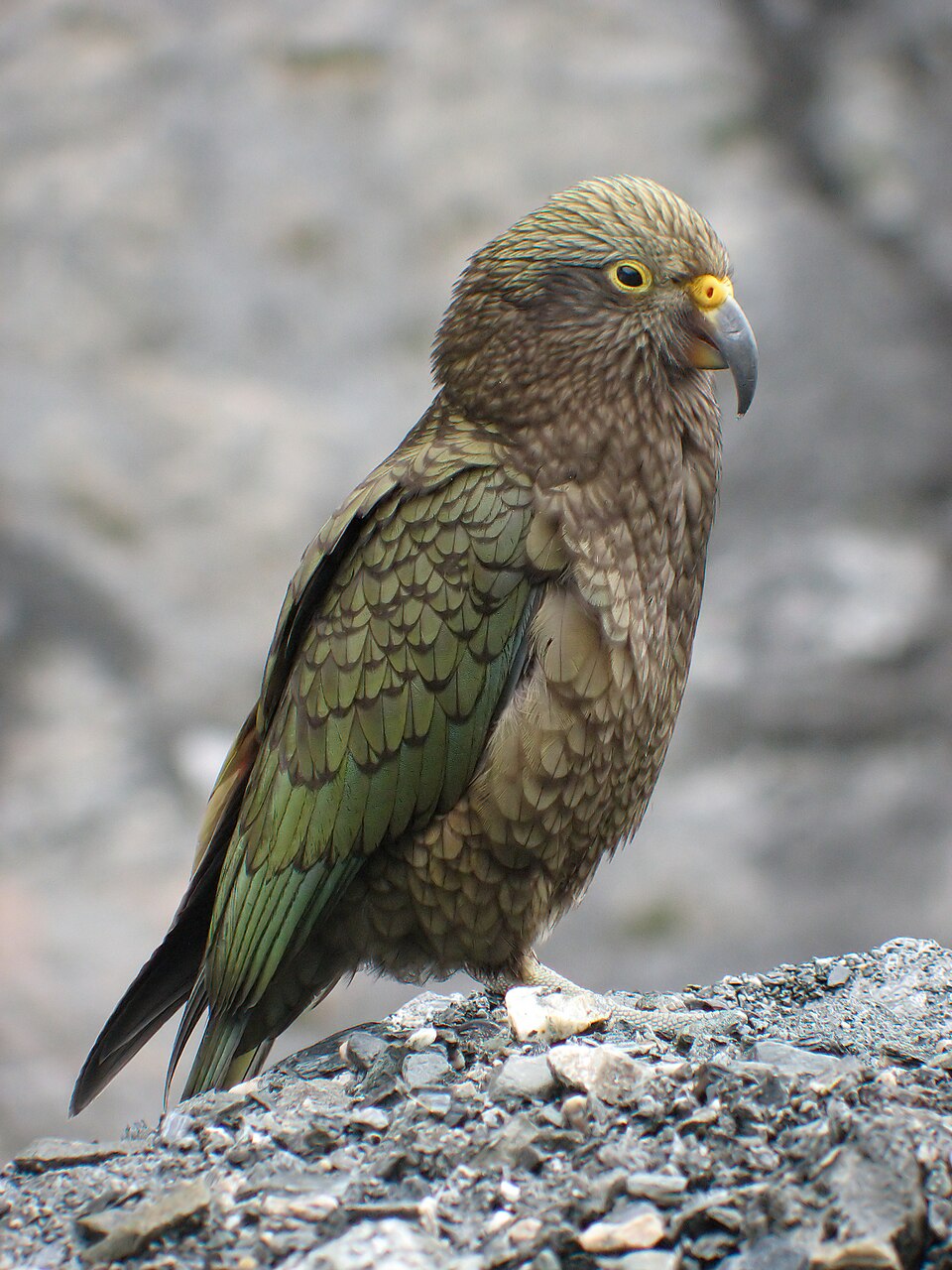
The kea is a parrot endemic to the mountains of the South Island of New Zealand. Recognizable by its olive green plumage and orange-red underwings, it is one of the rare parrots adapted to a cold, mountainous climate. Renowned for its remarkable intelligence, it is among the most curious and playful birds known. It lives in social groups and actively explores its environment, including human settlements. Its long, curved bill allows it to search the ground, bark and waste in search of food.
The kea measures approximately 48 cm long and weighs approximately 900 grams. Its plumage is mainly dark olive green, with bluish highlights on the wings and a bright orange-red underwing visible in flight. Its black bill, long and strongly hooked, is adapted both for feeding and for manipulating objects. The legs are gray and sturdy, with powerful claws.
Characteristics
Indicative values: they vary by subspecies, sex and region.
Habitat and distribution
The kea frequents montane and alpine areas of the South Island, from high altitude forests to rocky grasslands above the treeline. It tolerates harsh weather conditions, including snow, making it a unique cold-adapted parrot. It is also found near inhabited areas and ski resorts where human presence provides accessible food sources.
CURRENT RANGE
The species is endemic to the South Island of New Zealand, where it mainly occupies the mountain ranges of the New Zealand Alps. Its population is today fragmented and restricted compared to its historical range. It is not found anywhere else in the wild.
Behaviour
The kea is a very social bird, living in groups which can number several dozen individuals. It is considered one of the most intelligent birds in the world, capable of solving complex problems and using rudimentary tools. He displays marked playful behavior, playing alone or in groups, including with manufactured objects. His curiosity sometimes leads him to damage human equipment such as the rubber seals of cars.
Reproduction
The breeding season extends from July to January. The female generally lays 2 to 4 eggs in a nest installed in a rock cavity, crevice or under roots. Incubation lasts approximately 21 to 28 days and only the female incubates, fed by the male. The young become independent several months after fledging, with sexual maturity reached around 3 to 4 years of age.
Peculiarities
The kea is one of the only parrots in the world adapted to a cold and snowy alpine environment. It shares a common ancestor with the kākā, another New Zealand parrot, and belongs to a particularly ancient lineage of parrots. Its ability to manipulate objects and cooperate to solve tasks has been the subject of numerous scientific studies on avian cognition.
Threats and conservation
Historically hunted because it was considered harmful to sheep livestock, the kea saw its population greatly reduced in the 20th century. It remains threatened by introduced predators such as rats, stoats and opossums which destroy ground nests. Accidental poisoning from bait intended for other pests and collisions with human infrastructure remain persistent threats.
Numbers and trends vary across sources and regions. See the IUCN assessment for the latest reference data.
Gallery
1 documented photographs.
References
Profile updated 19 August 2026 · Reviewed by the TunisieVet editorial team.
Comments (0)
No comments yet.
CONSERVATION STATUS
Endangered (EN)
IUCN source, latest published assessment.
Species health
Documented diseases for this species.
See the 8 diseases of this species Find a veterinarianThis information is provided for educational purposes only and is not a substitute for a veterinary consultation. If you have any concerns about your animal's health, consult a veterinarian.
To discover around: Kea
Videos, facts, stories and records linked to this species.
RECORD
Unique species
The only alpine parrot
The kea is recognized as the only parrot in the world living in an alpine environment and...
Similar animals
Other species documented in Animalpedia.

TunisieVet in your pocket 📱🐾 Access your veterinary services wherever you are. [ Download the app ]
Learn more