
Presentation
The Raccoon dog (Nyctereutes procyonoides) is a canid native to East Asia, often confused with the raccoon due to its characteristic facial mask. Introduced into Europe in the 20th century for fur farming, the species has become widely naturalized there and considered invasive in several countries. It is an omnivorous and opportunistic animal, capable of adapting to varied environments, from forests to wetlands. It has the rare characteristic among canids of entering into semi-hibernation during the winter. The species is not present in Tunisia or North Africa.
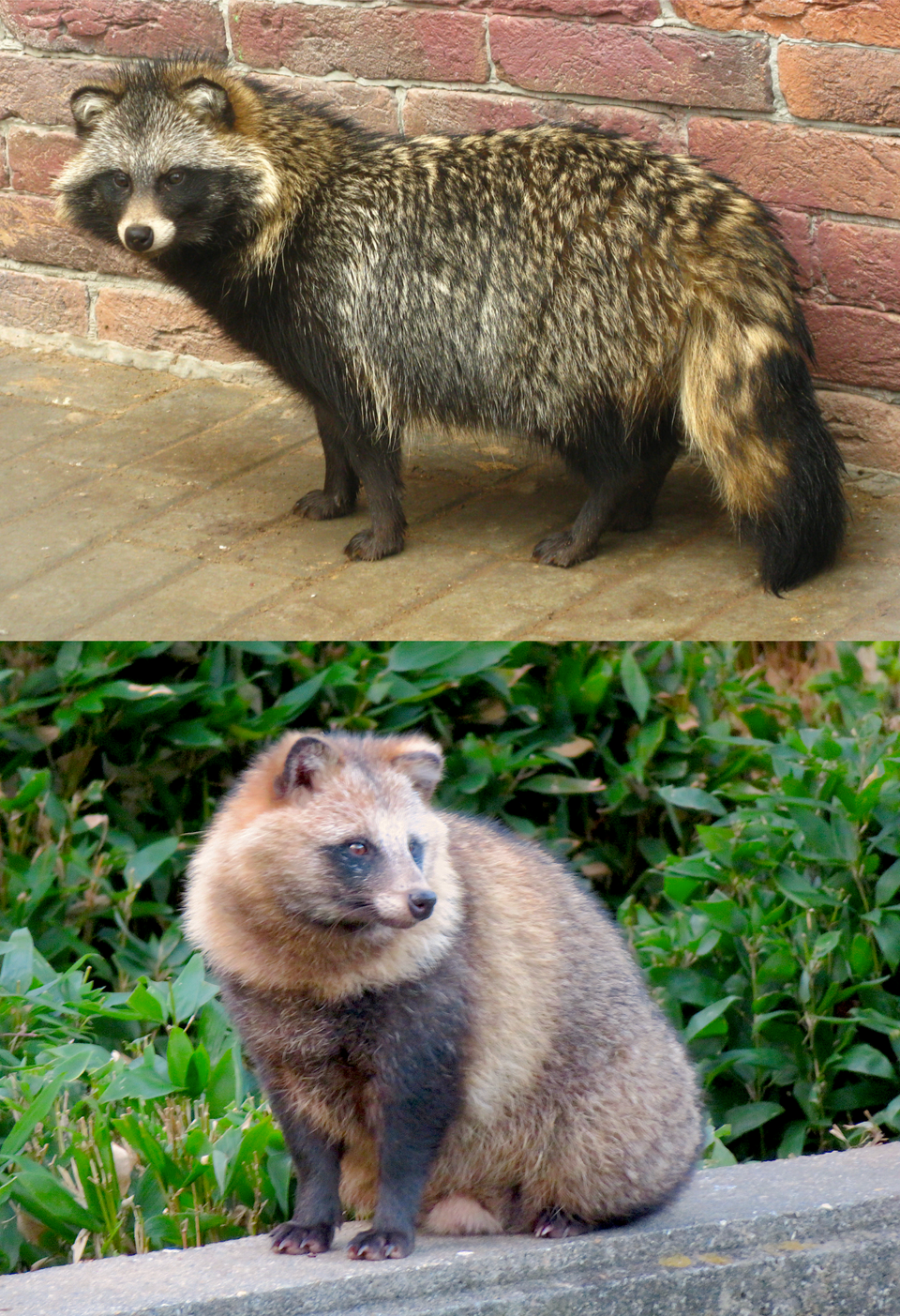
The Raccoon dog has a stocky body, short legs and a dark facial mask reminiscent of a raccoon, hence its vernacular name. Its coat is dense, gray-brown to reddish-brown, particularly thick in winter. The tail is short and bushy, without rings unlike the true raccoon. Its general silhouette remains close to that of a small, stocky fox.
Characteristics
Indicative values: they vary by subspecies, sex and region.
Habitat and distribution
The Raccoon dog frequents mixed forests, wetlands, the edges of rivers and lakes as well as meadows. It appreciates environments offering dense vegetation for shelter and proximity to water. It can also approach agricultural and peri-urban areas in search of food.
CURRENT RANGE
The species is native to East Asia, including China, Korea, Japan and eastern Russia. Introduced intentionally into the European Soviet Union in the 20th century for fur, it later spread to many countries in Central, Northern and Eastern Europe. It is today considered an invasive exotic species on the European continent.
Behaviour
The Raccoon dog is active mainly at dusk and night, although it can be diurnal depending on the seasons and food availability. It lives alone or in pairs and does not form packs like other canines. It is one of the few canid species to partially hibernate in cold regions, accumulating fat reserves in the fall. It communicates through discreet vocalizations and marks its territory with collective fecal deposits.
Reproduction
Reproduction takes place once a year, usually in spring, after a gestation of approximately 60 to 65 days. The female gives birth in a burrow of 6 to 8 young on average. Both parents participate in raising the young, which become independent after a few months.
Peculiarities
The Raccoon dog is one of the rare canids capable of partially hibernating during the winter. Its dark facial mask causes it to be frequently confused with raccoons, although the two species are not related. In Japanese culture, he is associated with the legendary figure of the “tanuki”.
Threats and conservation
In its introduced area in Europe, the species is itself perceived as a threat to local fauna and is the subject of regulatory measures. In its native range, it suffers from hunting for fur and loss of habitat. It is also vulnerable to communicable diseases such as rabies and scabies.
Numbers and trends vary across sources and regions. See the IUCN assessment for the latest reference data.
Gallery
1 documented photographs.
References
Profile updated 25 August 2026 · Reviewed by the TunisieVet editorial team.
Comments (0)
No comments yet.
CONSERVATION STATUS
Least concern (LC)
IUCN source, latest published assessment.
Species health
Documented diseases for this species.
See the 7 diseases of this species Find a veterinarianThis information is provided for educational purposes only and is not a substitute for a veterinary consultation. If you have any concerns about your animal's health, consult a veterinarian.
Related species
To discover around: Raccoon dog
Videos, facts, stories and records linked to this species.
Similar animals
Other species documented in Animalpedia.
