
Presentation
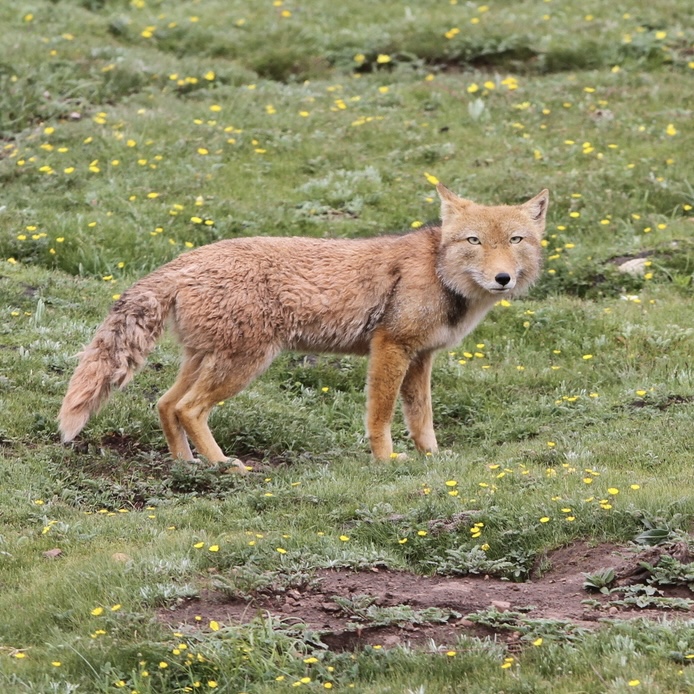
The Tibetan fox is a small canid characteristic of the central Asian highlands. It is distinguished by a square and massive head, a narrow muzzle and oblique eyes giving a particular expression. Its thick coat, gray-yellow on the back and lighter on the sides, effectively insulates it from the extreme cold of its habitat. The tail, bushy and ending with a white tip, represents almost half of the total length of the animal. This fox leads a discreet and solitary life or in pairs, mainly active during the day. It remains little studied due to its remote and difficult-to-access habitat.
The species has a stocky body, short legs and an unusually square head for a fox. The dense, double-layered coat protects against the freezing temperatures of the Tibetan Plateau. Coloration varies from reddish gray above to a pale gray almost white on the sides and belly, creating a sharp contrast.
Characteristics
Indicative values: they vary by subspecies, sex and region.
Habitat and distribution
The Tibetan fox lives on high plateaus and steppes at altitude, often between 3000 and 5300 meters. It frequents open, arid and rocky areas, devoid of dense plant cover. This extreme environment requires physiological adaptations to the cold and the scarcity of resources.
CURRENT RANGE
The species is endemic to the Tibetan Plateau and adjacent mountainous regions. It is found in China, Nepal, India (Ladakh, Sikkim) and Bhutan. Its distribution closely follows that of its high-altitude habitat and its main prey.
Behaviour
This species is rather solitary but can also be observed in pairs or small temporary family groups. It often hunts in discreet association with Pallas's cat or golden eagle, taking advantage of the same prey. The Tibetan fox is territorial and marks its domain with deposits of urine and feces. It digs or reuses burrows to rest and raise its young.
Reproduction
Breeding takes place once a year, usually between February and March. After a gestation of about two months, the female gives birth to two to five young in a burrow. The young are raised by both parents and become independent after a few months.
Peculiarities
The square and massive shape of its head, unique among foxes, gives it an easily recognizable appearance. Its narrow, oblique eyes reinforce this distinctive look. The species maintains notable ecological interactions with the Pallas's cat, with which it shares territory and prey.
Threats and conservation
The main threats include habitat degradation linked to overgrazing and campaigns to poison pikas, considered harmful by some breeders. Climate change also affects prey availability on the Tibetan Plateau. Hunting for fur remains a localized but existing pressure.
Numbers and trends vary across sources and regions. See the IUCN assessment for the latest reference data.
Gallery
1 documented photographs.
References
Profile updated 19 August 2026 · Reviewed by the TunisieVet editorial team.
Comments (0)
No comments yet.
CONSERVATION STATUS
Least concern (LC)
IUCN source, latest published assessment.
Species health
Documented diseases for this species.
See the 7 diseases of this species Find a veterinarianThis information is provided for educational purposes only and is not a substitute for a veterinary consultation. If you have any concerns about your animal's health, consult a veterinarian.
Related species
To discover around: Tibetan fox
Videos, facts, stories and records linked to this species.
Similar animals
Other species documented in Animalpedia.

TunisieVet in your pocket 📱🐾 Access your veterinary services wherever you are. [ Download the app ]
Learn more