Presentation
The kouprey is a wild bovine native to Southeast Asia, considered one of the world's rarest and most endangered large mammal species. First scientifically described in 1937 in Cambodia, it has not been reliably observed since the 1980s due to warfare and intensive poaching across its range. This wild bovine is distinguished by its characteristic spiralling horns in males and a pronounced dewlap hanging beneath the neck. It once inhabited open forests and wooded savannas of Cambodia, Laos, Thailand and Vietnam. Its current status remains uncertain, with some experts considering it functionally extinct in the wild. There is no known or documented captive breeding programme in existence to date.
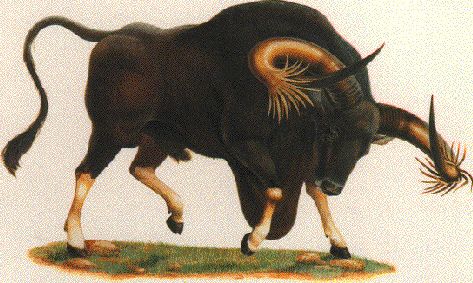
The kouprey is a large wild bovine with a massive body and long slender legs. Adult males develop a skin dewlap hanging beneath the throat and impressive horns that become increasingly fibrous and frayed at the tips with age. Coat colour ranges from dark grey to dark brown in older males, whilst females and young animals display a lighter grey-brown coat. The hooves are broad, well adapted to the sometimes muddy terrain of tropical forests.
Characteristics
Indicative values: they vary by subspecies, sex and region.
Habitat and distribution
The kouprey inhabited open deciduous forests and wooded savannas interspersed with grassy clearings. It favored areas near water sources, particularly during the dry season, as well as gently rolling terrain. These habitats provided forest cover for resting and open spaces for grazing. Deforestation and land conversion have considerably reduced these environments over the course of the twentieth century.
CURRENT RANGE
The historical range of the kouprey extended across northern Cambodia, southern Laos, western Vietnam, and eastern Thailand. The most recent documented observations date from the late 1960s and early 1980s, primarily in Cambodia. Prolonged armed conflicts in the region severely limited research opportunities and confirmation of its presence. No viable population has been formally located for several decades.
Behaviour
The kouprey lives in small herds of around twenty individuals, led by an older female who directs the group's movements. Adult males may be solitary or form bachelor groups outside the breeding season. The species is shy and avoids human contact, which makes direct observation extremely rare. Herds move between forests and clearings according to season, seeking out grazing pasture and water sources.
Reproduction
The female gives birth to a single calf after a gestation period of approximately nine months. The calving season is thought to occur at the start of the rainy season, which ensures access to abundant vegetation for nursing. The young remains with its mother for several months before becoming fully integrated into the herd. The precise details of reproduction remain poorly documented due to insufficient observations in the wild.
Peculiarities
The kouprey is sometimes called the 'ghost ox' because of the very small number of confirmed sightings and its uncertain status. Older males develop horns whose tips fray into fibers, a rare trait among bovids. The species was discovered relatively late by Western science, not until 1937, making it one of the last major mammal discoveries of the twentieth century.
Threats and conservation
The kouprey was decimated by intensive hunting, prolonged armed conflicts in Southeast Asia, and destruction of its forest habitat. Landmines left over from regional wars also limited researchers' access to its last potential refuges. Forest fragmentation and conversion of land to agricultural areas have finished reducing its available habitats. The species is considered by several experts to be probably extinct in the wild.
Numbers and trends vary across sources and regions. See the IUCN assessment for the latest reference data.
Gallery
1 documented photographs.
References
Profile updated 04 September 2026 · Reviewed by the TunisieVet editorial team.
Comments (0)
No comments yet.
CONSERVATION STATUS
Critically endangered (CR)
IUCN source, latest published assessment.
Species health
Documented diseases for this species.
See the 4 diseases of this species Find a veterinarianThis information is provided for educational purposes only and is not a substitute for a veterinary consultation. If you have any concerns about your animal's health, consult a veterinarian.
Similar animals
Other species documented in Animalpedia.

Be among the first to use our app. Sign up and get early Google Play access.
Discover