Presentation
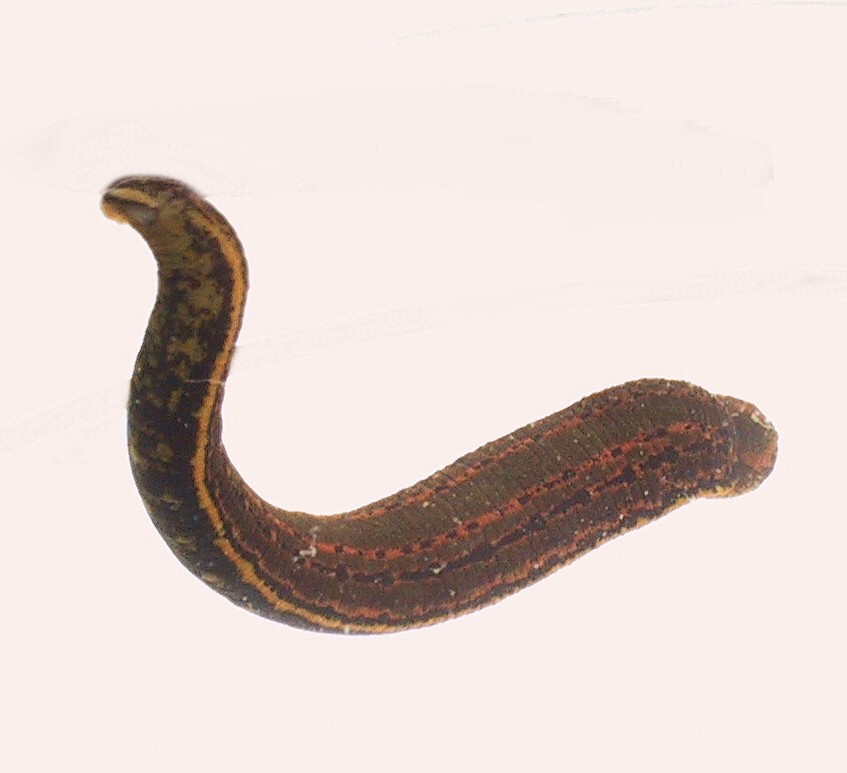
The leech is a segmented aquatic worm belonging to the class Clitellata, known for its ability to feed on the blood of other animals. Its soft, segmented, and extensible body bears a sucker at each end, allowing it to attach and move about. It lives primarily in calm fresh waters such as ponds, marshes, and ditches. Used since ancient times in traditional medicine for bloodletting, it possesses saliva containing anticoagulant substances. Today, certain species are still employed in modern medicine to promote blood microcirculation after certain surgical procedures. However, it remains little known to the general public, which often mistakenly associates it solely with a repulsive image.
The leech's body is elongated, flattened, and segmented, generally measuring between 5 and 15 cm depending on the species. It has two suckers, one anterior around the mouth and one posterior, used for attachment and locomotion. Its skin is smooth, often brownish or greenish with patterns, and secretes a protective mucus. Unlike earthworms, it has no visible external bristles.
Characteristics
Indicative values: they vary by subspecies, sex and region.
Habitat and distribution
The leech favors still or slow-flowing freshwater environments such as ponds, marshes, wetlands, and ditches rich in vegetation. Some species tolerate slightly brackish waters near coastal areas. It requires a permanently humid environment to survive, as desiccation is fatal. Its presence is often an indicator of still-preserved wetland zones.
CURRENT RANGE
Leeches are found on nearly all continents except polar regions, in temperate and tropical wetland zones. The medicinal leech is particularly widespread in Europe, North Africa, and western Asia. It was long overharvested for medical use, leading to marked decline in certain historical regions.
Behaviour
The leech is a rather discrete animal, active mainly during the search for food, which it detects through vibrations and the body heat of potential hosts. It moves with undulating motions or by alternating the attachment of its two suckers, somewhat like a measuring worm. Outside of feeding periods, it remains hidden under stones, in mud, or among aquatic vegetation. It can survive long periods without eating, adopting an energy-efficient lifestyle.
Reproduction
The leech is hermaphroditic but typically practices cross-fertilization between two individuals. After mating, it produces a cocoon containing several eggs, laid on a moist surface near water or in mud. Juveniles hatch after several weeks and resemble miniature adults, without passing through a distinct larval stage. Sexual maturity is reached after several months to a few years depending on environmental conditions.
Peculiarities
The leech possesses complex saliva containing hirudin, a powerful anticoagulant still studied today in pharmacology. It is capable of ingesting an amount of blood several times its own body weight in a single meal. Its medical use, hirudotherapy, is experiencing renewed interest in modern reconstructive surgery.
Threats and conservation
The destruction of wetland habitats and pollution of freshwater threaten natural leech populations. Historical overcollection for medical use also contributed to the decline of certain species, including the medicinal leech. These pressures led to regulated protection measures in several European countries.
Numbers and trends vary across sources and regions. See the IUCN assessment for the latest reference data.
Gallery
1 documented photographs.
References
Profile updated 31 August 2026 · Reviewed by the TunisieVet editorial team.
Comments (0)
No comments yet.
CONSERVATION STATUS
Near threatened (NT)
IUCN source, latest published assessment.
Species health
Documented diseases for this species.
Find a veterinarianThis information is provided for educational purposes only and is not a substitute for a veterinary consultation. If you have any concerns about your animal's health, consult a veterinarian.
To discover around: Leech
Videos, facts, stories and records linked to this species.
Similar animals
Other species documented in Animalpedia.

Be among the first to use our app. Sign up and get early Google Play access.
Discover