Presentation
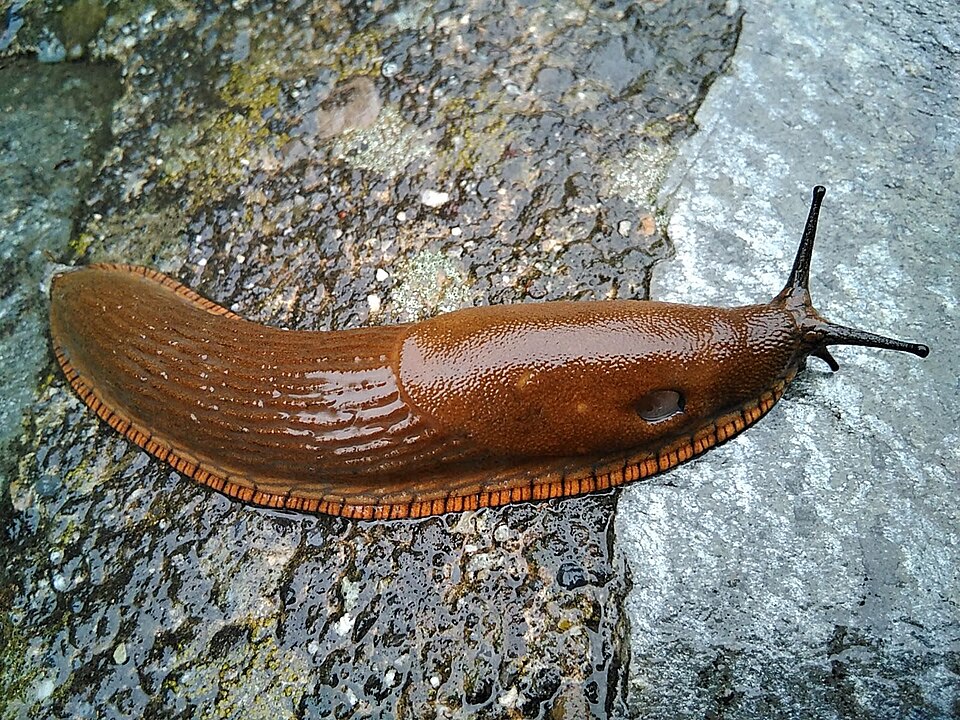
The slug is a land-dwelling gastropod mollusk with no visible external shell, or with a very small internal shell depending on the species. Its soft, elongated body is covered with mucus, a secretion that enables it to move and reduces water loss. Slugs are commonly found in gardens, vegetable patches, forests, and damp areas around the world. Most active at night or in humid weather, they hide during the day under stones, dead leaves, or in the soil. Many species exist, varying in size, color, and diet. Slugs play an important ecological role in the breakdown of organic matter.
The slug's body is soft, stretchable, and covered in protective mucus. It has two pairs of retractable tentacles on its head; the upper pair bears the eyes, while the lower pair serves for smell and touch. Its skin is permeable, making it very sensitive to drying out. Coloration varies from gray to brown, orange, or black depending on the species.
Characteristics
Indicative values: they vary by subspecies, sex and region.
Habitat and distribution
Slugs favor moist, shaded environments such as gardens, vegetable patches, forests, and grasslands. They are also common in cultivated areas and urban green spaces where soil moisture supports their survival. They avoid dry, exposed habitats, except during dormant periods when they burrow into the soil.
CURRENT RANGE
Slugs are found on nearly every continent except polar regions. They are particularly abundant in Europe, North America, and the Mediterranean basin, including North Africa. Some species have been accidentally introduced through horticultural trade outside their native range.
Behaviour
The slug is mainly nocturnal and crepuscular, most active in humid or rainy conditions. It moves slowly by means of muscular contractions of its foot, gliding along a trail of mucus. During dry or cold periods, it burrows into the soil or hides to limit water loss and enters dormancy. It is a solitary animal with no complex social behavior.
Reproduction
Slugs are hermaphroditic, with each individual possessing both male and female reproductive organs. Fertilization most often occurs through mating between two partners, though self-fertilization is possible in some species. After mating, slugs lay gelatinous eggs clustered in moist soil or beneath debris. Development is direct, with no larval stage; young slugs resemble miniature adults.
Peculiarities
Slugs can regenerate portions of their body following minor injuries. Their mucus, beyond facilitating movement, contains antibacterial properties that protect them from infection. Some species can enter dormancy for several months during dry periods.
Threats and conservation
Slugs are generally considered pests by gardeners and farmers, leading to the use of molluscicides for control. They are not subject to any specific conservation measures, as most common species are abundant. Natural predators such as hedgehogs, birds, and ground beetles help keep populations in check.
Numbers and trends vary across sources and regions. See the IUCN assessment for the latest reference data.
Gallery
1 documented photographs.
References
Profile updated 30 August 2026 · Reviewed by the TunisieVet editorial team.
Comments (0)
No comments yet.
CONSERVATION STATUS
Least concern (LC)
IUCN source, latest published assessment.
Species health
Documented diseases for this species.
Find a veterinarianThis information is provided for educational purposes only and is not a substitute for a veterinary consultation. If you have any concerns about your animal's health, consult a veterinarian.
To discover around: Slug
Videos, facts, stories and records linked to this species.
Similar animals
Other species documented in Animalpedia.

Be among the first to use our app. Sign up and get early Google Play access.
Discover