
Presentation
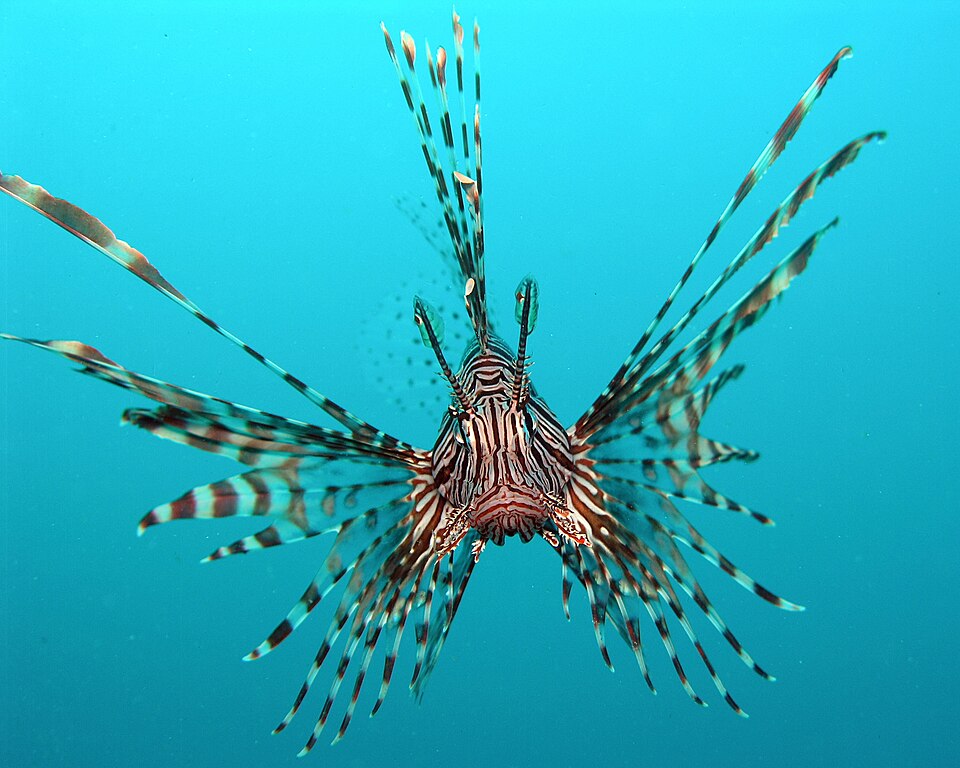
The Lionfish is a venomous marine fish recognizable by its long fan-shaped fins striped in red, white and brown. Originally from the Indo-Pacific, it has colonized the Mediterranean Sea and the Caribbean where it is considered a formidable invasive species. Its spiny fins contain a powerful venom used to defend against predators. An opportunistic nocturnal predator, it hunts small fish and crustaceans by cornering them with its outstretched fins. Its proliferation outside its original area threatens the balance of reef ecosystems.
The body is decorated with red, brown or black vertical stripes alternating with white. The pectoral and dorsal fins are long, fan-shaped and carry venomous spines. The head has fleshy appendages above the eyes and mouth. Size generally varies between 30 and 40 cm as adults.
Characteristics
Indicative values: they vary by subspecies, sex and region.
Habitat and distribution
The Lionfish frequents coral reefs, lagoons and coastal rocky areas. It tolerates a wide range of depths, from the surface to over 50 meters. It appreciates shelters such as crevices and wrecks where it hides during the day.
CURRENT RANGE
Native to the Indo-Pacific, it naturally extends from the African coasts of the Indian Ocean to the Western Pacific. Accidentally introduced, it has spread widely in the Caribbean and the western Atlantic. It has also been observed in the Mediterranean Sea, notably via the Suez Canal.
Behaviour
It is a rather solitary and territorial species, although small groups can form around areas rich in prey. The Lionfish is not very shy and adopts a defensive posture by deploying its venomous fins when faced with a threat. It is active mainly at dusk and night, resting in crevices during the day.
Reproduction
The female releases eggs enveloped in floating mucus, fertilized in open water by the male. A female can lay eggs several times per month throughout the year. The larvae are pelagic and drift with the currents before settling on a reef.
Peculiarities
The dorsal, pelvic and anal spines inject a painful but rarely fatal protein venom to humans. The species is considered invasive outside its native range due to its rapid proliferation and the absence of natural predators. Its showy livery serves as a warning (aposematism) rather than camouflage.
Threats and conservation
In its native range, fishing and the degradation of coral reefs constitute the main pressures. Outside of its native range, the species faces almost no natural threats, which fuels its uncontrolled expansion. Targeted fishing campaigns are organized in the Caribbean to limit its ecological impact.
Numbers and trends vary across sources and regions. See the IUCN assessment for the latest reference data.
Gallery
1 documented photographs.
References
Profile updated 30 August 2026 · Reviewed by the TunisieVet editorial team.
Comments (0)
No comments yet.
CONSERVATION STATUS
Least concern (LC)
IUCN source, latest published assessment.
Species health
Documented diseases for this species.
See the 4 diseases of this species Find a veterinarianThis information is provided for educational purposes only and is not a substitute for a veterinary consultation. If you have any concerns about your animal's health, consult a veterinarian.
Similar animals
Other species documented in Animalpedia.

TunisieVet in your pocket 📱🐾 Access your veterinary services wherever you are. [ Download the app ]
Learn more