
Presentation
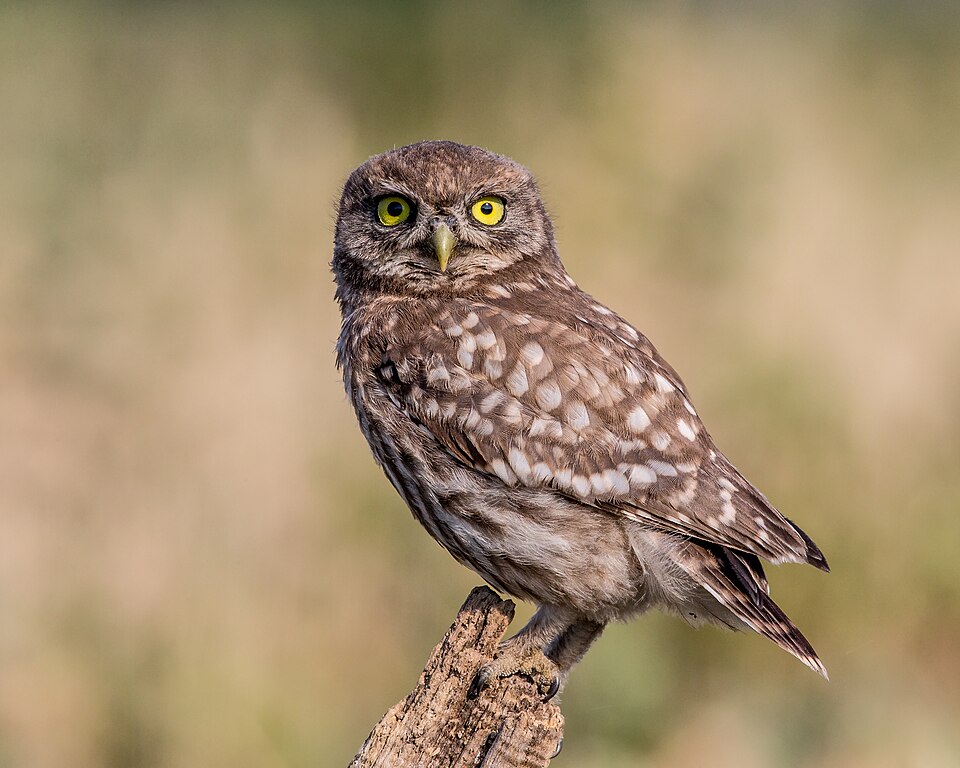
The little owl is a small, stocky nocturnal bird of prey, easily recognizable by its squat silhouette and its piercing yellow eyes topped with white eyebrows. It is widespread in Europe, North Africa and temperate Asia, where it frequents open environments punctuated by hollow trees, low walls and old buildings. Unlike many other nocturnal raptors, it is also active during the day, particularly at dusk and dawn. Its flight is low, undulating and rapid, often carried out close to the ground. It has long been associated with wisdom in Greek mythology, as the favorite bird of the goddess Athena. In Tunisia, it is present in rural and peri-urban areas where it readily nests near homes.
It measures around twenty centimeters and has brown plumage spotted with white, providing excellent camouflage. Its head is broad and flattened, without egrets, and its fixed gaze is characteristic of the genus. Its relatively long and sparsely feathered legs allow it to move easily on the ground by hopping.
Characteristics
Indicative values: they vary by subspecies, sex and region.
Habitat and distribution
The little owl favors open agricultural landscapes, meadows, orchards and steppe areas dotted with hollow trees or old buildings. It also adapts well to the outskirts of villages and peri-urban areas, where it finds cavities to nest. On the other hand, it avoids dense forests and too closed environments.
CURRENT RANGE
The species is widely distributed in Europe, North Africa and temperate Asia up to China. In Tunisia, it is present over a large part of the territory, particularly in the rural areas of the north and center. It was also introduced to New Zealand in the 19th century.
Behaviour
It is territorial and generally sedentary, occupying the same area all year round. Its partial diurnal behavior distinguishes it from other owls, and it can be observed perching in broad daylight near its burrow or nesting cavity. It emits a characteristic call, often described as a plaintive “kiew”, used to mark its territory.
Reproduction
The female generally lays between three and five eggs in a natural cavity, an old wall or an abandoned burrow. Incubation lasts about a month and is carried out mainly by the female, while the male provides food. The young leave the nest after about a month but remain dependent on the parents for several more weeks.
Peculiarities
Its mythological association with the goddess Athena gives it its scientific name, Athene noctua. Its ability to turn its head almost 270 degrees allows it to monitor its surroundings without moving. She sometimes adopts a body rocking posture when alerted or curious.
Threats and conservation
The disappearance of old buildings and cavity trees reduces its available nesting sites. The use of pesticides also reduces its insect food resources. Collisions with vehicles also constitute a significant cause of mortality.
Numbers and trends vary across sources and regions. See the IUCN assessment for the latest reference data.
Gallery
1 documented photographs.
References
Profile updated 03 September 2026 · Reviewed by the TunisieVet editorial team.
Comments (0)
No comments yet.
CONSERVATION STATUS
Least concern (LC)
IUCN source, latest published assessment.
Species health
Documented diseases for this species.
See the 4 diseases of this species Find a veterinarianThis information is provided for educational purposes only and is not a substitute for a veterinary consultation. If you have any concerns about your animal's health, consult a veterinarian.
To discover around: little owl
Videos, facts, stories and records linked to this species.
Similar animals
Other species documented in Animalpedia.

TunisieVet in your pocket 📱🐾 Access your veterinary services wherever you are. [ Download the app ]
Learn more