
Presentation
The Greek tortoise is a small, robust land turtle, emblematic of the Mediterranean and North African regions. It is characterized by a domed yellow to light brown carapace, decorated with distinctive dark patterns. This species is one of two land turtles native to the Mediterranean basin, alongside the Hermann's tortoise.
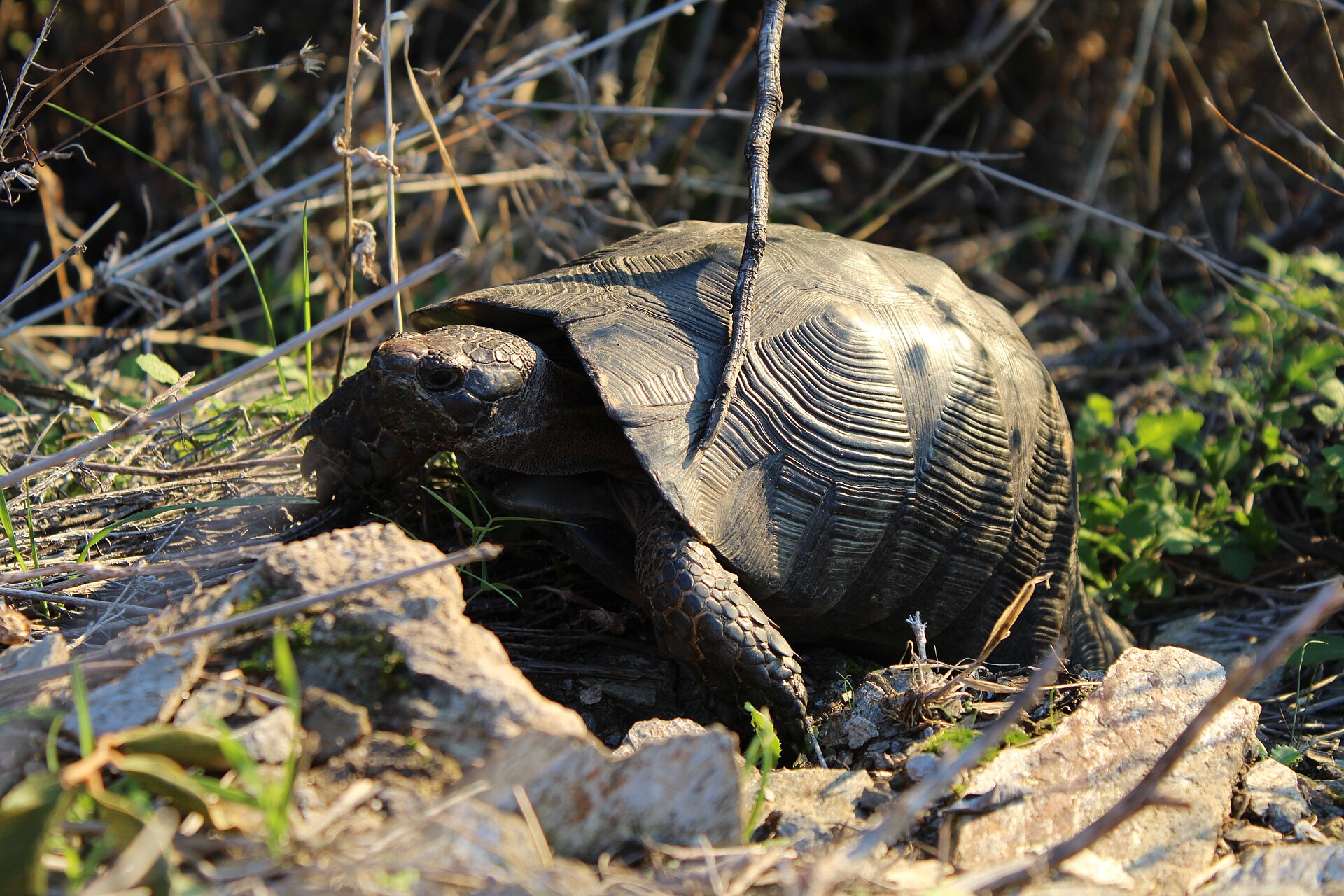
Greek tortoise has an oval to moderately rounded carapace, with clearly visible plates (scutes) separated by furrows. It generally has yellow spots on the marginal plates and a yellow band above the eyes. The forelimbs have characteristic horned tubercles, including spurs at the base of the hind legs, hence its English name.
Characteristics
Indicative values: they vary by subspecies, sex and region.
Habitat and distribution
Greek tortoise frequents open and semi-arid ecosystems: open forests, scrublands, steppes, semi-deserts and rocky slopes. It prefers areas with low and scattered vegetation, where it can excavate its burrows. It adapts to Mediterranean coastal areas up to mid-altitude mountainous regions.
CURRENT RANGE
The distribution area of Greek tortoise extends across North Africa (Morocco, Algeria, Tunisia, Libya) and the southeastern Mediterranean basin (Turkey, Israel, Jordan). It is present locally in Greece and partially extinct in Southern Europe. Its distribution extends from the Mediterranean coasts to inland semi-desert regions.
Behaviour
Greek tortoise is diurnal and territorial, spending the majority of its time on the ground in search of food. It digs burrows or shelters under rocks to protect itself from extreme thermal variations. In summer, it engages in aestivation, a period of rest during which its metabolism slows down considerably.
Reproduction
Reproduction of Greek tortoise begins in spring after emergence from hibernation. Females dig nests in soft soil and lay 2 to 8 elongated eggs. Incubation lasts approximately 60 to 90 days depending on temperature conditions. Juveniles emerge in late summer or early fall.
Peculiarities
Greek tortoise has a remarkable water retention capacity, allowing it to survive in semi-arid regions with little available water. It also has remarkable longevity and moves slowly but steadily over long distances. Its horned spurs are unique structures that mark its hind legs.
Threats and conservation
Greek tortoise is vulnerable to the illegal pet trade, which has greatly reduced wild populations. Habitat destruction, ecosystem degradation and climate change pose growing threats. Overgrazing and urbanization further fragment its natural habitat.
Numbers and trends vary across sources and regions. See the IUCN assessment for the latest reference data.
Gallery
1 documented photographs.
References
UICN — Liste rouge des espèces menacées
Profile updated 01 September 2026 · Reviewed by the TunisieVet editorial team.
Comments (0)
No comments yet.
CONSERVATION STATUS
Vulnerable (VU)
IUCN source, latest published assessment.
Species health
Documented diseases for this species.
This information is provided for educational purposes only and is not a substitute for a veterinary consultation. If you have any concerns about your animal's health, consult a veterinarian.
To discover around: Greek tortoise
Videos, facts, stories and records linked to this species.
Similar animals
Other species documented in Animalpedia.

TunisieVet in your pocket 📱🐾 Access your veterinary services wherever you are. [ Download the app ]
Learn more