
Presentation
The maned wolf (Chrysocyon brachyurus) is a South American canid recognizable by its very long legs and black mane standing erect along its neck. It lives mainly in the savannas and open grasslands of South America, particularly in Brazil, Paraguay, Bolivia, and Argentina. Solitary by nature, it feeds on both small animals and fruits, making it a canid with a particularly omnivorous diet. Its atypical appearance sometimes earns it the nickname "fox on stilts." The species is today threatened by the destruction of its natural habitat. It does not live in the wild in Tunisia but may be presented in certain zoos.
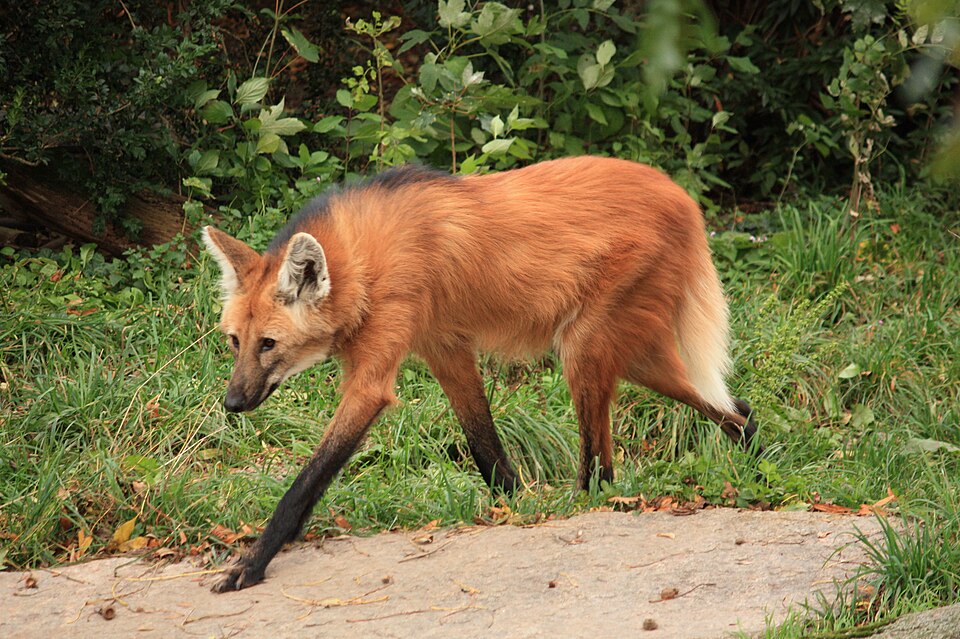
The Maned wolf is distinguished by its very long slender legs, adapted for life in the tall grasses of the savanna. Its reddish-orange coat contrasts with a black mane bristling on the nape and dark legs. Despite its name, it is not a true wolf but the sole representative of its genus, behaviourally closer to the fox. Its slender silhouette and large ears give it a singular appearance among canids.
Characteristics
Indicative values: they vary by subspecies, sex and region.
Habitat and distribution
The maned wolf frequents open grassy savannas, grasslands, and brushy areas of South America. It avoids dense forests, preferring open environments where its long legs give it an advantage for spotting prey and predators. It may also venture near wetland areas bordering its territory.
CURRENT RANGE
The species is found in central and southern Brazil, Paraguay, Bolivia, and northern Argentina. It inhabits mainly the vast expanses of the Brazilian Cerrado. Its range is now fragmented by the conversion of savannas to agricultural land.
Behaviour
The Maned wolf is a solitary canid and essentially nocturnal or crepuscular. It marks its territory, which is quite extensive, with urine that has a characteristic odor. Pairs form but share few activities, with each individual hunting on its own. Its ungainly gait, with its long legs, allows it to spot its prey in tall grass.
Reproduction
The female gives birth once a year, usually between April and June, after a gestation period of about 65 days. A litter typically consists of two to five pups, raised mainly by the mother. Young animals reach sexual maturity around one year of age.
Peculiarities
Its urine has a very strong odor, often compared to that of cannabis, which earned it the local nickname of "stinking wolf." Unlike most canids, it does not live in packs and hunts alone. Its disproportionately long legs relative to its body are a unique adaptation among living canids.
Threats and conservation
The main threat is the destruction and fragmentation of its natural habitat due to agricultural expansion in the Cerrado. Road collisions and diseases transmitted by domestic dogs also pose significant risks to remaining populations.
Numbers and trends vary across sources and regions. See the IUCN assessment for the latest reference data.
Gallery
1 documented photographs.
References
Profile updated 04 September 2026 · Reviewed by the TunisieVet editorial team.
Comments (0)
No comments yet.
CONSERVATION STATUS
Near threatened (NT)
IUCN source, latest published assessment.
Species health
Documented diseases for this species.
Find a veterinarianThis information is provided for educational purposes only and is not a substitute for a veterinary consultation. If you have any concerns about your animal's health, consult a veterinarian.
Related species
To discover around: Maned wolf
Videos, facts, stories and records linked to this species.
Similar animals
Other species documented in Animalpedia.

TunisieVet in your pocket 📱🐾 Access your veterinary services wherever you are. [ Download the app ]
Learn more