
Presentation
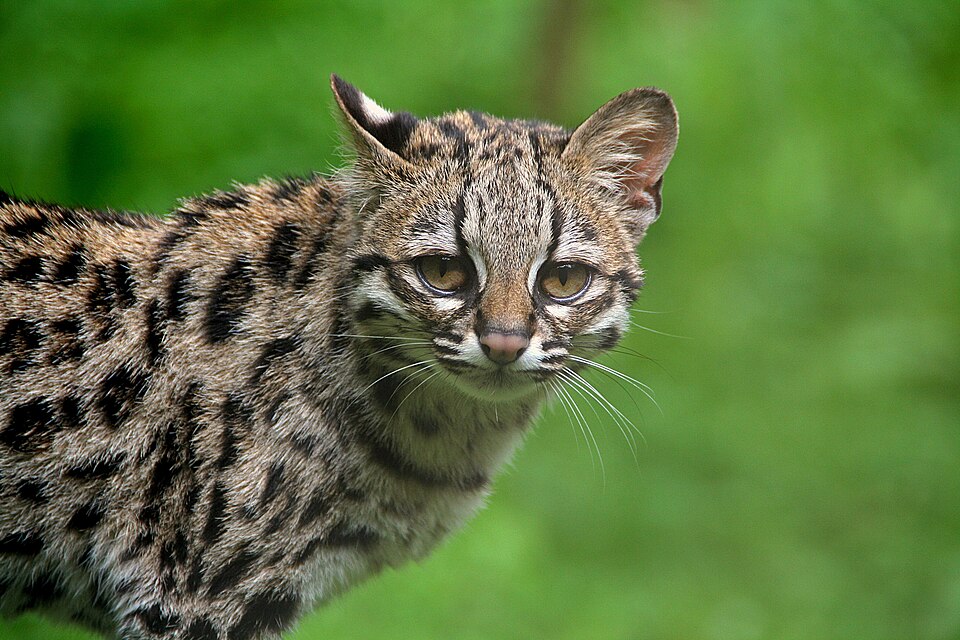
The Margay (Leopardus wiedii) is a small wild cat from Central and South America, known for its excellent adaptation to arboreal life. Its slender silhouette, large eyes and long tail are reminiscent of the ocelot, with which it shares part of its range. It hunts mainly at night, moving nimbly through the canopy of tropical forests. Discreet and solitary, it is rarely observed in the wild. Its spotted fur, once highly sought after, strongly contributed to the decline of its populations in the 20th century.
The Margay has a slender body, highly mobile hind limbs, and ankles capable of rotating 180 degrees, a unique adaptation allowing it to descend headfirst from trees. Its coat is beige to ocher, covered with rosettes and elongated black spots. Its tail, particularly long in relation to its body, serves as a balance when moving through the branches.
Characteristics
Indicative values: they vary by subspecies, sex and region.
Habitat and distribution
Margay lives primarily in dense, humid tropical forests, where the continuous canopy provides it with aerial routes of movement. It also frequents certain mountain forests at low and medium altitude. Its dependence on forest cover makes it very susceptible to deforestation.
CURRENT RANGE
The species is present from Mexico to northern Argentina, via Central America and the Amazon basin. Its populations are fragmented, particularly at the periphery of its range. It remains more common in large forest areas that are still intact.
Behaviour
A solitary and mainly nocturnal animal, the Margay spends a large part of its time in trees. It marks its territory by deposits of urine and scratches on the trunks. An excellent climber, it can descend trees vertically, head down, thanks to the exceptional rotation of its posterior joints.
Reproduction
The female generally gives birth to a single young after a gestation of around 80 days. The reproduction rate is low compared to other felines, which slows the recovery of populations. The young remain dependent on their mother for several months before becoming independent.
Peculiarities
The Margay is one of the few mammals capable of descending trees headfirst, like a squirrel. Observations have also reported imitations of prey calls to attract certain monkeys, a rare behavior among felines.
Threats and conservation
Deforestation and fragmentation of forest habitats constitute the main threat to the species. The illegal fur trade, although reduced since international regulations, has historically decimated numerous populations. The low natural density of the species makes it particularly vulnerable to local disturbances.
Numbers and trends vary across sources and regions. See the IUCN assessment for the latest reference data.
Gallery
1 documented photographs.
References
Profile updated 25 August 2026 · Reviewed by the TunisieVet editorial team.
Comments (0)
No comments yet.
CONSERVATION STATUS
Near threatened (NT)
IUCN source, latest published assessment.
Species health
Documented diseases for this species.
See the 7 diseases of this species Find a veterinarianThis information is provided for educational purposes only and is not a substitute for a veterinary consultation. If you have any concerns about your animal's health, consult a veterinarian.
Related species
To discover around: Margay
Videos, facts, stories and records linked to this species.
Similar animals
Other species documented in Animalpedia.

TunisieVet in your pocket 📱🐾 Access your veterinary services wherever you are. [ Download the app ]
Learn more