
Presentation
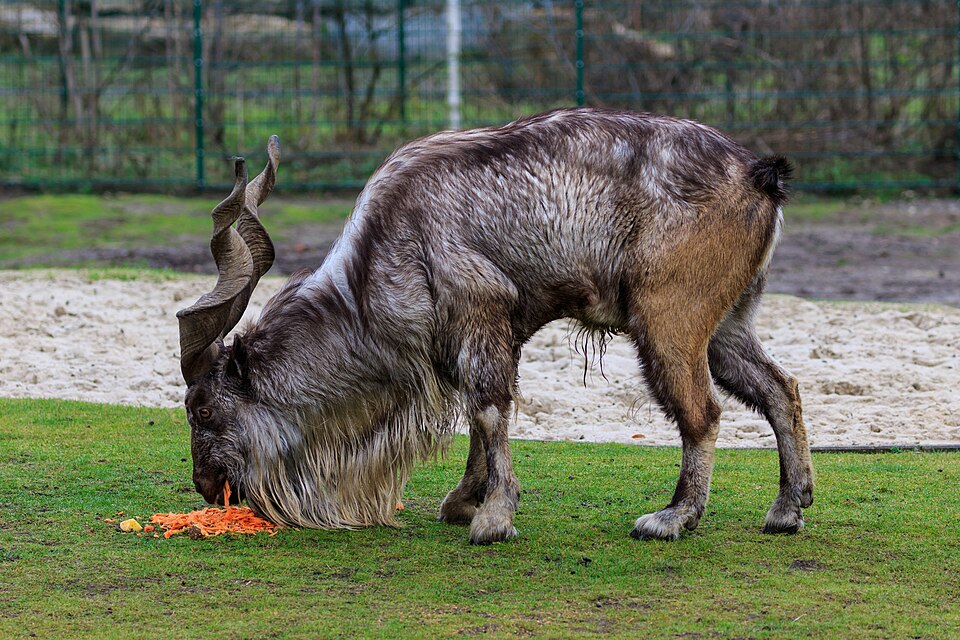
The markhor (Capra falconeri) is a large wild goat native to the high mountain ranges of Central and South Asia, particularly in Pakistan, Afghanistan, and Tajikistan. It is best recognized by its impressive spiral horns, which can exceed one metre in length in adult males. This species inhabits steep terrain, ranging from coniferous forests to rocky slopes at high altitudes. Once threatened by hunting and habitat loss, the markhor now benefits from conservation programmes that have brought about a notable recovery of its populations. It is the national animal of Pakistan, where it holds strong symbolic significance. Although not found in the wild in Tunisia, it occasionally appears in certain zoos in the country for educational and conservation purposes.
The markhor is distinguished by its long corkscrew-twisted horns, borne by both sexes but much more developed in males. Its coat varies from reddish-brown in summer to a paler grey in winter, with a characteristic thick beard in males. Its powerful legs and hooves adapted to mountainous terrain give it excellent agility. There is marked sexual dimorphism, with males being noticeably larger and more robust than females.
Characteristics
Indicative values: they vary by subspecies, sex and region.
Habitat and distribution
The markhor inhabits steep mountainous terrain between 600 and 3,600 meters in elevation, moving across coniferous forests, thorny shrubland, and rocky cliffs. It avoids areas with heavy snow in winter and migrates to lower elevations during that season. This rugged terrain provides effective protection from predators.
CURRENT RANGE
The species is found in the mountain ranges of Central and South Asia, notably in Pakistan, Afghanistan, Tajikistan, Uzbekistan, and certain regions of northern India. Its populations are fragmented and confined to isolated massifs. Pakistan holds the largest portion of the global population, particularly in the Chitral and Baltistan regions.
Behaviour
The markhor is diurnal, with peaks of activity in the morning and late afternoon. It lives in small matriarchal groups made up of females and young, while adult males often remain solitary or form separate groups outside the breeding season. It is an excellent climber, able to move over steep and nearly vertical rocky slopes. Males engage in ritualized horn fights, particularly during the rut.
Reproduction
Mating occurs in autumn and winter, a period when males compete for access to females. Gestation lasts approximately 135 to 170 days, typically resulting in the birth of one or two kids in spring. Young are able to follow their mother shortly after birth and are weaned by five to six months of age.
Peculiarities
Its distinctive corkscrew horns, unique among caprines, make it easily identifiable. The markhor is the national animal of Pakistan and a strong symbol of successful conservation in South Asia. Its name is believed to derive from Persian meaning 'serpent eater', though this etymology remains debated and not scientifically confirmed.
Threats and conservation
Main threats include poaching for horns and meat, as well as habitat loss from domestic livestock grazing and human development. Competition for food resources with domestic herds also reduces available forage. Controlled hunting programmes that generate income for local communities have contributed to the recent stabilization of populations.
Numbers and trends vary across sources and regions. See the IUCN assessment for the latest reference data.
Gallery
1 documented photographs.
References
Profile updated 06 September 2026 · Reviewed by the TunisieVet editorial team.
Comments (0)
No comments yet.
CONSERVATION STATUS
Near threatened (NT)
IUCN source, latest published assessment.
Species health
Documented diseases for this species.
See the 4 diseases of this species Find a veterinarianThis information is provided for educational purposes only and is not a substitute for a veterinary consultation. If you have any concerns about your animal's health, consult a veterinarian.
To discover around: Markhor
Videos, facts, stories and records linked to this species.
RECORD
up to 1.6 m long
Longest spiral horns among caprines
Measurement taken along the spiral in fully developed adult males.
Similar animals
Other species documented in Animalpedia.

TunisieVet in your pocket 📱🐾 Access your veterinary services wherever you are. [ Download the app ]
Learn more