
Presentation
The Reed Warbler is a small migratory songbird belonging to the family Acrocephalidae. It is characterized by streaked brown plumage on the back and a distinct pale eyebrow stripe that distinguishes it from other wetland warblers. Discreet and unobtrusive, it frequents reed beds and densely vegetated areas along waterways. Its song is a varied mix of trills, whistles and imitations of other birds, often delivered from a low perch or during courtship flight. This species migrates over extremely long distances between Europe and sub-Saharan Africa. In Tunisia, it is observed mainly during spring and autumn migration passages.
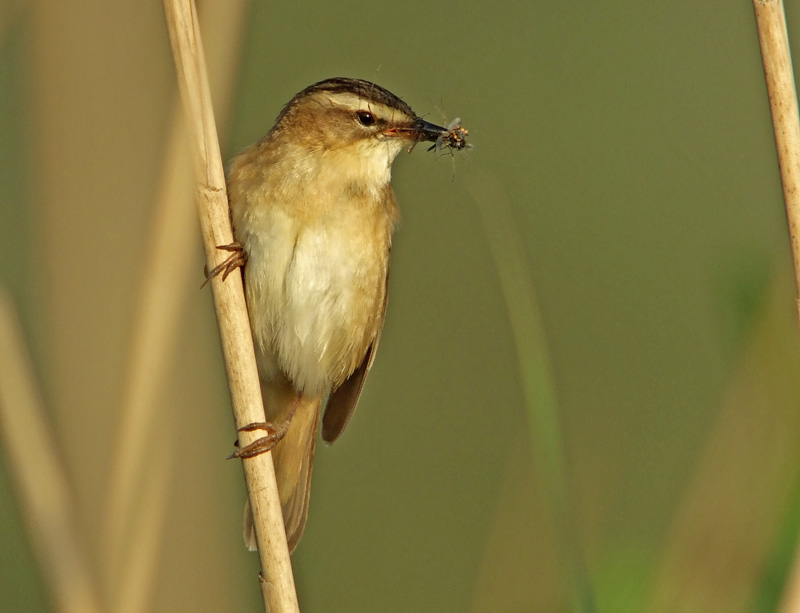
The Reed Warbler measures approximately 12 to 13 cm in length with a light weight, well adapted for long-distance flight. Its brown dorsal plumage streaked with black contrasts with a very visible cream-beige eyebrow stripe above the eye. The bill is fine and pointed, typical of insect-eaters, and the legs are pinkish brown. The sexes show similar plumage, making them difficult to distinguish in the field.
Characteristics
Indicative values: they vary by subspecies, sex and region.
Habitat and distribution
The reed warbler favors wetlands rich in low, dense vegetation, such as reed beds, marshes, and wet meadows bordering watercourses. It generally avoids pure, tall reeds, preferring mixed habitats with bushes and tall grasses. During migration, it also uses transitional habitats such as wet agricultural areas. In Tunisia, it frequents oases, sebkhas, and coastal wetlands during migration stopovers.
CURRENT RANGE
The species breeds in Europe and parts of temperate Asia, from the British Isles to western Siberia. It winters mainly in sub-Saharan Africa, crossing the Sahara during migration. Tunisia represents an important migration stopover point on this migration route. Regular observations are reported in the country's wetlands in spring and autumn.
Behaviour
The Reed Warbler is a discreet bird that often moves low in vegetation, more easily heard than seen. The male sings actively in spring to defend its territory and attract a mate, sometimes performing a short song flight. Outside breeding season, it leads a rather solitary life but may gather in groups during migration stopovers. Its nocturnal migration allows it to cover great distances while avoiding diurnal predators.
Reproduction
Breeding takes place in spring and early summer in temperate wetland areas of Europe and Asia. The female builds a cup-shaped nest woven from plant material, hidden in low vegetation near the ground or water. She typically lays 4 to 6 eggs, which she incubates alone for about two weeks. The young are fed by both parents and leave the nest after approximately ten days.
Peculiarities
The reed warbler is capable of crossing the Sahara in a single flight thanks to substantial fat reserves accumulated before departure. Its complex song frequently includes imitations of other bird species encountered along its migration route. The pronounced pale eyebrow stripe is the main identification feature that distinguishes it from similar species such as the great reed warbler.
Threats and conservation
Degradation and drying of wetlands in Europe and along migration routes represent the main threat to the species. Droughts in the Sahel, a major wintering area, also significantly affect populations. Pollution and urbanization of coastal wetlands further reduce available stopover sites. The population remains globally stable but is sensitive to climate variations.
Numbers and trends vary across sources and regions. See the IUCN assessment for the latest reference data.
Gallery
1 documented photographs.
References
Profile updated 24 August 2026 · Reviewed by the TunisieVet editorial team.
Comments (0)
No comments yet.
CONSERVATION STATUS
Least concern (LC)
IUCN source, latest published assessment.
Species health
Documented diseases for this species.
Find a veterinarianThis information is provided for educational purposes only and is not a substitute for a veterinary consultation. If you have any concerns about your animal's health, consult a veterinarian.
Similar animals
Other species documented in Animalpedia.
