Presentation
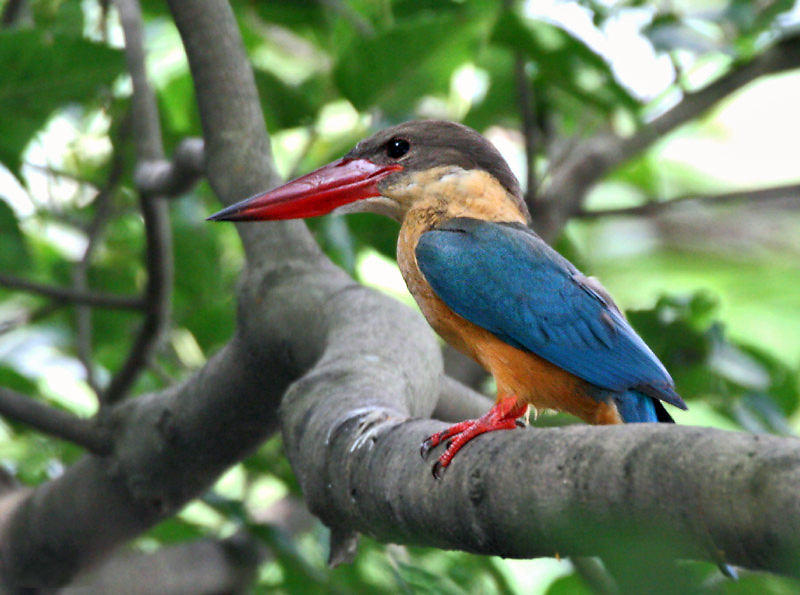
The giant kingfisher is a large bird of the kingfisher family, recognizable by its massive and powerful red-orange beak. It has a russet-brown head, blue-green back, and yellowish throat, creating a sharp contrast between colors. Despite its name evoking fishing, it behaves more as an opportunistic generalist predator. It is found in South and Southeast Asia, usually near freshwater or brackish water sources. It is a rather sedentary species, discreet despite its size, often detected by its loud call. It is not found in Tunisia.
The species is distinguished by its robust and disproportionate beak, adapted to capturing a variety of prey. Its plumage combines bright shades of blue, brown, and yellow, making it easy to identify in the field. It is one of the largest representatives of its family.
Characteristics
Indicative values: they vary by subspecies, sex and region.
Habitat and distribution
The species frequents wetlands, mangroves, rivers and lakes, as well as certain estuarine coastal areas. It prefers habitats with trees for perching close to water. It is sometimes found at the edges of urban areas near waterways.
CURRENT RANGE
The giant kingfisher is distributed from the Indian subcontinent through insular Southeast Asia. Its range includes India, Sri Lanka, Myanmar, Thailand, Malaysia, Indonesia and the Philippines. It occupies a wide variety of tropical and subtropical wetlands in this region.
Behaviour
It is a territorial and rather solitary bird outside the breeding season. It hunts from a perch, patiently watching for prey before diving rapidly. Its loud and repetitive call serves to mark its territory.
Reproduction
Nesting takes place in burrows dug into soft banks or in cavities of dead trees. The female typically lays 2 to 4 white eggs per clutch. Both parents share incubation duties and the feeding of young.
Peculiarities
Unlike many kingfishers, it tolerates brackish water and even some terrestrial habitats away from water. Its disproportionate bill and vibrant coloration make it a species that is easily identified locally.
Threats and conservation
Degradation of wetlands and deforestation of mangroves threaten certain populations locally. Pollution of waterways can reduce the availability of aquatic prey. The species remains widely distributed and is not globally threatened.
Numbers and trends vary across sources and regions. See the IUCN assessment for the latest reference data.
Gallery
1 documented photographs.
References
Profile updated 03 September 2026 · Reviewed by the TunisieVet editorial team.
Comments (0)
No comments yet.
CONSERVATION STATUS
Least concern (LC)
IUCN source, latest published assessment.
Species health
Documented diseases for this species.
This information is provided for educational purposes only and is not a substitute for a veterinary consultation. If you have any concerns about your animal's health, consult a veterinarian.
Similar animals
Other species documented in Animalpedia.

Be among the first to use our app. Sign up and get early Google Play access.
Discover