
Presentation
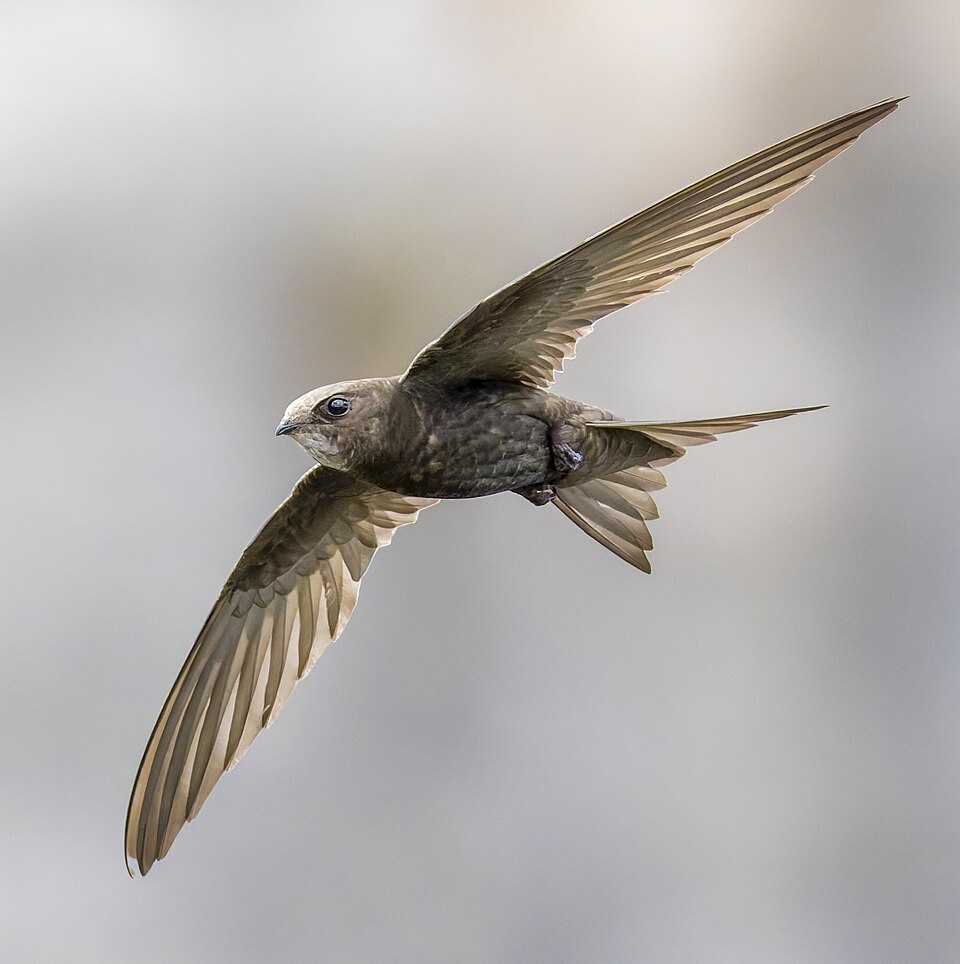
The black swift is a migratory bird with a streamlined body and long, narrow, sickle-shaped wings. It spends nearly all its life in flight, touching down only to nest in cavities in buildings or cliffs. Its plumage is a uniform dark brown-black, often appearing entirely black from a distance, with a small pale patch beneath the throat. Common throughout Tunisia during the breeding season, it is recognized by its shrill calls uttered in flight and its aerial acrobatics above towns and villages.
Streamlined body, very long sickle-shaped wings, short forked tail. Tiny legs poorly suited for walking, used mainly to cling to vertical surfaces. Short beak but wide mouth allowing it to catch insects in flight.
Characteristics
Indicative values: they vary by subspecies, sex and region.
Habitat and distribution
The swift frequents urban areas where it nests under roofs, on cornices, and in old buildings. It hunts over inhabited zones and surrounding countryside alike, as well as over wetlands and bodies of water. Outside the breeding season, it spends its time high in the sky over vast territories.
CURRENT RANGE
The common swift breeds across Europe, North Africa, and western Asia before migrating to sub-Saharan Africa to overwinter. In Tunisia, it is a common summer visitor, present from spring through summer in towns and villages in the north and central regions. It undertakes a remarkable transcontinental migration each year.
Behaviour
A gregarious and vocal species, the swift lives in colonies and moves in whirling groups at dusk. It is capable of sleeping and mating in flight, rarely if ever alighting on the ground. Its flight is swift, with long glides interspersed with sharp wing beats.
Reproduction
The female typically lays two to three eggs in a simple nest built in a cavity, under a roof, or in a wall crevice. Incubation lasts about three weeks, and both parents feed the chicks. The young birds leave the nest by flying directly, with no ground-based learning phase.
Peculiarities
The swift spends nearly its entire life, except during breeding, without ever landing, even to sleep. Its very short legs make takeoff from the ground nearly impossible, so the species always prefers vertical surfaces. Its name reflects its superficial resemblance to swallows, though it belongs to a completely different order.
Threats and conservation
The loss of nesting cavities due to renovation of old buildings threatens urban populations. The decline of flying insects from pesticide use also reduces its food resources. The species nonetheless remains widely distributed and is not considered globally threatened.
Numbers and trends vary across sources and regions. See the IUCN assessment for the latest reference data.
Gallery
1 documented photographs.
References
Profile updated 05 September 2026 · Reviewed by the TunisieVet editorial team.
Comments (0)
No comments yet.
CONSERVATION STATUS
Least concern (LC)
IUCN source, latest published assessment.
Species health
Documented diseases for this species.
Find a veterinarianThis information is provided for educational purposes only and is not a substitute for a veterinary consultation. If you have any concerns about your animal's health, consult a veterinarian.
Similar animals
Other species documented in Animalpedia.

TunisieVet in your pocket 📱🐾 Access your veterinary services wherever you are. [ Download the app ]
Learn more