
Presentation
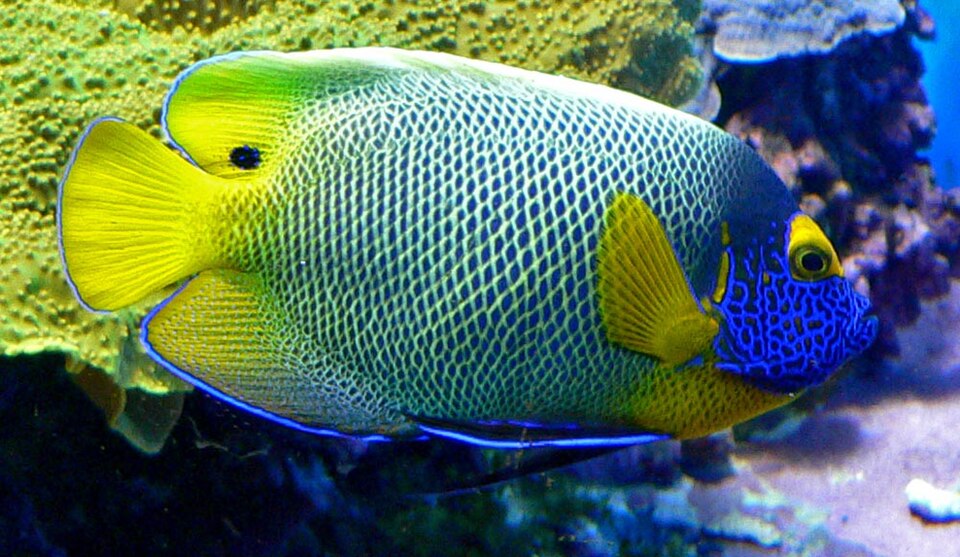
Angelfish refers to several marine species in the Pomacanthida family, known for their bright colors and contrasting patterns. They mainly live around coral reefs in tropical seas. Their body is flattened laterally, which facilitates their precise movements between the crevices of the reef. Very popular in marine aquariums, these fish often have a juvenile livery very different from that of the adult. The name "angel" refers to the elegance of their swimming and the shape of their fins.
Body oval and laterally compressed, dorsal and anal fins often extended into filaments. Bright coloring with varying stripe or spot patterns depending on species and age. A characteristic opercular spine distinguishes Pomacanthids from butterflyfish. Moderate size, generally between 15 and 40 cm depending on the species.
Characteristics
Indicative values: they vary by subspecies, sex and region.
Habitat and distribution
Angelfish frequents coral reefs and shallow lagoons in tropical and subtropical waters. It seeks out areas rich in cavities and sponges, essential for its nutrition and protection. Some species tolerate slightly cooler waters at the margins of reefs. The quality and health of the coral strongly determine its presence.
CURRENT RANGE
Angelfish are widely distributed in the tropical seas of the Indo-Pacific, the Caribbean, and the Red Sea. Their diversity is greatest in the Coral Triangle, in Southeast Asia. No species is naturally present in the Mediterranean or on the Tunisian coasts. Their distribution closely follows that of coral reefs.
Behaviour
Territorial fish, often solitary or living in stable pairs on an actively defended territory. Some species form small hierarchical groups with a dominant male. The behavior is diurnal, the animal taking refuge in cavities in the reef at night. Juveniles sometimes adopt cleaning behavior towards other fish.
Reproduction
Reproduction occurs by pelagic spawning, with eggs and larvae drifting in plankton before settling on the reef. Some species are protogynous hermaphrodites, changing sex during their life. Courtship precedes the synchronized release of gametes, often at the end of the day. No parental care is provided after egg-laying.
Peculiarities
The livery of juveniles differs radically from that of adults in many species, to the point of having long been confused with distinct species. This difference in coloring would play a role in reducing the territorial aggressiveness of adults towards young people. Some species change sex during their existence.
Threats and conservation
The degradation of coral reefs, particularly through bleaching linked to global warming, constitutes the main threat. Overfishing for the aquarium trade affects certain populations locally. Coastal pollution and the destruction of reef habitats compound these pressures.
Numbers and trends vary across sources and regions. See the IUCN assessment for the latest reference data.
Gallery
1 documented photographs.
References
Profile updated 30 August 2026 · Reviewed by the TunisieVet editorial team.
Comments (0)
No comments yet.
CONSERVATION STATUS
Least concern (LC)
IUCN source, latest published assessment.
Species health
Documented diseases for this species.
Find a veterinarianThis information is provided for educational purposes only and is not a substitute for a veterinary consultation. If you have any concerns about your animal's health, consult a veterinarian.
To discover around: Angelfish
Videos, facts, stories and records linked to this species.
Similar animals
Other species documented in Animalpedia.

TunisieVet in your pocket 📱🐾 Access your veterinary services wherever you are. [ Download the app ]
Learn more