
Presentation
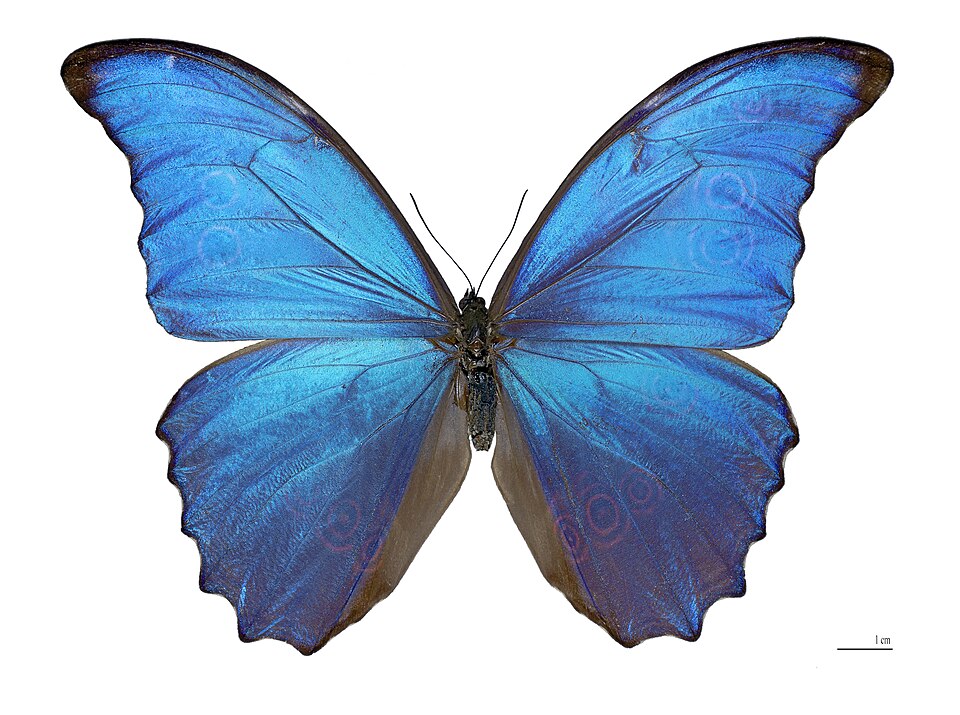
Morpho refers to a genus of day-flying butterflies native to tropical America, renowned for the brilliant metallic blue sheen of their wings. This coloring is not caused by pigment but by the microscopic structure of the wing scales, which refract light. Morpho butterflies rank among the largest butterflies in the Americas, with wingspans reaching over 15 cm in some species. The underside of their wings—dull brown adorned with eyespots—contrasts sharply with the upper surface and helps them blend into vegetation when at rest. They inhabit understory and clearings in humid tropical rainforests. About thirty species make up this genus, with Morpho peleides and Morpho menelaus being the best known.
Morpho wings display microstructured scales that produce blue iridescence through light refraction, a phenomenon called structural coloration. The body is robust and covered with fine hair, with long thread-like antennae. The underside of the wings, often brown or gray, bears eyespots that serve as a decoy against predators.
Characteristics
Indicative values: they vary by subspecies, sex and region.
Habitat and distribution
The morpho lives in humid tropical forests at low and moderate altitudes, particularly in shaded understory and along forest streams. It favors clearings and forest edges where filtered light enhances its shimmering flight.
CURRENT RANGE
The genus Morpho is found from Mexico to northern Argentina, with maximum diversity in the Amazon basin. It is naturally absent from Africa, Europe, and Asia.
Behaviour
Morpho butterflies fly with a broad, irregular pattern of wing beats alternating with glides, which emphasizes the shimmering of their wings. They are active during the day, especially in warm hours, and frequently land on the ground or tree trunks to feed on rotting fruit. Males patrol along the forest's sunlit gaps in search of mates, while the eyespots on the underside of the wings deter certain predators when the butterfly is at rest.
Reproduction
Mating occurs shortly after the adults emerge, often guided by visual signals linked to wing iridescence. The female lays her eggs singly on leaves of specific host plants. Development passes through the typical stages of egg, caterpillar, and chrysalis before the adult emerges, with adult life being relatively brief, lasting only a few weeks.
Peculiarities
The morpho's iconic blue color, resulting from the physical structure of the scales rather than pigment, has inspired research in optics and nanotechnology applied to textiles and anti-counterfeiting materials. This butterfly ranks among the world's most collected and exhibited insects because of its spectacular appearance.
Threats and conservation
Tropical deforestation reduces the natural habitat of several morpho species. Commercial collection for the trade in decorative wings and mounted insects can locally affect certain populations, though most species remain common.
Numbers and trends vary across sources and regions. See the IUCN assessment for the latest reference data.
Gallery
1 documented photographs.
References
Profile updated 09 September 2026 · Reviewed by the TunisieVet editorial team.
Comments (0)
No comments yet.
CONSERVATION STATUS
Data deficient (DD)
IUCN source, latest published assessment.
Species health
Documented diseases for this species.
Find a veterinarianThis information is provided for educational purposes only and is not a substitute for a veterinary consultation. If you have any concerns about your animal's health, consult a veterinarian.
To discover around: Morpho
Videos, facts, stories and records linked to this species.
RECORD
Blue iridescence without pigment
Most studied structural coloration in butterflies
Caused by the microstructure of wing scales that diffract light, widely studied in optics.
Similar animals
Other species documented in Animalpedia.

TunisieVet in your pocket 📱🐾 Access your veterinary services wherever you are. [ Download the app ]
Learn more