
Presentation
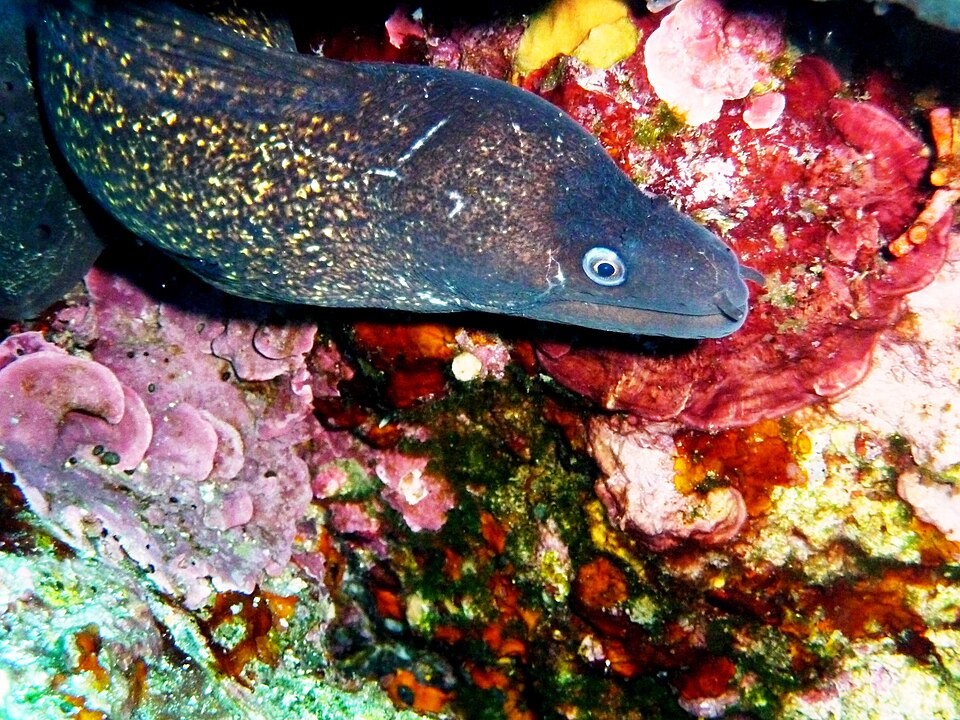
The moray eel is an elongated marine fish, lacking visible scales, belonging to the Muraenidae family. Its serpentine body and powerful jaw filled with sharp teeth give it a formidable appearance. It lives hidden in rocky faults and reefs, only emerging partially to watch for its prey. Present in warm and temperate seas around the world, including the Mediterranean, this nocturnal predator plays an important role in the balance of reef ecosystems. Despite its aggressive reputation, it only attacks humans if it feels threatened or provoked. Several species exist, varying in size, color and patterns.
Cylindrical and elongated body that can exceed 1.5 meters depending on the species, lacking pectoral and pelvic fins. The skin, thick and viscous, replaces the missing scales and secretes a protective mucus that is sometimes toxic on contact. The jaw has a second retractable pharyngeal jaw for grasping and pulling prey towards the esophagus. Its small eyes indicate poor eyesight, compensated by a very developed sense of smell.
Characteristics
Indicative values: they vary by subspecies, sex and region.
Habitat and distribution
The moray eel favors coral reefs, rocky bottoms and shallow to medium-deep underwater caves. It looks for narrow cavities offering safe shelter from predators and a hiding position for hunting. It is found both in the Mediterranean Sea and in the tropical waters of the Indo-Pacific and the Atlantic. Some species tolerate brackish waters near river mouths.
CURRENT RANGE
moray eel is present in most warm and temperate seas around the world, including the Mediterranean, Atlantic, Indo-Pacific and Red Sea. In Tunisia, the common moray eel (Muraena helena) is regularly observed along rocky coasts. Its distribution generally follows the presence of reefs and rocky bottoms adapted to its way of life.
Behaviour
An essentially solitary and territorial animal, the moray eel spends most of the day hidden in a rocky or coral crevice. It breathes by regularly opening and closing its mouth, which gives it a menacing appearance even though it is a gill ventilation mechanism. Some species establish cooperative hunting associations with fish such as grouper. She only becomes aggressive towards humans in the event of provocation or a feeling of threat.
Reproduction
Reproduction occurs by spawning in open water, often after migration to deeper areas. Fertilized eggs give rise to planktonic larvae called leptocephali, which drift for a long time before metamorphosing. This larval phase can last several months depending on the species. Sexual maturity is reached after several years of growth.
Peculiarities
The moray eel has a double jaw, a retractable pharyngeal unique among marine vertebrates, which allows it to pull its prey into its body. Its skin mucus may contain protective toxins depending on the species. She is capable of twisting her body to tear off pieces of overly large prey. Its weak eyesight is compensated by an exceptionally developed sense of smell.
Threats and conservation
moray eel is not subject to major threats on a global scale, its populations being generally stable. The degradation of coral reefs and coastal pollution constitute indirect threats to its habitat. It is sometimes caught by sport fishing or for marine aquariums. Local overfishing may affect some coastal populations.
Numbers and trends vary across sources and regions. See the IUCN assessment for the latest reference data.
Gallery
1 documented photographs.
References
Profile updated 28 August 2026 · Reviewed by the TunisieVet editorial team.
Comments (0)
No comments yet.
CONSERVATION STATUS
Least concern (LC)
IUCN source, latest published assessment.
Species health
Documented diseases for this species.
This information is provided for educational purposes only and is not a substitute for a veterinary consultation. If you have any concerns about your animal's health, consult a veterinarian.
To discover around: moray eel
Videos, facts, stories and records linked to this species.
Similar animals
Other species documented in Animalpedia.

TunisieVet in your pocket 📱🐾 Access your veterinary services wherever you are. [ Download the app ]
Learn more