
Presentation
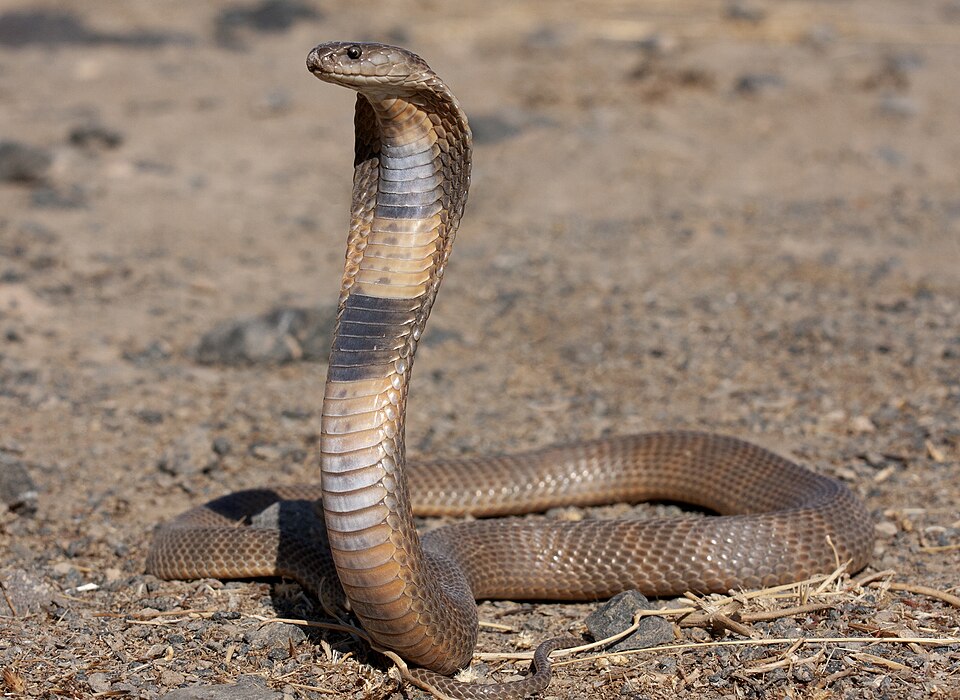
The Naja, or cobra, refers to a genus of venomous snakes belonging to the Elapidae family. It is distinguished by its ability to raise the anterior part of its body and deploy a cervical hood when it feels threatened. This genus brings together several dozen species distributed in Africa and Asia, adapted to very varied environments. The Naja has a powerful neurotoxic venom which allows it to neutralize its prey. It occupies an important place in local cultures, particularly in India and ancient Egypt. Although feared, it plays an ecological role by regulating rodent populations.
The body is elongated and covered with smooth scales, with a head indistinguishable from the neck. The most notable feature is the presence of movable cervical ribs allowing expansion of a hood during defensive postures. Coloration varies greatly between species, from uniform brown to black with light markings on the throat. Certain species, called spitters, can project their venom several meters towards the eyes of an attacker.
Characteristics
Indicative values: they vary by subspecies, sex and region.
Habitat and distribution
The Naja frequents a wide diversity of environments, from humid tropical forests to dry savannahs, including rocky areas and sometimes the surroundings of human habitations. Some species adapt to agricultural areas where rodents abound. Others are associated with wetlands and around water points. This ecological plasticity explains the wide distribution of the genus.
CURRENT RANGE
The Naja genus is present over a large part of the African continent, particularly south of the Sahara, as well as in South and Southeast Asia, including India, southern China and island Asia. It is absent from Europe, Oceania and the Americas. The highest species diversity is found in sub-Saharan Africa.
Behaviour
The Naja is generally solitary and active at dusk or night depending on the species. When faced with a threat, it adopts a characteristic defensive posture by straightening the front third of its body and deploying its hood while emitting a hissing sound. He most often avoids direct confrontation and favors escape when possible. Some species are able to swim or climb trees depending on their habitat.
Reproduction
Reproduction is oviparous, with the female laying between 10 and 30 eggs depending on the species. Laying takes place in a nest of decaying vegetation or an abandoned burrow which provides some incubation warmth. Some females, as in the spitting Naja, show a form of surveillance of the nest. Incubation generally lasts two to three months before the young, already venomous and autonomous, hatch.
Peculiarities
The Naja is associated with many beliefs and cultural symbols, notably in ancient Egypt where it adorned the crowns of the pharaohs. Some spitting species specifically target the attacker's eyes to cause temporary blindness. The venom varies greatly in composition between species, with some being primarily neurotoxic and others cytotoxic.
Threats and conservation
Major threats include destruction of natural habitat and direct persecution by humans through fear or conflict. Illegal trade for skins, traditional medicine or the exotic pet market affects some local populations. The conservation status varies greatly depending on the species, the majority remaining little threatened on a global scale.
Numbers and trends vary across sources and regions. See the IUCN assessment for the latest reference data.
Gallery
1 documented photographs.
References
Profile updated 02 September 2026 · Reviewed by the TunisieVet editorial team.
Comments (0)
No comments yet.
CONSERVATION STATUS
Least concern (LC)
IUCN source, latest published assessment.
Species health
Documented diseases for this species.
This information is provided for educational purposes only and is not a substitute for a veterinary consultation. If you have any concerns about your animal's health, consult a veterinarian.
To discover around: Naja
Videos, facts, stories and records linked to this species.
Similar animals
Other species documented in Animalpedia.

TunisieVet in your pocket 📱🐾 Access your veterinary services wherever you are. [ Download the app ]
Learn more