
Presentation
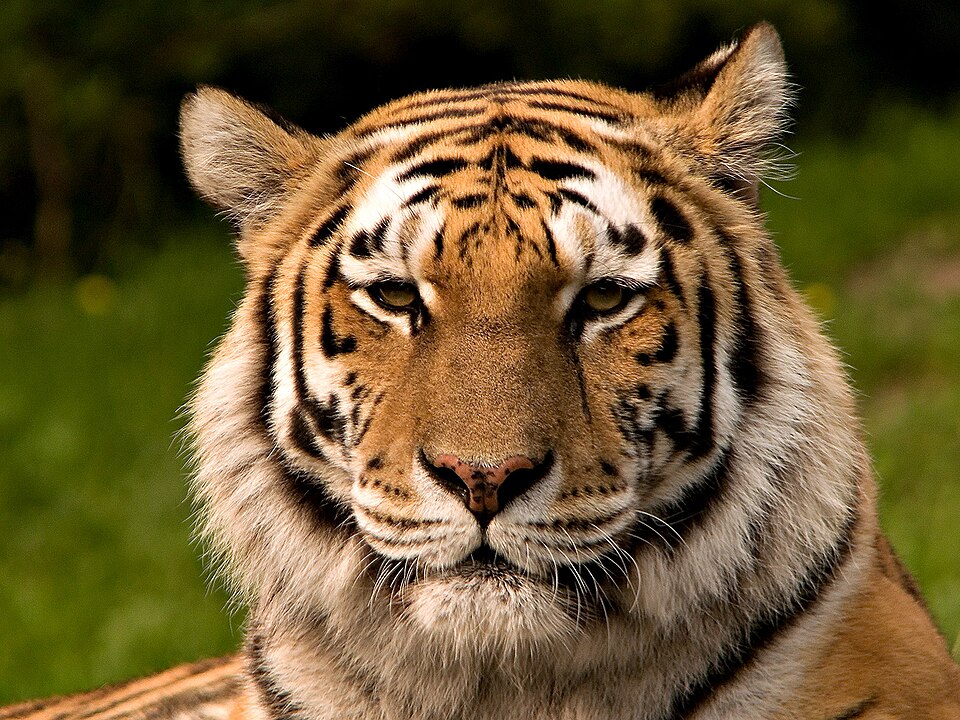
The Tiger is the largest feline in the world, recognizable by its characteristic orange coat striped with black. This impressive predator embodies the power and grace of the animal kingdom. A solitary and territorial animal, the Tiger is a formidable hunter that dominates the forest ecosystems of Asia.
With its distinctive orange-red coat streaked with black, Tiger has an impressive and powerful muscular build. Its stripes are unique to each individual, like fingerprints. It has sharp retractable claws, imposing canines and an extremely powerful jaw which make it a most efficient predator.
Did you know?
Why do tigers have stripes?
Characteristics
Indicative values: they vary by subspecies, sex and region.
Habitat and distribution
The Tiger mainly inhabits dense tropical and subtropical forests, as well as mixed forest areas. It prefers regions with abundant woodland cover, proximity to water and sufficient prey density. It is found in a wide variety of forest habitats, from mangroves to temperate montane forests.
CURRENT RANGE
Tiger is present in South and Southeast Asia, including India, Russia (Far East), China, Thailand and Indonesia. Its range has become considerably fragmented and reduced over the past century. Remaining populations are widely dispersed into several geographically distinct subspecies.
Behaviour
An essentially solitary and territorial animal, the Tiger generally hunts at dawn or dusk. It is capable of traveling long distances to explore its territory. The Tiger is an excellent swimmer and, unlike most cats, does not fear water. When communicating, it uses loud roars, growls and scent markings.
Reproduction
The Tiger female is polyandrous and generally mates every three to four years. After a gestation period of about 3 and a half months, she gives birth to 2-4 young. The young stay with their mother for 18 to 24 months to learn hunting techniques before becoming independent.
Peculiarities
Each Tiger has a unique stripe pattern that never changes during its life. The roar of the Tiger can be heard over 3 km away. Unlike other large felids, the Tiger is an excellent swimmer who can cross large streams and enjoys water, which strongly distinguishes it from other felids.
Threats and conservation
The Tiger is threatened primarily by habitat loss due to deforestation and urbanization, as well as intensive poaching for its skin and bones for the black market. The scarcity of its natural prey and conflicts with humans also constitute major threats to its survival.
Numbers and trends vary across sources and regions. See the IUCN assessment for the latest reference data.
Gallery
1 documented photographs.
References
UICN — Liste rouge des espèces menacées
Profile updated 31 August 2026 · Reviewed by the TunisieVet editorial team.
Comments (0)
No comments yet.
CONSERVATION STATUS
Endangered (EN)
IUCN source, latest published assessment.
Species health
Documented diseases for this species.
See the 4 diseases of this species Find a veterinarianThis information is provided for educational purposes only and is not a substitute for a veterinary consultation. If you have any concerns about your animal's health, consult a veterinarian.
Related species
To discover around: Tiger
Videos, facts, stories and records linked to this species.
Similar animals
Other species documented in Animalpedia.

TunisieVet in your pocket 📱🐾 Access your veterinary services wherever you are. [ Download the app ]
Learn more