
Presentation
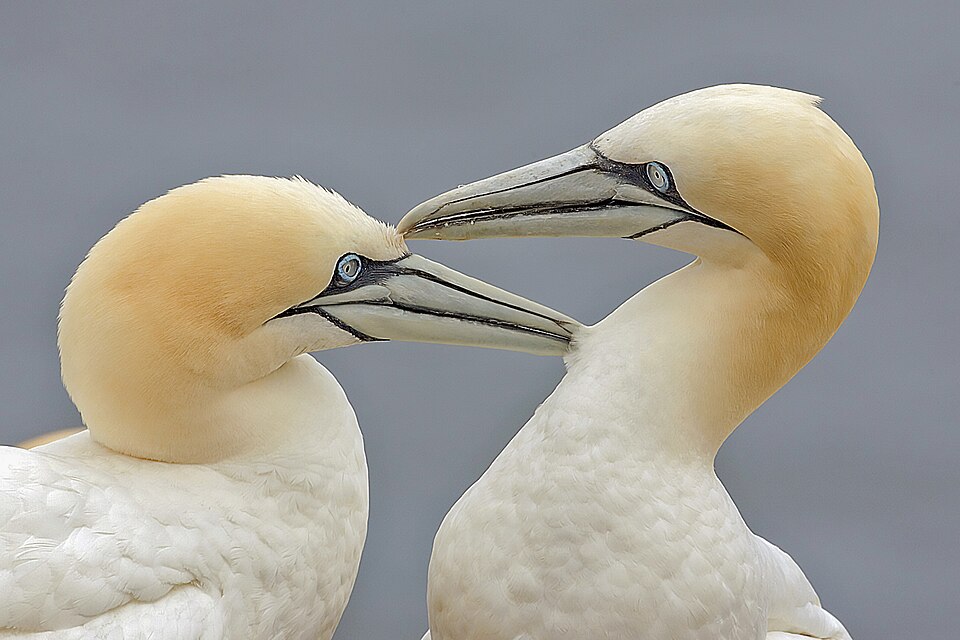
The Northern gannet is a large white seabird recognizable by its bluish beak and pale yellow facial mask. It inhabits rocky coasts and cliffs along the North Atlantic, where it forms vast noisy colonies. Its powerful flight and spectacular dives from heights of dozens of meters to catch fish are characteristic of the species. Adults measure roughly one meter in length with a wingspan approaching two meters. Juveniles display brown mottled plumage that gradually whitens over several years. It is one of the largest seabirds in the Northern Hemisphere.
The adult plumage is immaculate white, except for black wing tips. The head and neck display a light ochreous yellow tint, more pronounced during breeding season. The long, robust beak is blue-gray in color and lacks external nostrils, an adaptation for diving.
Characteristics
Indicative values: they vary by subspecies, sex and region.
Habitat and distribution
The species nests on steep coastal cliffs and rocky islets that are difficult for land predators to access. Outside the breeding season, it spends most of its time at sea, far from shore. It also frequents coastal waters that are rich in fish schools.
CURRENT RANGE
The northern gannet breeds along the coasts of the North Atlantic, notably in the United Kingdom, Iceland, Canada, and Scandinavia. In winter, it migrates south, sometimes reaching the coasts of North Africa and the western Mediterranean. Winter sightings have been reported on the Tunisian coast, though the species does not breed there.
Behaviour
This species is gregarious and nests in dense colonies that can number several tens of thousands of pairs on coastal cliffs. Couples, typically faithful over several seasons, engage in elaborate courtship displays including crossed-bill presentations. Outside breeding season, the bird leads a largely pelagic and solitary life at sea.
Reproduction
The female lays a single egg, which she and the male incubate in turns by holding it beneath their webbed feet, as they lack a brood pouch. Incubation lasts about 44 days, and the chick remains in the nest for nearly three months before fledging. Sexual maturity is reached at four to five years of age.
Peculiarities
Its eyes are protected by a reinforced nictitating membrane that limits damage during high-speed dives. The absence of functional external nostrils prevents water from entering on impact.
Threats and conservation
The species is locally affected by marine pollution, accidental capture in fishing nets, and more recently by avian influenza outbreaks that have decimated some colonies. Its global populations remain stable and are increasing slightly at several protected sites.
Numbers and trends vary across sources and regions. See the IUCN assessment for the latest reference data.
Gallery
1 documented photographs.
References
Profile updated 07 September 2026 · Reviewed by the TunisieVet editorial team.
Comments (0)
No comments yet.
CONSERVATION STATUS
Least concern (LC)
IUCN source, latest published assessment.
Species health
Documented diseases for this species.
See the 4 diseases of this species Find a veterinarianThis information is provided for educational purposes only and is not a substitute for a veterinary consultation. If you have any concerns about your animal's health, consult a veterinarian.
To discover around: Northern Gannet
Videos, facts, stories and records linked to this species.
RECORD
up to 100 km/h
Fastest dive speed in a seabird
Speed reached during a steep vertical dive to catch fish near the surface.
Similar animals
Other species documented in Animalpedia.

TunisieVet in your pocket 📱🐾 Access your veterinary services wherever you are. [ Download the app ]
Learn more